
Guest Connection
AtomicXCore provides CoGuestStore and LiveSeatStore modules, used to manage the complete business process of audience mic connection. You don’t need to worry about complex state synchronization or signaling interactions—simply call a few straightforward methods to add robust audio/video interaction between hosts and viewers in your live broadcast. This guide walks you through how to quickly implement voice mic-link functionality in your iOS app using
CoGuestStore and LiveSeatStore.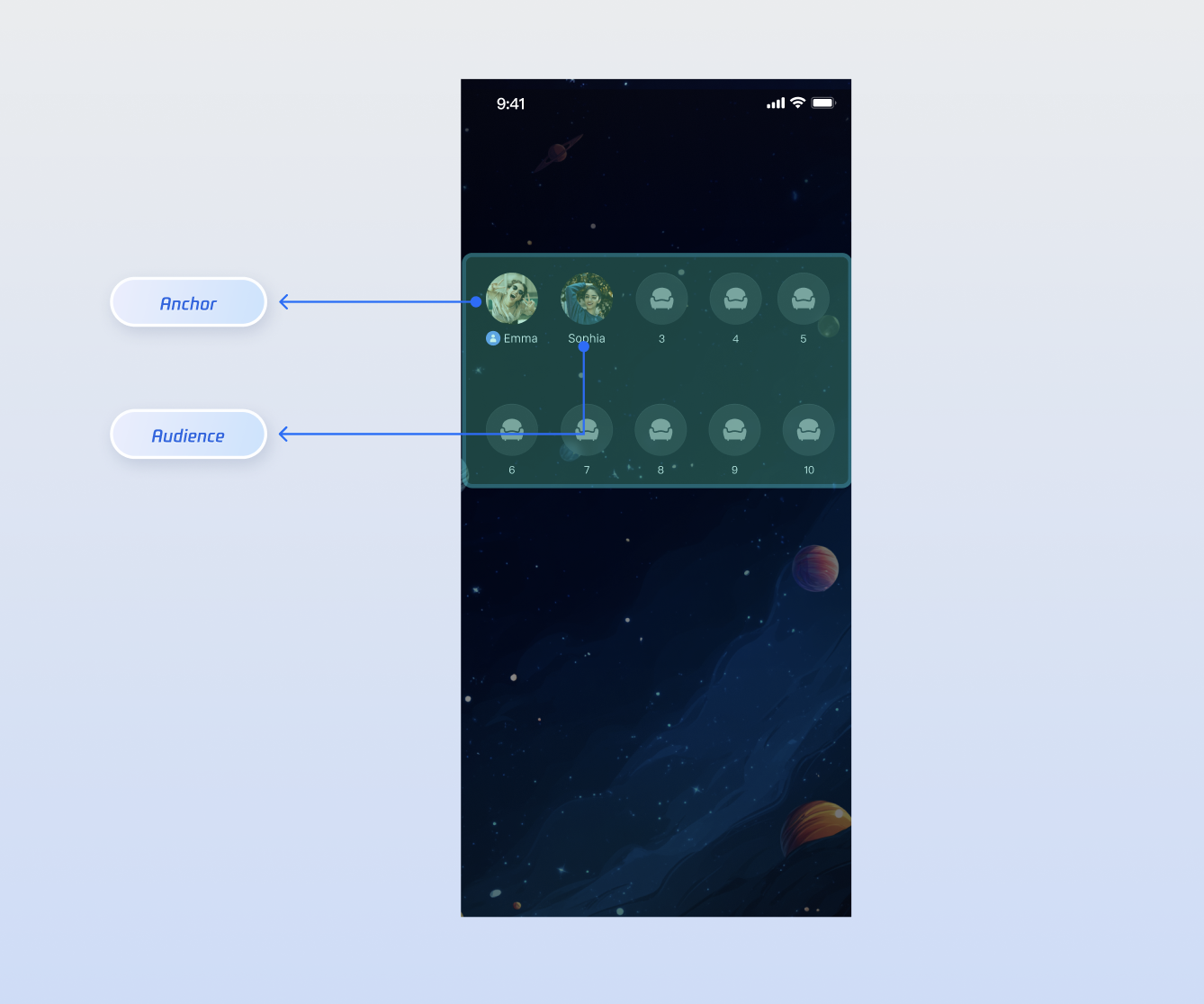
Core Scenarios
CoGuestStore and LiveSeatStore support the following mainstream scenarios:Audience request to speak: The audience proactively initiates a mic connection request, and the anchor can grant or reject it upon receiving the request.
Anchor invitation to speak: The anchor can proactively initiate a mic connection invitation to any audience in the live streaming room.
Anchor seat management: The anchor can perform operations such as forced microphone removal, muting, and locking on the user on the seat.
Implementation Steps
Step 1: Integrate the Components
Note:
Before enabling co-hosting features, you must obtain the
liveId (the unique identifier for the live room) to distinguish between different live rooms. You can get it as follows:Host: Specify when creating a live stream via
LiveListStore.shared.createLive(liveInfo).Client: Get it from
liveInfo in LiveListState.liveList.value, or obtain it by the Anchor sharing the live streaming room ID.Step 2: Implement Audience Co-host Application
Audience Implementation
As an audience member, your main tasks are initiating a request, handling the response, and leaving the mic proactively.
1. Submit a co-host application
When the user taps the "Request Mic-Link" button in the UI, call the
applyForSeat method.import 'package:atomic_x_core/atomicxcore.dart';final String liveId = "room ID";late CoGuestStore guestStore;@overridevoid initState() {super.initState();guestStore = CoGuestStore.create(liveId);}// User click "Apply for Mic Connection"Future<void> requestToConnect() async {// seatIndex: The seat index, starting from 0, represents the applied microphone position. 0 means the first seat. View seat status via LiveSeatState.seatList.value and select an idle seat.// timeout: Request timeout (seconds). The audience can call cancelApplication to cancel the request to speak within the timeout period.// The request will expire if it hasn't been processed after reaching the timeout periodfinal result = await guestStore.applyForSeat(seatIndex: 0,timeout: 30,extraInfo: null,);if (result.isSuccess) {debugPrint('Mic connection request sent, waiting for anchor processing...');} else {debugPrint('Failed to send request: ${result.message}');}}
2. Listen for Host Response
By adding
GuestListener, you can receive the host's responselate GuestListener _guestListener;// Subscribe to events when your Widget initializesvoid subscribeGuestEvents() {_guestListener = GuestListener(onGuestApplicationResponded: (isAccept, hostUser) {if (isAccept) {debugPrint('Anchor ${hostUser.userName} granted your request, preparing to join the mic');// 1. Turn on microphone// DeviceStore is the device management module provided by AtomicXCore, used for managing microphones, cameras and other physical devices.// When the host agrees to connect mic, turn on microphone to start collecting audio.DeviceStore.shared.openLocalMicrophone();// 2. Update UI herein, such as disabling the apply button and displaying the mic connection state} else {debugPrint('Anchor ${hostUser.userName} refused your request');// Pop-up prompts user that the application was rejected}},);guestStore.addGuestListener(_guestListener);}@overridevoid dispose() {guestStore.removeGuestListener(_guestListener);super.dispose();}
3. Leave Seat
When an audience member on mic wants to end the interaction, call
disConnect to return to regular audience status.// User click "Disconnect" buttonFuture<void> leaveSeat() async {final result = await guestStore.disconnect();if (result.isSuccess) {debugPrint('Disconnected successfully');} else {debugPrint('Failed to leave the seat: ${result.message}');}}
4. (Optional) Cancel Request
If the audience member wants to withdraw the request before the host responds, call
cancelApplication.// While waiting, the user clicks "Cancel Application"Future<void> cancelApplication() async {final result = await guestStore.cancelApplication();if (result.isSuccess) {debugPrint('Request canceled');} else {debugPrint('Failed to cancel request: ${result.message}');}}
Host Implementation
As the host, your main tasks are receiving requests, displaying the request list, and handling requests.
1. Listen for New Co-host Applications
By adding
HostListener, you can receive immediate notification when a new audience applies and prompt.import 'package:atomic_x_core/atomicxcore.dart';final String liveId = "room ID";late CoGuestStore guestStore;late HostListener _hostListener;@overridevoid initState() {super.initState();guestStore = CoGuestStore.create(liveId);// Subscribe to anchor event_hostListener = HostListener(onGuestApplicationReceived: (guestUser) {debugPrint('Received mic connection request from audience ${guestUser.userName}');// Update the UI here, for example display a red dot on the "application list" button},);guestStore.addHostListener(_hostListener);}@overridevoid dispose() {guestStore.removeHostListener(_hostListener);super.dispose();}
2. Display Request List
CoGuestStore's coGuestState maintains the current applicant list in real time. You can subscribe to it to update your UI.late final VoidCallback _applicantsListener = _onApplicantsChanged;// Subscribe to status changevoid subscribeApplicants() {guestStore.coGuestState.applicants.addListener(_applicantsListener);}void _onApplicantsChanged() {final applicants = guestStore.coGuestState.applicants.value;debugPrint('Current number of applicants: ${applicants.length}');// Update your "applicant list" UI here}@overridevoid dispose() {guestStore.coGuestState.applicants.removeListener(_applicantsListener);super.dispose();}
3. Handle Co-host Requests
When you select an audience member from the list and tap "Accept" or "Reject", call the corresponding method.
// Anchor clicks the "Grant" button and imports the applicant's userIDFuture<void> accept(String userId) async {final result = await guestStore.acceptApplication(userId);if (result.isSuccess) {debugPrint('Approved $userId\'s request, the other party is joining the mic');}}// Anchor clicks the "Reject" buttonFuture<void> reject(String userId) async {final result = await guestStore.rejectApplication(userId);if (result.isSuccess) {debugPrint('$userId\'s application denied');}}
Step 3: Host Invites Audience to Co-host
Host Implementation
1. Invite audience to co-host
When the host selects a viewer from the audience list and taps "Invite to Mic", call the
inviteToSeat method.// Anchor selects audience and initiates invitationFuture<void> invite(String userId) async {// inviteeID: The ID of the invitee, seatIndex: The seat index, timeout: The invitation timeout durationfinal result = await guestStore.inviteToSeat(inviteeID: userId,seatIndex: 0,timeout: 30,extraInfo: null,);if (result.isSuccess) {debugPrint('Sent invitation to $userId, waiting for peer response...');}}
2. Listen for Audience Response
Listen to the
onHostInvitationResponded event via HostListener.// Add to the HostListener configuration_hostListener = HostListener(onHostInvitationResponded: (isAccept, guestUser) {if (isAccept) {debugPrint('Audience ${guestUser.userName} accepted your invitation');} else {debugPrint('Audience ${guestUser.userName} refused your invitation');}},);
Audience Implementation
1. Receive Host Invitation
Listen to the
onHostInvitationReceived event via GuestListener.// Add to the GuestListener configuration_guestListener = GuestListener(onHostInvitationReceived: (hostUser) {debugPrint('Received mic connection invitation from Anchor ${hostUser.userName}');// Pop up a dialog box for user selection between "Accept" or "Reject"// showInvitationDialog(hostUser);},);
2. Respond to invitation
After the user makes a selection in the pop-up dialog box, call the method accordingly.
final String inviterId = "anchor ID who initiates invitation"; // obtain from onHostInvitationReceived event// User clicks "Accept"Future<void> accept() async {final result = await guestStore.acceptInvitation(inviterId);if (result.isSuccess) {// Turn the mic on// DeviceStore is the device management module provided by AtomicXCore, used for managing microphones, cameras and other physical devices.// After accepting the invitation, turn on microphone to start collecting audioDeviceStore.shared.openLocalMicrophone();}}// User click "Reject"Future<void> reject() async {await guestStore.rejectInvitation(inviterId);}
Advanced Features
Once a user is on mic, the host may need to manage mic seats. The following features are primarily provided by
LiveSeatStore, which functions with CoGuestStore.Microphone Control: DeviceStore vs LiveSeatStore
When working with seat features, it’s important to understand the difference between
DeviceStore and LiveSeatStore for microphone control:DeviceStore: Manage physical devices.
openLocalMicrophone starts up the microphone device to perform audio capture. closeLocalMicrophone stops audio capture and releases the microphone device.LiveSeatStore: Manages seat business (i.e., audio stream).
muteMicrophone mutes and stops sending local audio stream to the remote end, but the microphone device itself keeps running. unmuteMicrophone unmutes and restores sending audio stream to the remote end.Recommended workflow: You should follow the principle of "open the device only once and use the mute switch for Anchor."
1. When going on stage: Once the audience succeeds in going on stage, call
openLocalMicrophone only once to start the device.2. When on stage: For all "unmute" and "mute" operations on the seat, users should call
unmuteMicrophone and muteMicrophone to control the upstream audio stream.3. When going off stage: When a user goes off stage (such as calling
disconnect), call closeLocalMicrophone to release the device.Microphone Mute/Unmute for Users on Seat
Users on seat (including the anchor) can mute or unmute their own microphone using methods provided by
LiveSeatStore.Implementation:
1. Mute: Call the
muteMicrophone() method. This is a one-way request with no callback.2. Unmute: Call the
unmuteMicrophone() method.Example:
final seatStore = LiveSeatStore.create(liveId);seatStore.muteMicrophone(); // Muteawait seatStore.unmuteMicrophone(); // Unmute
Host Remotely Controls User’s Microphone
The anchor can forcibly mute users on seat or invite them to unmute.
Implementation:
1. Force Mute (Lock): The host calls
closeRemoteMicrophone to forcibly mute the target user's microphone and lock their mic control. The muted user will receive the onLocalMicrophoneClosedByAdmin event via liveSeatEventPublisher, and their local "Open Microphone" button should become disabled.2. Invite to Unmute (Unlock): The host calls
openRemoteMicrophone—this does not forcibly open the user's mic, but unlocks their mic control, allowing them to unmute themselves. The target user receives the onLocalMicrophoneOpenedByAdmin event, their "Open Microphone" button should become enabled, but they remain muted until they unmute themselves.3. User Unmutes Themselves: After receiving the unlock notification, the user must actively call
LiveSeatStore's unmuteMicrophone() to actually unmute and be heard in the room.Example:
Host Side:
final seatStore = LiveSeatStore.create(liveId);final String targetUserId = "userD";// 1. Force mute userD and lockfinal result1 = await seatStore.closeRemoteMicrophone(targetUserId);if (result1.isSuccess) {debugPrint('Muted and locked $targetUserId');}// 2. Unlock userD's microphone permission (at this point userD remains muted)final result2 = await seatStore.openRemoteMicrophone(userID: targetUserId,policy: DeviceControlPolicy.unlockOnly,);if (result2.isSuccess) {debugPrint('Unlocked $targetUserId\'s microphone, user can unmute manually');}
Audience Side:
late LiveSeatListener _seatListener;// userD listens to the Anchor's operationvoid subscribeSeatEvents() {_seatListener = LiveSeatListener(onLocalMicrophoneClosedByAdmin: () {debugPrint('Muted by anchor');// muteButton.isEnabled = false;},onLocalMicrophoneOpenedByAdmin: (policy) {debugPrint('Anchor unmuted and unlocked');// muteButton.isEnabled = true;// muteButton.text = "Turn on microphone";},);seatStore.addLiveSeatEventListener(_seatListener);}@overridevoid dispose() {seatStore.removeLiveSeatEventListener(_seatListener);super.dispose();}
CloseRemoteMicrophone API Parameters
Parameter | Type | Description |
userID | String | Operating user userID. |
OpenRemoteMicrophone API Parameters
Parameter | Type | Description |
userID | String | Operating user userID. |
policy | DeviceControlPolicy | Turn on microphone policy. |
Host Removes On-Mic User from the Seat
Implementation:
1. Remove User from Mic: The anchor can call the
kickUserOutOfSeat method to force the specified user off the mic.2. Listen for Event Notification: Users kicked off the mic will receive the
GuestListener onKickedOffSeat event notification.Example:
// Assume "userB" is to be kicked outfinal String targetUserId = "userB";final result = await seatStore.kickUserOutOfSeat(targetUserId);if (result.isSuccess) {debugPrint('Kicked $targetUserId off the mic');} else {debugPrint('Kick user failed: ${result.message}');}// "userB" received the kicked off the mic event_guestListener = GuestListener(onKickedOffSeat: (seatIndex, hostUser) {// Show a toast notificationdebugPrint('You have been kicked off the mic by anchor');},);
KickUserOutOfSeat API Parameter
Parameter | Type | Description |
userID | String | The user kicked off the mic userID. |
Host Locks and Unlocks Mic Seats
The host can lock or unlock a specific mic seat.
Implementation:
1. Lock Seat: The anchor can call the
lockSeat method to lock the seat with a specified index. Once locked, audiences cannot use applyForSeat or takeSeat to occupy the seat, but the anchor can invite an audience to the locked seat via inviteToSeat.2. Unlock Seat: Call
unlockSeat to unlock the seat. The seat can be occupied again after unlocking.Example:
// Lock seat 2final result1 = await seatStore.lockSeat(2);if (result1.isSuccess) {debugPrint('Seat 2 locked');}// Unlock seat 2final result2 = await seatStore.unlockSeat(2);if (result2.isSuccess) {debugPrint('Seat 2 unlocked');}
LockSeat API Parameter
Parameter | Type | Description |
seatIndex | int | Index of the mic to lock. |
UnlockSeat API Parameter
Parameter | Type | Description |
seatIndex | int | Index of the mic to unlock. |
Move User to Another Seat
Host and co-host can call
moveUserToSeat to change seat positions.Implementation:
1. Host Moves User to Mic Seat: The host can call this API to move any user to a specified seat. At this point,
userID is the ID of the target user, targetIndex is the index of the target seat, and the policy parameter specifies the move strategy if the target seat is occupied. For details, see the API parameter description.2. On-Mic User Moves Themselves: On-mic users can also call this API to move themselves. In this case,
userID must be the user's own ID, targetIndex is the desired new seat index, and the policy parameter is ignored. If the target seat is occupied, the move fails with an error.Example code:
final result = await seatStore.moveUserToSeat(userID: "userC",targetIndex: newSeatIndex,policy: MoveSeatPolicy.abortWhenOccupied,);if (result.isSuccess) {debugPrint('Successfully moved to seat $newSeatIndex');} else {debugPrint('Seat change failed, possibly seat is occupied');}
MoveUserToSeat API Parameters
Parameter | Type | Description |
userID | String | The user who needs to move the mic userID. |
targetIndex | int | Index of the target seat. |
policy | MoveSeatPolicy | Processing policy when the target seat is occupied abortWhenOccupied: Abort movement when the target seat is occupied (default policy)forceReplace: Forcibly replace the user on the target seat. The replaced user will be kicked off the mic.swapPosition: Exchange with the user on the target seat. |
API documentation
For detailed information about ALL public interfaces, attributes, and methods of CoGuestStore, LiveSeatStore, and its related classes, see the official API documentation of the AtomicXCore framework. The related Store used in this guide is as follows:
Store/Component | Feature Description | API Reference |
CoGuestStore | Audience co-broadcasting management: join microphone application/invite/consent/deny, member permission control (microphone/camera), state synchronization. | |
LiveSeatStore | Seat management: mute/unmute, lock/unlock seats, remove speaker, remotely control Anchor microphone, listen to list status. |
FAQs
What are the differences between voice room co-hosting and video live co-hosting?
The main difference between both lies in business form and UI display:
Video live streaming: The focus is on video display. Use
LiveCoreWidget as the main component to render the anchor and guest video streams. The UI emphasizes video layout and sizing, and you can use VideoViewDelegate to add overlays (such as nicknames or placeholders). Both camera and microphone can be enabled.Voice room (chat room): The focus is on the seat grid. You do not use
LiveCoreWidget, but instead build a grid UI (such as GridView) based on the liveSeatState of LiveSeatStore (especially seatList). The UI displays each seat’s SeatInfo status in real time: whether it’s occupied, muted, locked, or currently speaking. Only the microphone needs to be enabled.How do I update seat info in the UI in real time?
You should subscribe to the
seatList property in LiveSeatState, which is a responsive data of ValueListenable<List<SeatInfo>> data type. It will notify you to re-render the microphone position list whenever the array changes. By traversing this array, you can:Get user information on the seat through
seatInfo.userInfo.Check whether the seat is locked through
seatInfo.isLocked.Check the mic status of the on-mic user through
seatInfo.userInfo.microphoneStatus.
