
Live Battles
Displaying PK User Score on Video ViewAtomicXCore provides two primary modules: CoHostStore and BattleStore, which handle cross-room co-hosting and PK battles respectively. This guide walks you through using both modules together to implement the complete workflow from co-hosting to PK in a live streaming scenario.
Core Scenario
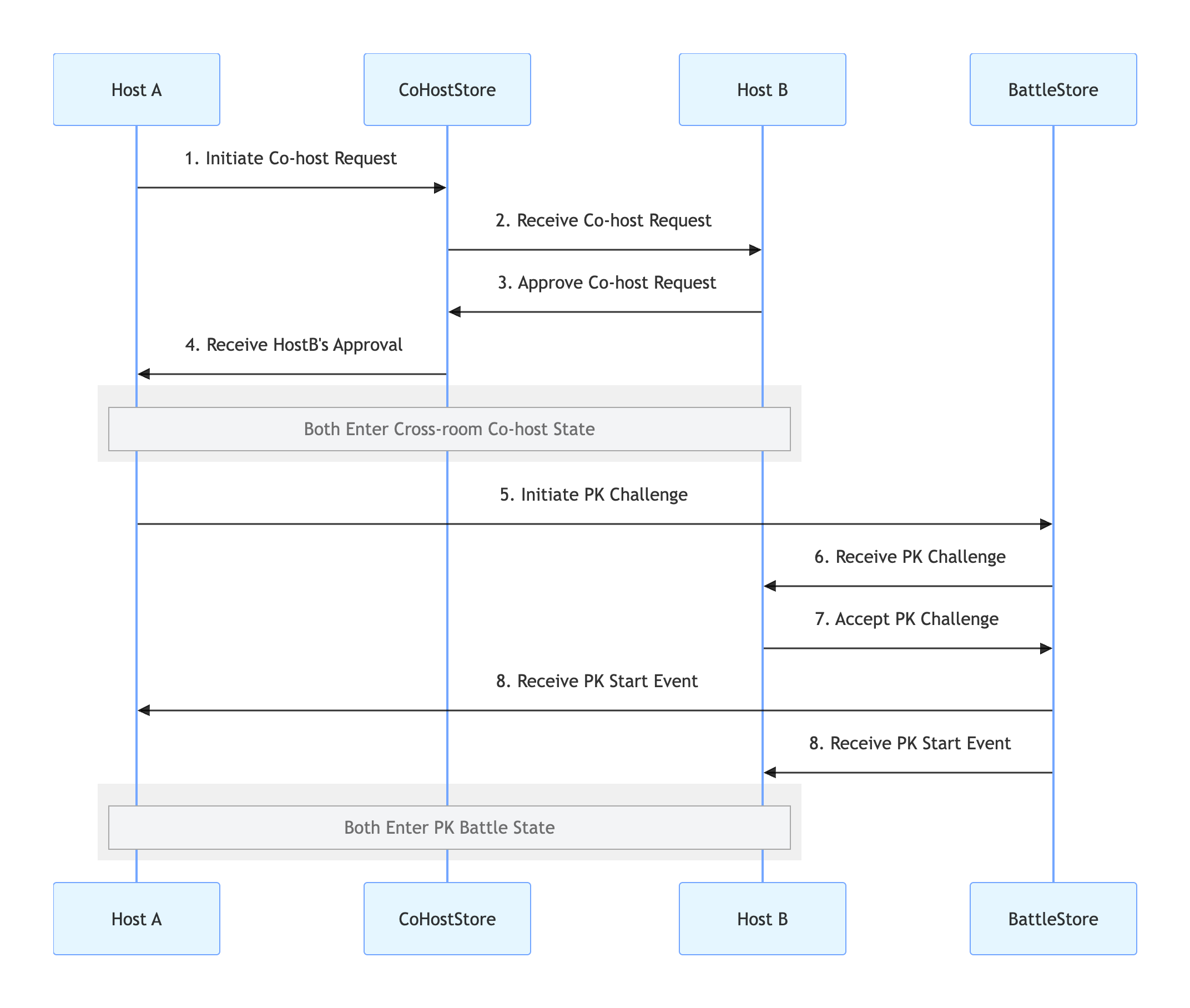
A typical "Host Co-hosting PK" session consists of three main stages, as shown below:
1. Cross-room Co-hosting: Two hosts connect, and both video streams are displayed in a shared view.
2. Initiate PK: After the connection is established, either host can start a PK challenge.
3. PK Battle: Both hosts compete in a PK battle, with scores updated in real time.
Implementation
Step 1: Component Integration
Step 2: Implement Cross-Room Co-hosting
The goal of this step is to display the video streams of two hosts in the same view. Use CoHostStore to achieve this.
Inviter (Host A) Implementation
1. Initiate Co-hosting Invitation
When Host A selects Host B in the UI and initiates a co-hosting request, call the
requestHostConnection method.import AtomicXCoreimport Combine// Host A's view controllerclass AnchorAViewController {private let liveId = "Host A's Room ID"private var cancellables: Set<AnyCancellable> = []private lazy var coHostStore: CoHostStore = {return CoHostStore.create(liveID: self.liveId)}()// User clicks the "Co-host" button and selects Host Bfunc inviteHostB(targetHostLiveId: String) {let layout: CoHostLayoutTemplate = .hostDynamicGrid // Choose a layout templatelet timeout: TimeInterval = 30.0 // Invitation timeoutcoHostStore.requestHostConnection(targetHost: targetHostLiveId,layoutTemplate: layout,timeout: timeout) { result inswitch result {case .success():print("Co-hosting invitation sent, waiting for response...")case .failure(let error):print("Failed to send invitation: \(error.message)")}}}}
2. Listen for Invitation Result
Subscribe to
coHostEventPublisher to receive Host B's response.// Set up listener during AnchorAViewController initializationfunc setupListeners() {coHostStore.coHostEventPublisher.sink { [weak self] event inswitch event {case .onCoHostRequestAccepted(let invitee):print("Host \(invitee.userName) accepted your co-hosting invitation")case .onCoHostRequestRejected(let invitee):print("Host \(invitee.userName) rejected your invitation")case .onCoHostRequestTimeout:print("Invitation timed out, no response from the other party")default:break}}.store(in: &cancellables)}
Invitee (Host B) Implementation
1. Receive Co-hosting Invitation
Host B listens for invitations from Host A via
coHostEventPublisher.import AtomicXCoreimport Combine// Host B's view controllerclass AnchorBViewController {// ... coHostStore and cancellables initialization ...// Set up listener during initializationfunc setupListeners() {coHostStore.coHostEventPublisher.sink { [weak self] event inif case let .onCoHostRequestReceived(inviter, _) = event {print("Received co-hosting invitation from host \(inviter.userName)")// self?.showInvitationDialog(from: inviter)}}.store(in: &cancellables)}}
2. Respond to Co-hosting Invitation
After Host B receives the invitation, prompt for “Accept” or “Reject” and call the appropriate method:
// Part of AnchorBViewControllerfunc acceptInvitation(fromHostLiveId: String) {coHostStore.acceptHostConnection(fromHostLiveID: fromHostLiveId, completion: nil)}func rejectInvitation(fromHostLiveId: String) {coHostStore.rejectHostConnection(fromHostLiveID: fromHostLiveId, completion: nil)}
Step 3: Implement Host PK
After a successful co-hosting connection, either host can initiate a PK. Use BattleStore for PK functionality.
Challenger (e.g., Host A) Implementation
1. Initiate PK Challenge
When Host A clicks the "PK" button, call the
requestBattle method.// Part of AnchorAViewControllerprivate lazy var battleStore: BattleStore = BattleStore.create(liveID: self.liveId)func startPK(with opponentUserId: String) {var config = BattleConfig(duration: 300) // PK lasts 5 minutesbattleStore.requestBattle(config: config, userIDList: [opponentUserId], timeout: 30.0, completion: nil)}
2. Listen for PK Status
Subscribe to
battleEventPublisher to monitor key PK events such as start and end.// Add to AnchorAViewController's setupListeners methodbattleStore.battleEventPublisher.sink { [weak self] event inswitch event {case .onBattleStarted:print("PK started")case .onBattleEnded:print("PK ended")default:break}}.store(in: &cancellables)
Opponent (Host B) Implementation
1. Receive PK Challenge
Listen for PK invitations via
battleEventPublisher.// Add to AnchorBViewController's setupListeners methodbattleStore.battleEventPublisher.sink { [weak self] event inif case let .onBattleRequestReceived(battleId, inviter, _) = event {print("Received PK challenge from host \(inviter.userName)")// Show dialog for Host B to choose "Accept" or "Reject"// self?.showPKChallengeDialog(battleId: battleId)}}.store(in: &cancellables)
2. Respond to PK Challenge
Prompt Host B for “Accept” or “Reject” and call the corresponding method:
// Part of AnchorBViewController// User clicks "Accept Challenge"func acceptPK(battleId: String) {battleStore.acceptBattle(battleID: battleId) { result in// ...}}// User clicks "Reject Challenge"func rejectPK(battleId: String) {battleStore.rejectBattle(battleID: battleId) { result in// ...}}
Step 4: End PK and Disconnect Co-hosting
After the PK session, end the PK and disconnect co-hosting in sequence.
1. End PK Battle
PK typically ends automatically when the timer expires, but hosts can also end PK early. Use
exitBattle:Note:After PK ends, both hosts remain connected (side-by-side video streams). Only the PK progress bar and score panel are removed.
func stopPK(battleId: String) {battleStore.exitBattle(battleID: battleId) { result inswitch result {case .success:print("PK ended")// UI receives onBattleEnded event; refresh UI in callbackcase .failure(let error):print("Failed to end PK: \(error.message)")}}}
2. Disconnect Cross-room Co-hosting
To return to solo live streaming, call
exitHostConnection:func stopConnection() {coHostStore.exitHostConnection { result inswitch result {case .success:print("Co-hosting disconnected, back to solo live")// UI receives onCoHostUserLeft eventcase .failure(let error):print("Failed to disconnect co-hosting: \(error.message)")}}}
3. Listen for End Events
Handle UI cleanup in event listeners for consistency:
func setupAdditionalListeners() {// Listen for PK end eventbattleStore.battleEventPublisher.sink { [weak self] event inif case .onBattleEnded(let battleInfo, let reason) = event {print("Received PK end event, reason: \(reason)")// self?.removeBattleUI()}}.store(in: &cancellables)// Listen for co-host disconnect eventcoHostStore.coHostEventPublisher.sink { [weak self] event inif case .onCoHostUserLeft(let userInfo) = event {print("Anchor \(userInfo.userName) has left co-hosting")// self?.resetToSingleStreamLayout()}}.store(in: &cancellables)}
Run and Test
After integrating the above features, use Host A and Host B to test the corresponding operations. The runtime effect is shown below. For UI customization, see Refine UI Details.

Refine UI Details
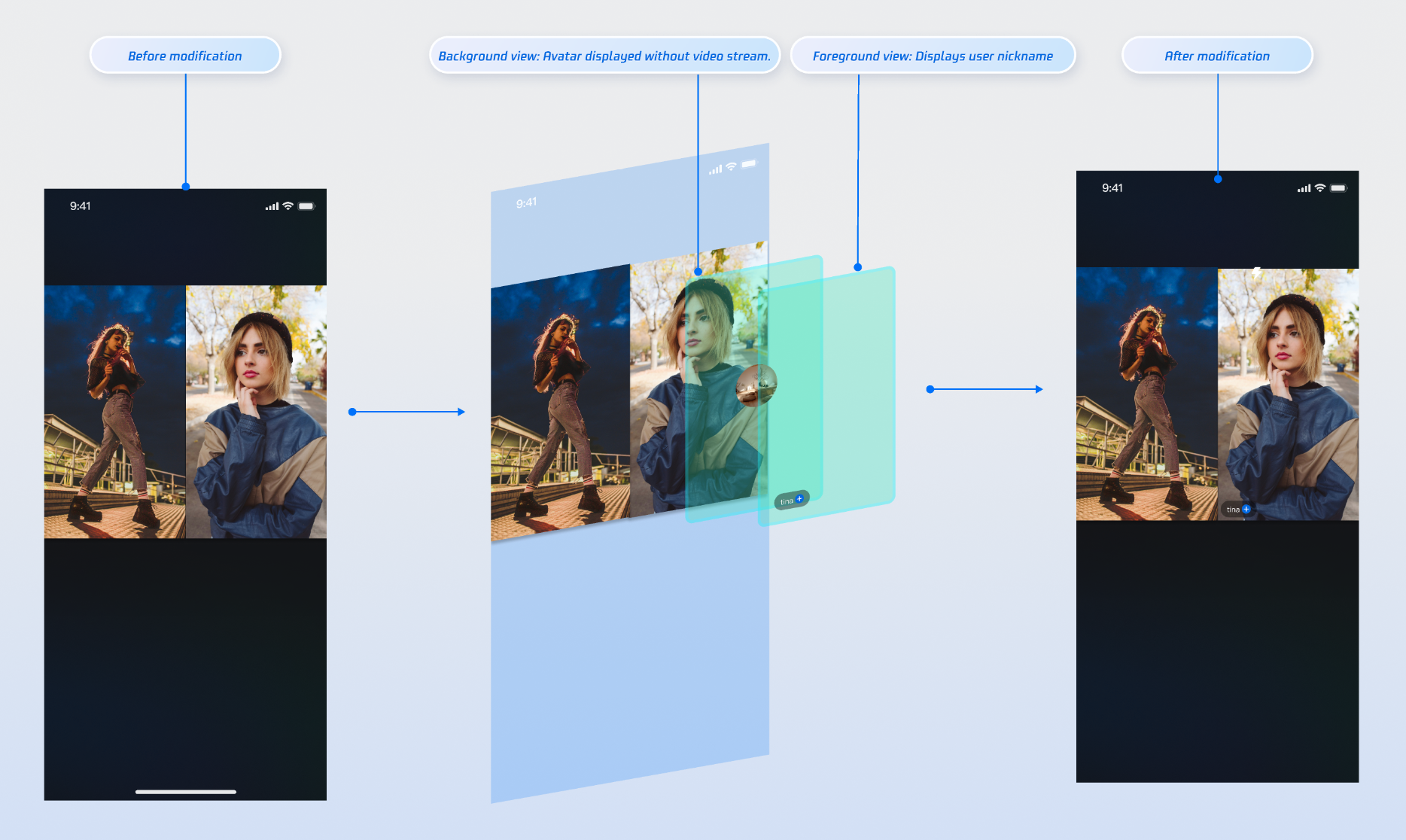
Use the slot capability in the
LiveCoreView.VideoViewDelegate interface to overlay custom views on video streams, such as nicknames, avatars, PK progress bars, or placeholder images when the host’s camera is off.Display Nicknames on Video Streams
Implementation Example
Implementation
Step 1: Create a foreground view
CustomSeatView to display user information above the video stream.Note:
You can also refer to the open-source TUILiveKit files AnchorCoHostView.swift and AnchorEmptySeatView.swift for complete implementation logic.
import UIKitimport SnapKit// Custom floating user info view (foreground)class CustomSeatView: UIView {lazy var nameLabel: UILabel = {let label = UILabel()label.textColor = .whitelabel.font = .systemFont(ofSize: 14)return label}()override init(frame: CGRect) {super.init(frame: frame)backgroundColor = UIColor.black.withAlphaComponent(0.5)addSubview(nameLabel)nameLabel.snp.makeConstraints { make inmake.bottom.equalToSuperview().offset(-5)make.leading.equalToSuperview().offset(5)}}}
Step 2: Create a background view
CustomAvatarView to use as a placeholder when the user has no video stream.import UIKitimport SnapKit// Custom avatar placeholder view (background)class CustomAvatarView: UIView {lazy var avatarImageView: UIImageView = {let imageView = UIImageView()imageView.tintColor = .grayreturn imageView}()override init(frame: CGRect) {super.init(frame: frame)backgroundColor = .clearlayer.cornerRadius = 30addSubview(avatarImageView)avatarImageView.snp.makeConstraints { make inmake.center.equalToSuperview()make.width.height.equalTo(60)}}}
Step 3: Implement the
VideoViewDelegate.createCoHostView protocol method and return the appropriate view based on viewLayer.import AtomicXCoreimport RTCRoomEngine// 1. In your view controller, conform to the VideoViewDelegate protocolclass YourViewController: UIViewController, VideoViewDelegate {// ... other code ...// 2. Fully implement the protocol method, handling both viewLayer typesfunc createCoHostView(seatInfo: TUISeatFullInfo, viewLayer: ViewLayer) -> UIView? {guard let userId = seatInfo.userId, !userId.isEmpty else {return nil}if viewLayer == .foreground {let seatView = CustomSeatView()seatView.nameLabel.text = seatInfo.userNamereturn seatView} else { // viewLayer == .backgroundlet avatarView = CustomAvatarView()// Optionally load the user's avatar using seatInfo.userAvatarreturn avatarView}}}
Parameter Description:
Parameter | Type | Description |
seatInfo | TUISeatFullInfo | Seat information object containing user details |
seatInfo.userId | String? | User ID on the seat |
seatInfo.userName | String? | User nickname on the seat |
seatInfo.userAvatar | String? | User avatar URL |
seatInfo.userMicrophoneStatus | TUIDeviceStatus | User microphone status |
seatInfo.userCameraStatus | TUIDeviceStatus | User camera status |
viewLayer | ViewLayer | View layer enum .foreground: Foreground widget view, always displayed on top of the video.background: Background widget view, under the foreground view, displayed only when the user has no video stream (e.g., camera off), typically used for the user's default avatar or a placeholder image |
Displaying PK User Score on Video View
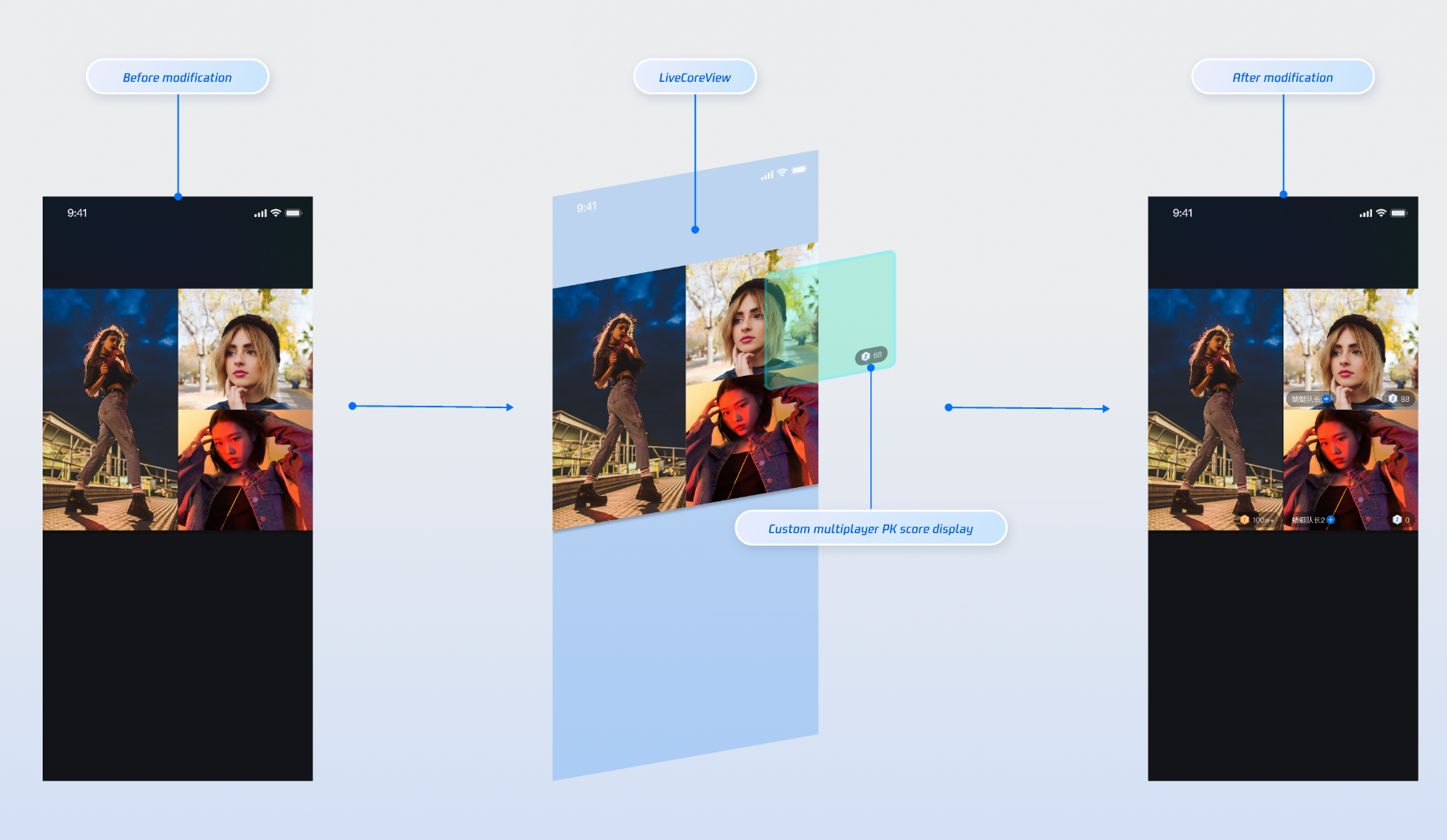
When the host starts a PK, you can attach a custom view to the opponent's video to display gift values or other PK-related information.
Implementation Example
Implementation
Step 1: Create a custom PK user view. For a complete implementation, refer to AnchorBattleMemberInfoView.swift.
import AtomicXCoreimport RTCRoomEngineimport SnapKit// Custom PK user viewclass CustomBattleUserView: UIView {private let scoreView: UIView = {let view = UIView()view.backgroundColor = .black.withAlphaComponent(0.4)view.layer.cornerRadius = 12return view}()private lazy var scoreLabel: UILabel = {let label = UILabel()label.textColor = .whitelabel.font = .systemFont(ofSize: 14, weight: .bold)return label}()private var userId: Stringprivate let battleStore: BattleStoreprivate var cancellableSet: Set<AnyCancellable> = []init(liveId: String, battleUser: TUIBattleUser) {self.userId = battleUser.userIdself.battleStore = BattleStore.create(liveID: liveId)super.init(frame: .zero)backgroundColor = .clearisUserInteractionEnabled = falsesetupUI()subscribeBattleState()}private func setupUI() {addSubview(scoreView)scoreView.addSubview(scoreLabel)scoreLabel.snp.makeConstraints { make inmake.leading.trailing.equalToSuperview().inset(5)}scoreView.snp.makeConstraints { make inmake.height.equalTo(24)make.bottom.equalToSuperview().offset(-5)make.trailing.equalToSuperview().offset(-5)}}// Subscribe to PK score changesprivate func subscribeBattleState() {battleStore.state.subscribe(StatePublisherSelector(keyPath: \BattleState.battleScore)).removeDuplicates().receive(on: RunLoop.main).sink { battleScore inguard let score = battleScore[self.userId] else { return }self.scoreLabel.text = "\(score)"}.store(in: &cancellableSet)}}
Step 2: Implement the
VideoViewDelegate.createBattleView protocol.// 1. Let your view controller conform to the VideoViewDelegate protocolextension YourViewController: VideoViewDelegate {public func createBattleView(battleUser: TUIBattleUser) -> UIView? {// CustomBattleUserView is your custom PK user info viewlet customView = CustomBattleUserView(liveId: liveId, battleUser: battleUser)return customView}}
Parameter Description:
Parameter | Type | Description |
battleUser | TUIBattleUser | PK user info object |
battleUser.roomId | String | PK room ID |
battleUser.userId | String | PK user ID |
battleUser.userName | String | PK user nickname |
battleUser.avatarUrl | String | PK user avatar URL |
battleUser.score | UInt | PK score |
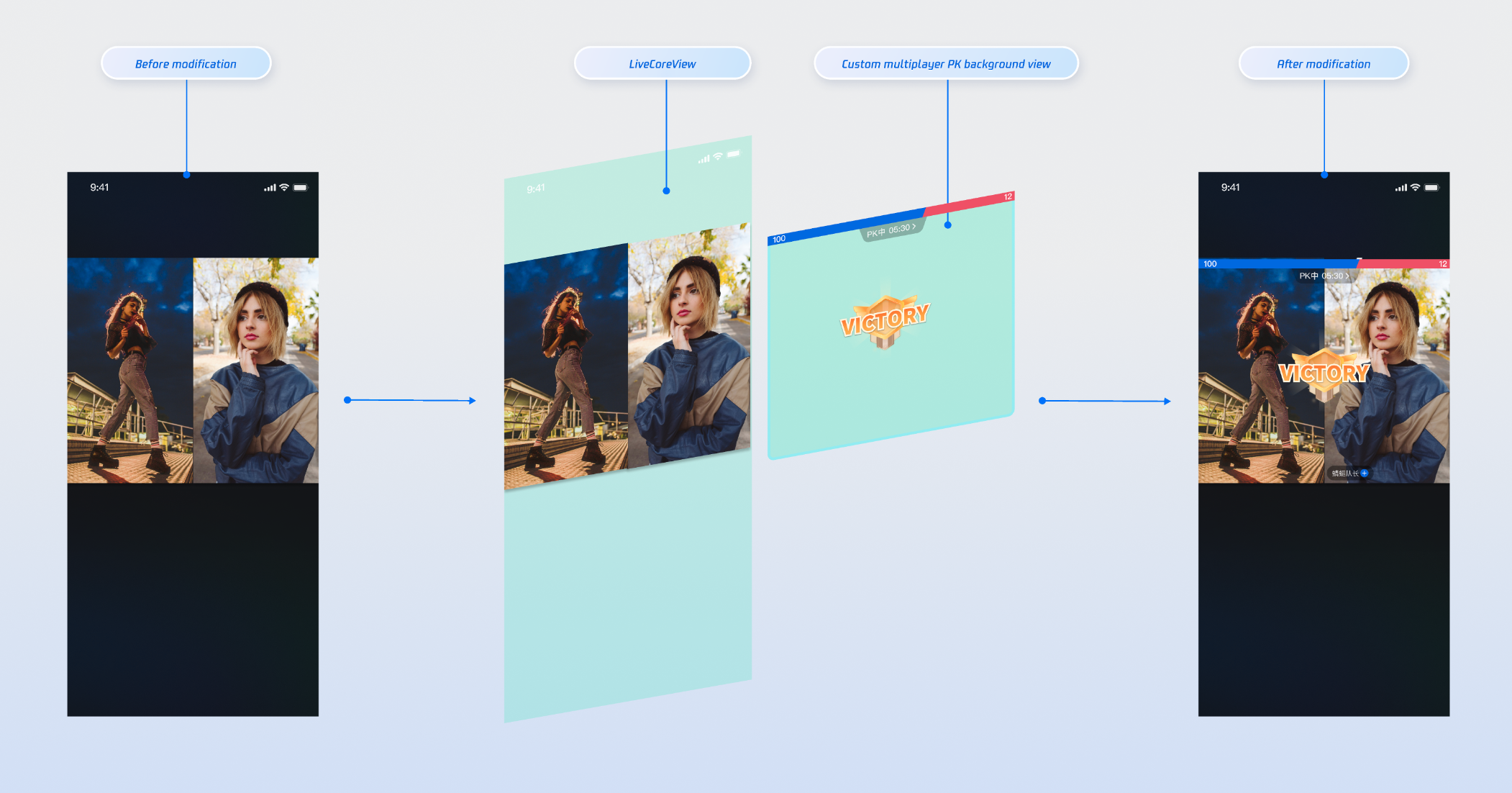
Displaying PK Status on Video Stream
Implementation Example
Implementation
Step 1: Create a custom PK global view (CustomBattleContainerView). For a complete implementation, refer to AnchorBattleInfoView.swift.
Step 2: Implement the
VideoViewDelegate.createBattleContainerView protocol.// Let your view controller conform to the VideoViewDelegate protocol and set the delegateextension YourViewController: VideoViewDelegate {func createBattleContainerView() -> UIView? {return CustomBattleContainerView()}}
Advanced Features
Updating PK Score via REST API
In typical live host PK scenarios, the value of gifts received by the host is linked to the PK score (for example, when a viewer sends a "Rocket" gift, the host's PK score increases by 500 points). You can implement real-time PK score updates using our REST API.
Note:
The PK score system in the LiveKit backend uses pure numeric calculation and accumulation. You must calculate the PK score according to your own business logic before calling the update API. See the following PK score calculation examples:
Gift Type | Score Calculation Rule | Example |
Basic Gift | Gift value × 5 | 10 RMB gift → 50 points |
Intermediate Gift | Gift value × 8 | 50 RMB gift → 400 points |
Advanced Gift | Gift value × 12 | 100 RMB gift → 1200 points |
Special Effect Gift | Fixed high score | 520 RMB gift → 1314 points |
REST API Call Flow
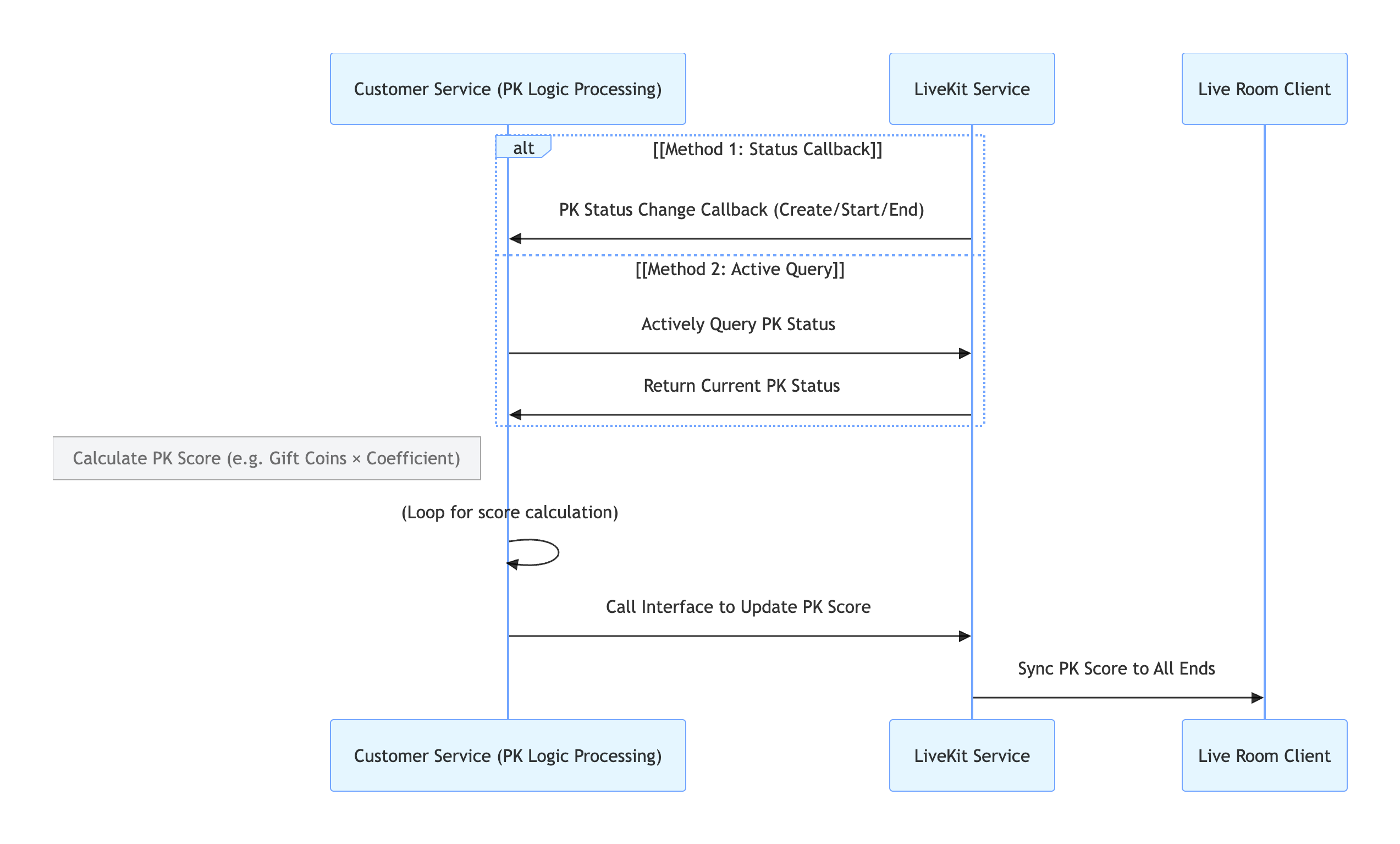
Key Process Description
1. Obtain PK Status:
Callback Configuration: Configure PK Status Callback to have the
LiveKit backend actively notify your system when PK starts or ends.Active Query: Your backend can call the PK Status Query API at any time to check the current PK status.
2. PK Score Calculation: Your backend calculates the PK score increment based on your business rules.
3. PK Score Update: Your backend calls the Update PK Score API to update the PK score in the LiveKit backend.
4. LiveKit Backend Syncs to Client: The backend automatically synchronizes the updated PK score to all clients.
Involved REST API Endpoints
API | Function Description | Request Example |
Active API - Query PK Status | Check whether the current room is in PK | |
Active API - Update PK Score | Update the calculated PK score | |
Callback Configuration - PK Start Callback | Receive real-time notification when PK starts | |
Callback Configuration - PK End Callback | Receive real-time notification when PK ends |
API Documentation
For detailed information on all public interfaces, properties, and methods of CoHostStore and related classes, refer to the official API documentation included with the AtomicXCore framework. The relevant stores used in this guide are as follows:
Store/Component | Description | API Reference |
LiveCoreView | Core view component for displaying and interacting with live video streams. Handles video rendering and view widgets, supports host streaming, audience co-hosting, host connections, and more. | |
DeviceStore | Controls audio/video devices: microphone (on/off, volume), camera (on/off, switch, quality), screen sharing, and real-time device status monitoring. | |
CoHostStore | Handles host cross-room connections: supports multiple layout templates (dynamic grid, etc.), initiates/accepts/rejects connections, and manages co-host interactions. | |
BattleStore | Manages host PK battles: initiate PK (set duration/opponent), manage PK status (start/end), synchronize scores, and listen for battle results. |
FAQs
Why didn't the other party receive my co-hosting invitation?
Ensure that
targetHostLiveId is correct and that the other host's live room is broadcasting normally.Check network stability. The invitation signaling has a default timeout of 30 seconds.
What happens if one host disconnects from the network or the app crashes during co-hosting or PK?
Both
CoHostStore and BattleStore include built-in heartbeat and timeout detection. If one party exits abnormally, the other party is notified via events such as onCoHostUserLeft or onUserExitBattle. You can update the UI accordingly, for example, by displaying "The other party has disconnected" and ending the interaction.Why can PK scores only be updated via REST API?
The REST API meets the security, real-time, and scalability requirements for PK scores:
Tamper-proof and fair: Requires authentication and data validation. Each update is traceable (e.g., tied to a gift action), preventing manual score changes or cheating and ensuring fair competition.
Real-time synchronization across multiple clients: Uses standardized formats (such as JSON) to quickly connect gift, PK, and display systems, ensuring real-time consistency of scores among hosts, viewers, and backend.
Flexible rule adaptation: Backend configuration changes (such as adjusting gift-to-score mapping or bonus points) can be made without modifying the frontend, reducing iteration costs.
How do I manage the lifecycle and events of custom views added via VideoViewDelegate?
LiveCoreView automatically manages views returned by delegate methods, including adding and removing them. No manual lifecycle management is required.

