
インテリジェントカスタマーサー
Scenario Introduction
Intelligent Voice Customer Service leverages Artificial Intelligence (AI) and Automatic Speech Recognition (ASR) to automate customer interactions and resolve issues efficiently.
Traditionally, these systems relied on natural language processing and machine learning algorithms to understand customer intent, combined with predefined rules and knowledge bases to deliver responses. With the development of Large Language Models (LLMs), modern intelligent customer service systems can now understand conversational context more deeply, enabling coherent and contextually relevant exchanges that closely mimic human conversation.
By integrating Real-Time Communication (RTC) technology, you can further enhance your intelligent customer service solution:
Enable real-time audio and video communication for seamless customer engagement
Deliver instant responses to customer inquiries with immediate feedback and solutions
Support multi-party calling and screen sharing to enhance the efficiency and quality of customer support
Implementation Solution
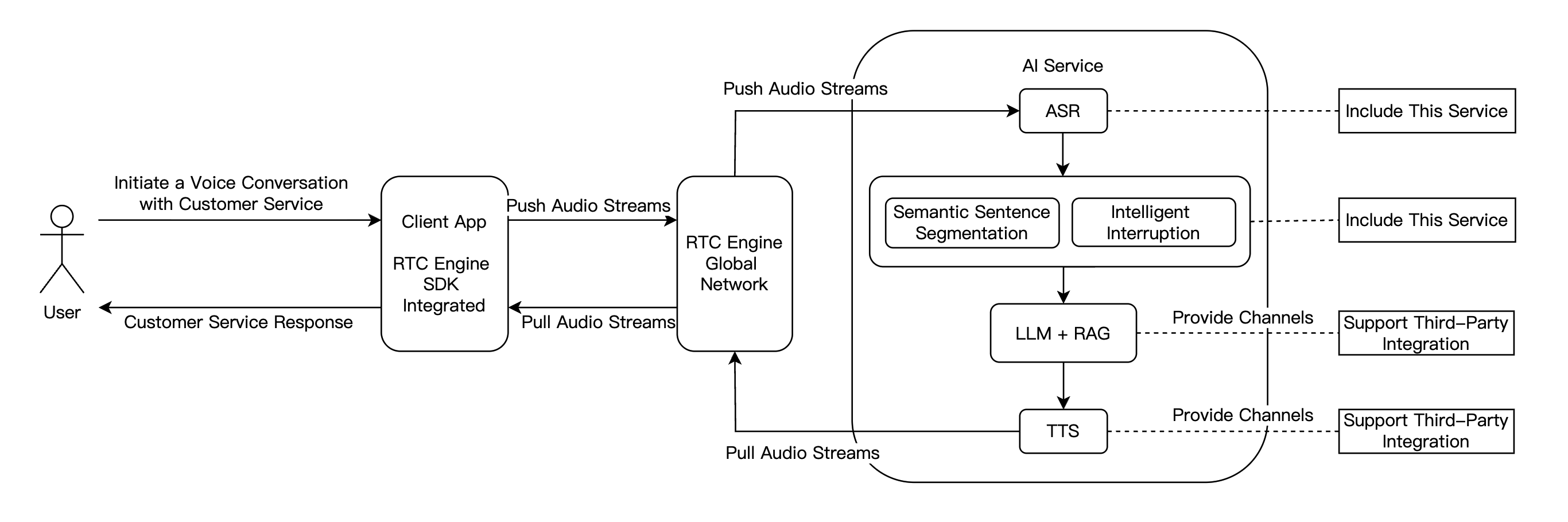
A comprehensive Intelligent Voice Customer Service solution consists of several core modules: Real-Time Audio/Video, AI Real-Time Conversation, Large Language Models (LLM), and Text-to-Speech (TTS). The table below outlines the key capabilities of each module:
Feature | AI Intelligent Voice Customer Service Application |
Real-Time Audio/Video | Provides continuous, stable audio and video streaming with minimized latency and jitter, delivering a high-quality experience comparable to human agent calls. This enables natural interactions that improve user satisfaction. |
AI Real-Time Conversation | Enables flexible integration with multiple LLM services to support real-time audio and video interactions between AI agents and users. Powered by Tencent RTC's global low-latency network, voice conversation latency can be reduced to as low as 1 second, enabling natural, human-like dialogue with seamless integration. |
Large Language Model (LLM) | Enables the system to understand conversational context and maintain coherent, contextually relevant exchanges. LLMs capture semantic information, recognize user intent, and connect previous dialogue to ongoing interactions for more intelligent responses |
Text-to-Speech (TTS) | Supports integration with third-party TTS solutions and allows customization through training data or model parameter adjustments. The TTS service can generate voice output tailored to specific requirements and offer different voice styles based on user preferences or scenario needs. |
Solution Architecture
Prerequisites
Prepare LLM
AI Real-Time Conversation supports any LLM model compatible with the OpenAI protocol, as well as platforms like Tencent Cloud Agent Development Platform, Dify, and Coze. For a full list of supported platforms, see the LLMConfig Configuration Guide.
Using Retrieval-Augmented Generation (RAG)
For Intelligent Voice Customer Service scenarios, organizations typically need to integrate their own knowledge bases, including proprietary documents and Q&A materials. This requires enhanced retrieval capabilities through LLM+RAG. Developers can implement an OpenAI API-compatible interface in their backend to send context-enriched requests to third-party models.
Note:
Using LLM features like RAG or Function Call may increase initial token response time, resulting in higher AI reply latency. If your application is sensitive to latency, we recommend using SystemPrompt instead of RAG.
Prepare Text-to-Speech (TTS)
Using Tencent Cloud TTS
1. Activate the TTS service for your application to enable speech synthesis
2. Retrieve your
APPID from Account Information3. Obtain your
SecretId and SecretKey from API Key Management. Note that the SecretKey is only displayed once upon creation, so save it immediately4. Browse available voice styles in the Voice List
Using Third-Party or Custom TTS:
Prepare RTC Engine
Note:
AI Real-Time Conversation is a paid feature. For pricing details, see the AI Real-Time Conversation Billing Guide.
Integration Steps
Advanced Features
To further optimize your implementation, you can configure advanced features including:
FAQs
Supporting Products for the Solution
System Level | Product Name | Application Scenarios |
Access Layer | Provides low-latency, high-quality real-time audio and video interaction solutions, serving as the foundational capability for audio and video call scenarios. | |
Cloud Services | Enables real-time audio and video interactions between AI agents and users, with Conversational AI capabilities tailored to specific business scenarios. | |
LLM | Provides the intelligence layer for customer service systems, offering multiple agent development frameworks including LLM+RAG, Workflow, and Multi-agent capabilities. | |
Data Storage | Provides storage services for audio recording files and audio slicing files. |

