







Everything you need to know about AI-powered real-time translation — how it works, where it's used, and why it matters.
Learn More about Our Simultaneous Interpretation Technology
What Is Simultaneous Interpretation?
Simultaneous interpretation is the process of translating spoken language from a source language into a target language in real-time, with no pauses. The interpreter — human or AI — listens to a continuous stream of speech, processes its meaning, and delivers the translation concurrently with the original speech.
This makes it the gold standard for large-scale multilingual events, live broadcasts, international summits, and any context where pausing for translation is not an option. Unlike consecutive interpretation, where speakers pause and interpreters render full segments, simultaneous interpretation delivers an uninterrupted experience for the audience across all language channels.
A Brief History
The formal inception of simultaneous interpretation is attributed to the Nuremberg Trials (1945–1946). Prior to this, international diplomacy relied on consecutive interpreting, which doubled meeting durations. The ability to interpret concurrently across four languages — English, French, Russian, and German — using early headsets and microphones transformed international relations. Today, the discipline has evolved from analog radio-frequency booths to cloud-based platforms and AI-powered browser extensions capable of reaching any audience globally.
How Simultaneous Interpretation Works Today
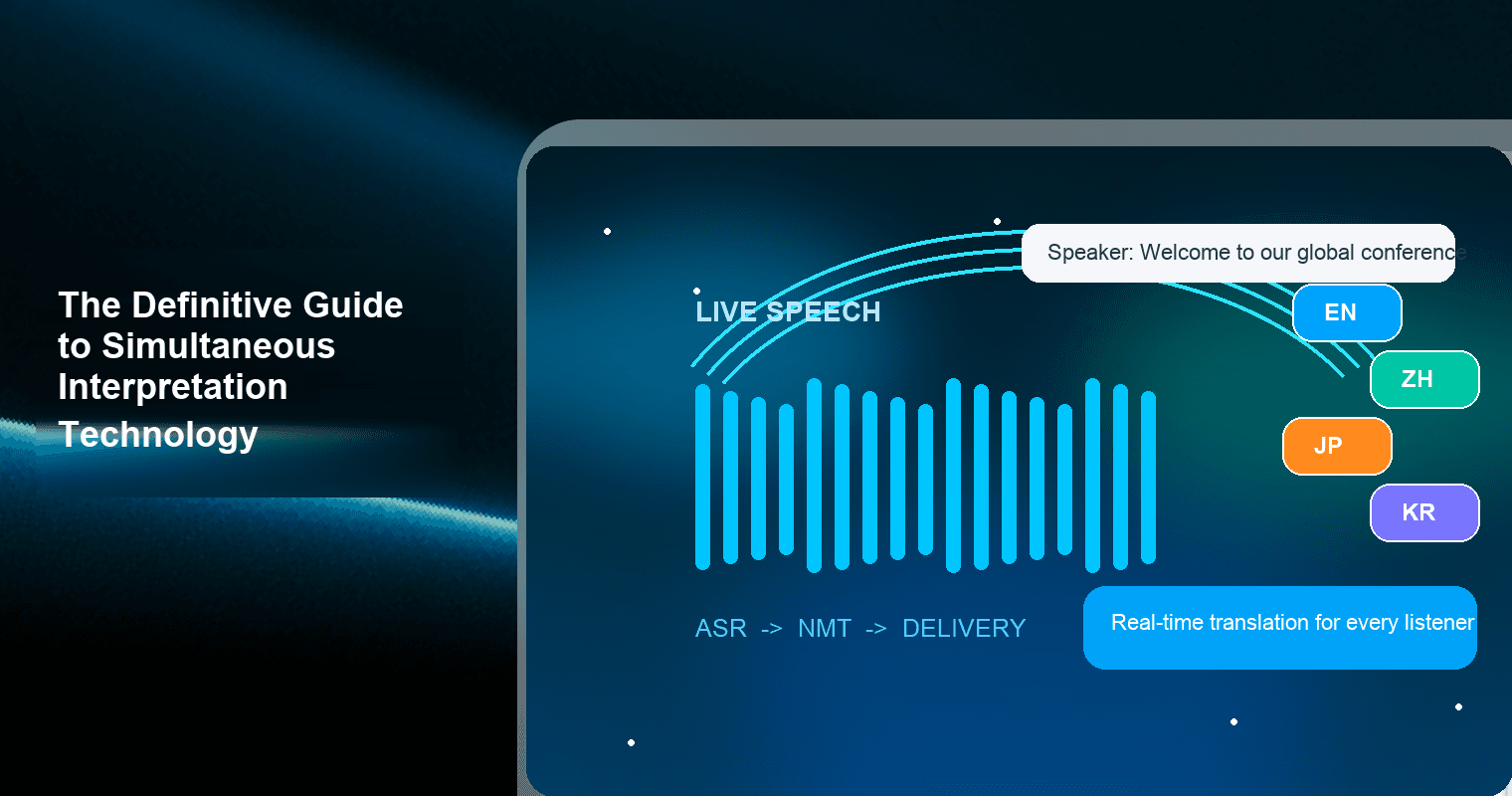
The technology stack behind modern simultaneous interpretation has three layers. First, Automated Speech Recognition (ASR) captures the speaker's audio stream and converts it to text in real-time, accounting for accents, speaking pace, and background noise. Second, Neural Machine Translation (NMT) processes the recognized text and generates an accurate translation that preserves context and natural flow. Third, output delivery — whether as audio through headphones or as synchronized subtitles on screen — reaches the audience with minimal delay.
The critical performance metric is latency: the gap between the speaker uttering a word and the audience hearing or reading its translation. Professional human interpreters operate with a natural 2–6 second ear-voice span. AI-powered tools like the Tencent RTC Chrome Extension deliver translations in approximately 0.5 seconds.
Performance note: A latency below 1 second is required for a genuinely "simultaneous" experience. Anything above 2–3 seconds introduces noticeable lag that breaks comprehension flow for the audience.
Where Simultaneous Interpretation Is Used
International Conferences and Summits
Large-scale events — from the World Economic Forum to industry trade shows — require multiple language channels running concurrently. Traditional setups rely on soundproof booths, IR headsets, and on-site interpreters governed by ISO 2603 and ISO 4043 booth standards. Modern hybrid events increasingly route remote interpreters through cloud-based RSI platforms, allowing attendees to switch language channels directly on a smartphone app.
Live Streaming and Global Content
Live sports broadcasts, product launches, creator streams, and political events now reach audiences across dozens of countries simultaneously. AI browser tools deliver real-time subtitles in the viewer's native language without waiting for a post-produced dubbed or subtitled version — making global content accessible the moment it goes live.
Corporate and Enterprise Meetings
Multinational companies conducting all-hands meetings, training sessions, and client presentations across language groups need reliable, low-friction interpretation. AI-powered tools that integrate directly into video conferencing platforms eliminate the cost and scheduling complexity of human interpreter services while scaling instantly to any number of participants. Complementing these audio solutions with PowerPoint AI helps presenters maintain visual consistency while ensuring that complex data remains legible for international stakeholders during live sessions.
Online Education and E-Learning
Academic lectures and professional certification courses published in one language can reach global learners through real-time interpretation. Dual-language subtitle display — showing both the source and translated text simultaneously — is especially valuable for language learners who want to verify translation accuracy while building comprehension.
Legal, Medical, and Financial Services
High-stakes settings require both accuracy and confidentiality. AI tools with end-to-end encryption and no persistent audio storage are increasingly meeting the compliance requirements of regulated industries, making real-time interpretation viable for telehealth consultations, legal depositions, and financial advisory sessions.
How to Choose the Right Interpretation Solution
Evaluate any simultaneous interpretation tool against these four criteria:
- Latency. Is translation delivered in under 1 second? Anything above 2 seconds breaks the simultaneous experience for live content viewers.
- Language coverage. Does the tool support your specific language pairs, including regional variants and dialects? A claim of "100+ languages" should be tested on your actual content before deployment.
- Domain-specific accuracy. General NMT models perform well on everyday speech but can struggle with technical jargon, proper nouns, and industry acronyms. Test with real sample content from your domain before committing.
- Integration and deployment effort. For consumer and SMB use cases, a zero-friction browser extension that activates in one click is far preferable to an SDK integration requiring engineering resources.
The Future of Simultaneous Interpretation
Three trends are reshaping the industry. First, AI accuracy is converging with human performance for the majority of language pairs and content types, as models are fine-tuned on domain-specific corpora. Second, the Human-in-the-Loop model is becoming standard for high-stakes settings, combining AI efficiency with human judgment. Third, real-time interpretation is shifting from a premium add-on to a baseline audience expectation — organizations that cannot provide it will find their global reach limited.
The infrastructure that makes this possible — low-latency audio pipelines, globally distributed edge networks, and real-time AI processing — is precisely what Tencent RTC is built to deliver.