








 In the modern entertainment landscape, the fan meeting has evolved from a niche promotional tactic into a multi-billion dollar cornerstone of artist management. Unlike concerts, which focus on performance spectacle, fan meetings are meticulously engineered events designed to deepen the psychological bond between artist and audience.
Whether you are an event organizer, a community manager, or a developer building the next generation of fan engagement platforms, understanding the anatomy of a successful fan meeting is non-negotiable. This comprehensive guide serves as the definitive resource for planning, executing, and scaling fan meetings in both physical and virtual realms.
What is a Fan Meeting? Defining the Experience
To the uninitiated, the terms "concert," "fan meeting," and "fan sign" are often used interchangeably. However, in the industry (particularly within K-pop and Asian entertainment), these are distinct product lines with different revenue models and operational requirements.
The "80/20" Rule
The most accurate way to distinguish a fan meeting from a concert is the 80/20 rule:
- Concerts: 80% Performance (Singing/Dancing), 20% Talk (Ment/Intermissions).
- Fan Meetings: 80% Interaction (Games/Q&A/Talk), 20% Performance (2-3 Songs).
Core Characteristics
- Intimacy over Scale: While concerts fill stadiums, fan meetings often target theaters or halls (1,000–3,000 capacity) to ensure every attendee feels "seen."
- Scripted Spontaneity: The event follows a rigorous script designed to showcase the artist's personality, "TMI" (Too Much Information) trivia, and hidden talents.
- The "Hi-Touch" Element: A physical fan meeting almost always concludes with a "Hi-Touch" or "Send-off" session, where fans line up to high-five or wave to the artist at close range.
The Psychology of Fan Interaction
Successful fan meetings leverage parasocial interaction—the psychological phenomenon where audiences develop a one-sided relationship with media personas. Organizers must design the event to validate this relationship.
The "Exclusive Friend" Narrative
During a concert, the artist is a distant idol. During a fan meeting, the artist is positioned as a "friend." The stage design often mimics a living room or a cozy café rather than a grand stage.
- Why this matters: Fans pay a premium not for the music, but for the illusion of access. The script must include segments where the artist reads fan letters, answers specific questions, or reacts to fan-made art.
- The Emotional ROI: The goal is to make the fan feel that their support is personally recognized. This emotional return on investment (ROI) drives higher merchandise sales and long-term loyalty.
Organizing a Physical Fan Meeting: A Step-by-Step Framework
Executing a physical fan meeting requires military-grade logistics. Below is the operational framework for a standard 2-hour event.
1. Venue Selection & Layout
- Acoustics vs. Intimacy: Unlike concerts where acoustics are paramount, fan meetings require venues with excellent sightlines and lighting. You need the audience to see the artist's facial expressions clearly.
- The "Hi-Touch" Corridor: You must plan a logistical route for the post-show High-Five session. Can 2,000 people exit the seating area, pass by the artist safely, and exit the venue within 45 minutes?
2. The "Ment" and Scripting
- The MC Role: The Master of Ceremonies (MC) is critical. They must be fluent in the local language and the artist's language (or work seamlessly with a translator). A bad MC can ruin the "friendship" vibe.
- Segment Transitioning: Transitions between talking and performing must be seamless.
- Example: Artist plays a game -> loses -> punishment is to wear a funny costume -> performs a serious ballad (This jarring transition is a common mistake; ensure the "punishment" phase ends before the song intro starts).
3. Ticketing Strategies
- Lottery System: Popular in Japan and Korea. Fans apply for a "chance" to buy tickets. This prevents scalping and rewards official fan club members.
- Tiered Benefits:
- VVIP: Front row + Group Photo + Hi-Touch + Signed Poster.
- VIP: Hi-Touch + Poster.
- General: Attendance only.
Key Segments & Engagement Activities
Content is king in a fan meeting. You cannot rely on a setlist of hit songs. You need a "Run of Show" filled with engaging segments.
The "Q&A Board"
How it works: Before the show, fans write questions on Post-it notes and stick them on a board. The artist picks 5-10 to answer on stage.
- Organizer Tip: Pre-screen the notes for inappropriate content, but leave enough "randomness" to keep it authentic.
The "Mission Bingo"
How it works: The artist must complete a bingo board of tasks (e.g., "Do a random dance," "Wink at the camera for 10 seconds," "Call a member on the phone").
- Why it works: It gamifies the interaction and creates viral moments ("meme-able content") that fans will share on social media, acting as free marketing.
Telepathy Games
How it works: The artist and the audience must choose between two options (e.g., "Pizza vs. Burger") simultaneously. Fans who match the artist remain standing; the last fan standing wins a prize.
- Organizer Tip: This is excellent for massive audience participation without needing complex tech in a physical venue.
The Virtual Shift: Hosting Online Fan Meetings
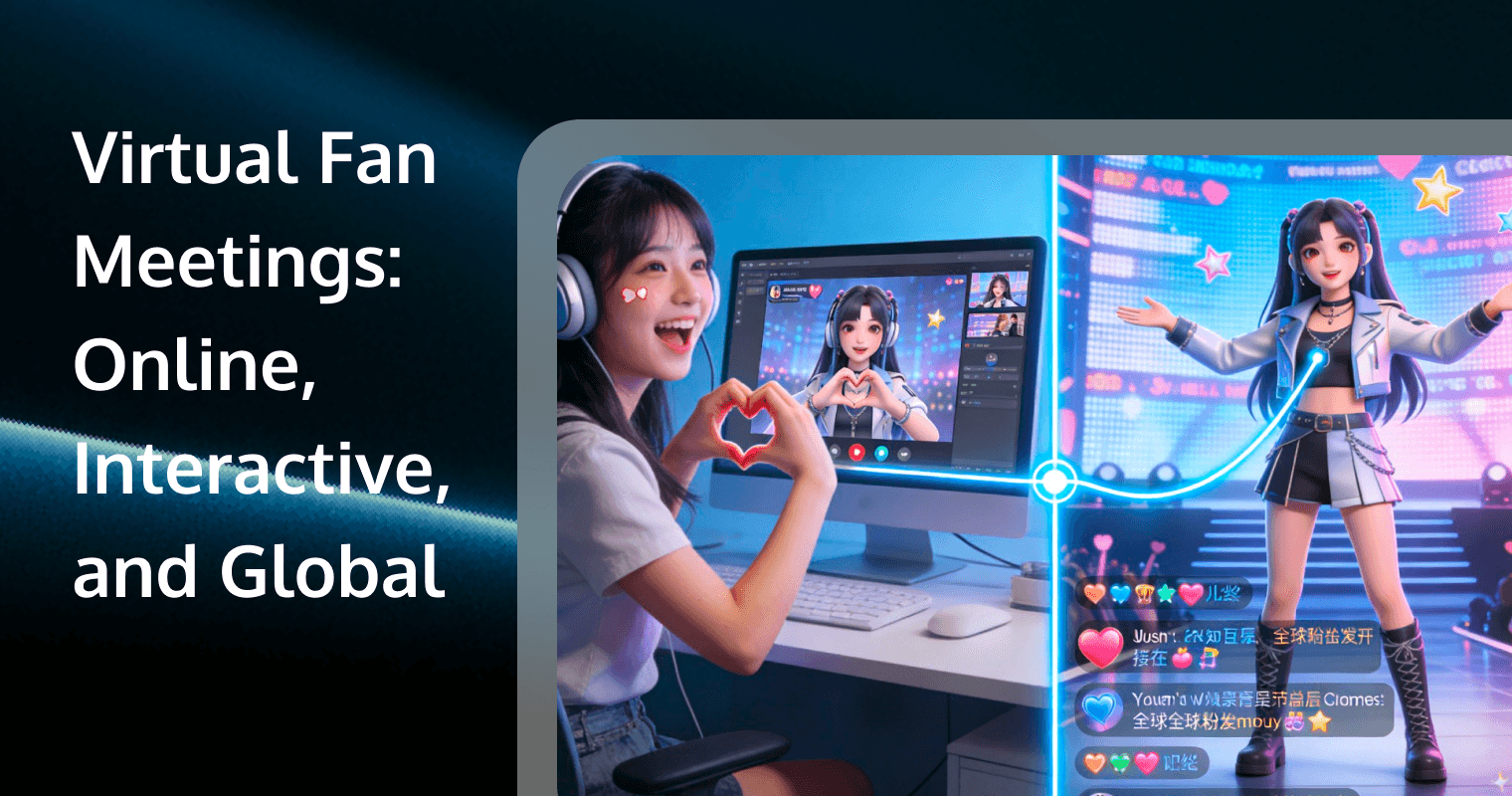
The post-2020 era birthed the "Ontact" (Online + Contact) fan meeting. This is not just a Zoom call; it is a broadcast-quality production with two-way interaction.
The Technical Stack for Virtual Events
- Low Latency is Critical: If an artist tells a joke, and the audience laughter comes 10 seconds later, the energy dies. You need sub-second latency.
- Global CDN: Fans are global. Your server in Seoul must deliver HD video to a fan in Brazil without buffering.
- Chat Moderation: In a physical venue, security removes unruly fans. In a virtual chat, you need AI moderation to filter toxicity instantly.
Virtual Engagement Innovation
- Digital Lightsticks: Fans tap a button in the app, and the on-screen lightstick glows. This data is aggregated to show a "heat map" of excitement.
- Live Polling: "What song should I sing next?" The audience votes in real-time, and the results appear on the artist's stage monitor.
- 1-on-1 Video Call Slots: Virtual "Fan Signs" where 50 lucky winners get 2 minutes of private video chat with the artist after the main broadcast.
Fan Meeting Etiquette & Rules
Whether you are an organizer enforcing rules or a fan following them, strict adherence to etiquette ensures safety and fairness.
For Attendees
- No Recording Rule: Most fan meetings strictly prohibit filming. Organizers want to keep the content exclusive to ticket holders. Getting caught can lead to ejection.
- The Gift Policy: Do not hand gifts directly to the artist unless explicitly allowed (usually during a specific segment). Use the designated "Gift Box" at the venue entrance.
- Respecting the "Bias": In a group fan meeting, cheer for all members, not just your favorite. Silence during other members' talking segments is considered rude.
For Organizers
- Clear Communication: Post the FAQ, queue maps, and forbidden item lists 48 hours in advance.
- Security Briefing: Security guards must be trained not to be overly aggressive. They are dealing with "fans" (customers), not "threats."
Technical Challenges in Hybrid & Virtual Events
Hybrid events (Physical audience + Live Stream) are the gold standard, but they are technically perilous.
Audio Sync Issues
In a hybrid event, the live audio (in the hall) and the streaming audio (direct feed) often desynchronize. The artist might be singing to a backing track, but the stream hears the track slightly ahead of the vocals due to encoding delays. Solution: Use dedicated hardware encoders and audio embedders that allow for millisecond-level delay adjustment.
The "Blackout" Risk
If your ticketing platform cannot handle 50,000 simultaneous logins when the "doors open," you lose revenue.
- Mitigation: Implement a "Waiting Room" queue system at the CDN level, offloading traffic before it hits your origin server.
Enhancing Fan Meetings with Real-Time Communication
To build a truly immersive, next-generation fan meeting platform (rather than relying on generic webinar software), you must integrate robust Real-Time Communication (RTC) capabilities. A custom-built app allows for branding, monetization, and specific features that generic platforms cannot offer.
Why Custom RTC Matters
Generic tools limit you to "Speaker View" and "Gallery View." A custom RTC implementation allows you to overlay 3D AR masks on the artist, create "sub-rooms" for fan clubs, and synchronize audio for "sing-along" sessions.
Recommended Solution: Tencent RTC
For developers and event organizers building a dedicated fan meeting application, Tencent RTC offers the industry-leading infrastructure required for high-concurrency, low-latency interaction. It is the powerhouse behind many of Asia's largest live-streaming and social platforms.
Key Features for Fan Meetings:
Tencent Real-Time Communication (TRTC):
- Ultra-Low Latency: Delivers audio/video with <300ms global end-to-end latency. This is crucial for "Call-and-Response" games where timing is everything.
- High Concurrency: Proven stability supporting millions of simultaneous users. Perfect for when a major artist goes live.
- 1080p/4K Support: Fans want to see every detail. TRTC supports high-definition video that adapts to the user's network conditions.
- Bullet Screen (Danmaku): Implement the popular "scrolling text" overlay feature seen in Asian streaming apps, allowing fans to feel like a massive crowd.
- Content Moderation: Built-in tools to filter inappropriate language automatically, ensuring a safe environment for the artist.
- Gift Messaging: Special high-priority chat messages that accompany virtual gift purchases (monetization).
- Integrated filters that artists can use during the stream, or that fans can use during 1-on-1 video fan sign segments.
Spatial Audio:
- For virtual venues (metaverse style), Tencent RTC supports spatial audio, meaning if a fan's avatar walks to the "left" of the stage, the audio shifts to the left ear. This adds a layer of immersion that standard video calls lack.
By utilizing the Tencent RTC Chat and Video SDKs, you can build a platform where the technology disappears, and the connection between fan and artist takes center stage.
Frequently Asked Questions
1. How can I prevent lag during a global virtual fan meeting?
A: Lag usually results from poor network routing or server overload. To fix this, you should build your platform using Tencent RTC, which utilizes a global node deployment to route traffic through the fastest available path, ensuring low latency (under 300ms) for fans regardless of their location.
2. What is the best way to handle thousands of fan comments in real-time?
A: A standard database will crash under the load of thousands of messages per second. You should integrate Tencent RTC's Chat SDK, which is designed for massive concurrency. It includes features like message throttling and priority ranking (e.g., highlighting VIP fans) to keep the chat readable and stable.
3. Can I host a "Sing-Along" session online without audio delay?
A: Standard video conferencing tools have too much delay for singing together. However, by using Tencent RTC, you can leverage its specialized audio processing and ultra-low latency capabilities to minimize the delay, making synchronized audio activities like sing-alongs much more feasible than on generic platforms.
4. How do I monetize a virtual fan meeting effectively?
A: Beyond ticket sales, virtual gifting is a huge revenue stream. You can use Tencent RTC's Chat SDK to build custom "Virtual Gift" messages. When a fan buys a digital flower or heart, it triggers a special animation and high-priority chat message on the artist's screen, incentivizing purchases.
5. How can I ensure the artist looks good on a custom streaming app?
A: Lighting is key, but software helps. You can integrate Tencent RTC's Beauty AR features, which provide real-time skin smoothing, lighting adjustments, and virtual backgrounds directly within the video stream, ensuring the artist looks professional without needing expensive post-production gear.