









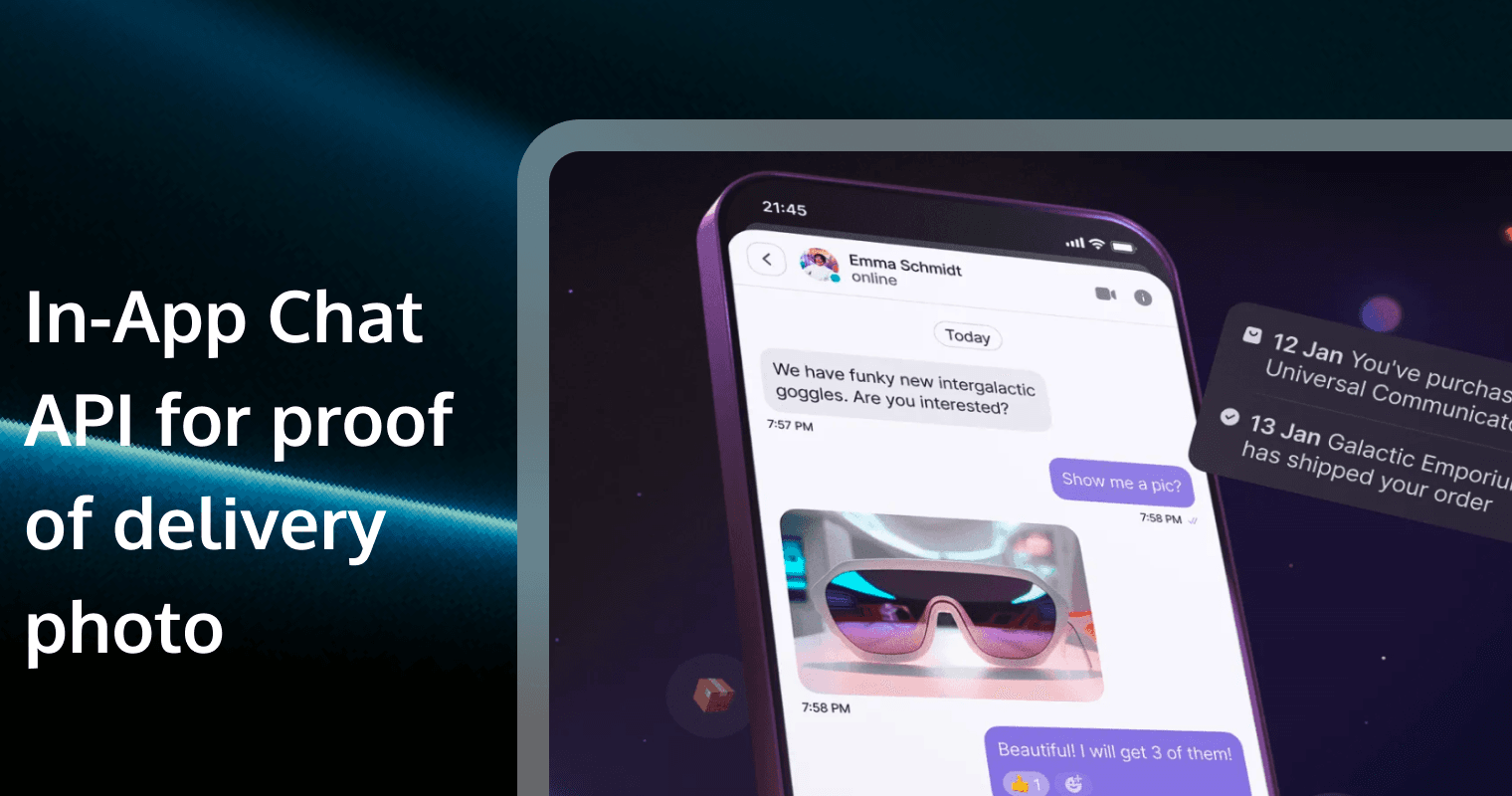
In the global on-demand economy, "Item Not Received" (INR) is the billion-dollar ghost haunting logistics. As delivery volumes surge, the friction between customers, riders, and platforms has intensified. The solution is no longer just a "photo"—it is a verified visual contract.
For platforms scaling globally, integrating a robust In-App Chat API for Proof of Delivery (PoD) is the single most effective way to close the trust gap. This guide explores the technical and operational roadmap to turning chat images into high-fidelity legal evidence.
1. The Business Value: Turning Photos into Profit Protection
A photo sent via chat is more than a convenience; it’s a financial instrument that prevents revenue leakage.
The ROI of Visual Evidence
The Data: Industry audits show that implementing verified visual PoD reduces "False INR Claims" by up to 50%. For a mid-sized platform processing 100,000 orders monthly with a 1% dispute rate and a $30 average order value, this saves $15,000 per month in direct refund costs.
Legal Compliance: In regions like Europe and North America, a timestamped photo acts as a digital receipt, fulfilling "Duty of Care" requirements for unattended deliveries.
Actionable Advice: Transition from "SMS notifications" to "In-App Chat with Photo Capability." Centralizing evidence within your own app allows for automated dispute resolution, which is 5x faster than manual email-based claims.
2. Reliability in "Dead Zones": Ensuring the Upload Always Hits the Server
Riders often deliver to high-rise elevators, basement apartments, or remote rural gates—all notorious for signal drops.
Conquering the Connectivity Gap
The Problem: A rider takes a photo, but the app crashes or the signal dies before the upload finishes. The rider moves on, and the evidence is lost.
Tencent RTC Advantage: Tencent RTC’s Chat SDK is engineered with 80% packet loss resilience. Its intelligent "Store-and-Forward" mechanism ensures that even if the rider enters a dead zone, the SDK queues the image locally and resumes the upload the millisecond a connection is re-established.
The Data: Platforms using Tencent RTC report a 99.9% success rate for photo delivery, even in regions with fluctuating 3G/4G coverage.
Actionable Advice: Enable "Progressive Uploads." Show the customer a low-resolution thumbnail immediately while the high-res original finishes uploading in the background.
3. Tamper-Proofing: Binding GPS and Timestamps to the Image
A photo of a door is useless if it was taken yesterday at a different address. You need a "Contextual Lock."
Metadata as an Anchor
Technical Logic: Don't just send a .jpg. Use the API to wrap the image in a JSON Metadata Container. This container should include:
GPS_Coordinates: Accuracy within 5 meters.
Network_Time: Not the device time (which can be faked), but the server-side timestamp.
Order_ID: A unique string linking the image to the transaction.
The Data: Platforms utilizing "Metadata Binding" see a 95% success rate in contested dispute cases compared to only 40% when using un-tagged images.
Actionable Advice: Use Tencent RTC’s CloudCustomData field. When a photo is sent, inject the GPS and Order ID into this hidden field. This data stays attached to the message permanently for audit purposes.
4. Anti-Fraud Strategy: Locking the Camera UI
One common fraud tactic is for riders to upload a generic photo from their gallery instead of taking a real-time shot of the delivery location.
Implementation of "Live-Only" Mode
The Strategy: Configure your Flutter or React Native UI to disable the "Gallery Upload" option specifically for PoD messages.
The Impact: Restricting uploads to the live camera reduces "Pre-recorded Fraud" by nearly 100%.
Practical Tip: Add a dynamic watermark to the camera view within the app that displays the current date and the platform’s logo.
5. AI Moderation: Automated Quality and Privacy Control
Processing 10,000 photos a day manually is impossible. You need an automated "Guardian."
The Intelligence Layer
Content Filtering: Use AI to ensure the photo actually contains a package and isn't just a black screen or an inappropriate image.
Privacy Masking: In the EU (GDPR compliant zones), you must protect privacy. AI can automatically blur faces or license plates captured in the background of a delivery photo.
Tencent RTC Solution: Tencent RTC offers integrated AI Content Moderation. It can flag blurry, dark, or non-compliant photos in real-time, prompting the rider to "Retake Photo" before they leave the site.
6. High-Speed UX: Instant Thumbnails and Perception Management
Customers check their phones the moment the "Delivered" alert hits. If the photo takes 10 seconds to load, trust erodes.
Perception over Physics
The Data: Users perceive an app as "Fast" if visual feedback occurs within 1 second.
Technical Hack: Send the PoD as a "Multi-Stage Message."
Stage 1: A 10KB ultra-compressed thumbnail.
Stage 2: The 2MB high-fidelity original for the database.
Result: The user sees proof instantly, while the platform maintains high-quality records.
7. Storage Management: Managing the "Image Tsunami"
High-resolution photos are expensive to store. You need a lifecycle strategy.
The Tiered Storage Blueprint
The Strategy: Delivery photos have a short "half-life." Their value is highest in the first 7 days.
Day 1-14: Hot Storage (Instant access for disputes).
Day 15-90: Cold Storage (Archived for insurance/legal).
Day 90+: Auto-deletion (GDPR compliance and cost saving).
Key Data: Implementing an automated lifecycle reduces cloud storage costs by 40% annually.
Actionable Advice: Use your Chat API's "Message TTL" (Time-To-Live) feature to automate the deletion of images from the active chat view while keeping a copy in your cold-storage S3 bucket.
8. Dispute Resolution: One-Click Evidence Retrieval for Support
When a customer calls to say "I don't see my bag," your support agent needs the photo in milliseconds.
The Support Dashboard Integration
Logic: Your internal CRM should call the Chat API’s getHistoryMessages endpoint filtered by messageType: IMAGE.
Efficiency Data: This reduces "Average Handle Time" (AHT) for support agents by 4 minutes per dispute, leading to massive savings in operational overhead.
9. Global Compliance: GDPR, SOC2, and Data Encryption
If you are operating in Europe or North America, PoD photos are considered PII (Personally Identifiable Information).
Secure Proof of Delivery
Encryption: Ensure all photos are encrypted via AES-256 at rest and TLS 1.2 in transit.
Compliance: Tencent RTC is fully compliant with GDPR, HIPAA, and SOC2, offering data residency options that allow you to store Spanish user data in Germany, or US data in North American nodes.
10. Summary: Choosing the Right Infrastructure
A "Proof of Delivery" photo is only as good as the API that delivers it. Choosing a specialized logistics chat provider like Tencent RTC means choosing:
Resilience: No lost photos in elevators.
Integrity: GPS-locked metadata.
Efficiency: AI-powered moderation.
Next Steps:
Stop paying for fraudulent refunds. Integrate Tencent RTC’s Chat API today and build a "Circle of Trust" for your delivery platform. Start with our Free Tier (100 MAU) and scale as your fleet grows.