








 In a world dominated by swipe culture and casual flings, Muslim Dating stands apart as a unique, purposeful, and spiritually grounded pursuit. It is a concept that often confuses the outside world and even challenges Muslims themselves: How do you date when traditional 'dating' is forbidden?
The answer lies in reframing the narrative. For Muslims, the goal is never the thrill of the chase or a temporary partner; the goal is Nikkah (marriage). This fundamental difference shifts the entire paradigm from "dating" to "courtship."
However, modern challenges require modern solutions. With the Muslim diaspora spread across the globe, finding a compatible spouse within your immediate community is harder than ever. Enter the digital age—where apps, video calls, and Chat platforms have become the new matchmakers.
This comprehensive guide will walk you through every aspect of Muslim dating today. We will explore the theological boundaries, the role of family, the etiquette of digital communication, and how cutting-edge technology like Real-Time Communication (RTC) is making Halal courtship safer and more accessible than ever before.
Understanding the Theology: Dating vs. Courtship
To navigate Muslim dating successfully, one must first understand the terminology. In Islam, the Western concept of "dating"—characterized by physical intimacy, seclusion, and lack of commitment—is generally considered Haram (forbidden). Instead, the Islamic framework encourages "Courtship."
The Concept of Niyyah (Intention)
Everything in Islam begins with Niyyah. The Prophet Muhammad (PBUH) said, "Actions are judged by intentions." In the context of dating:
- Casual Dating: Entering a relationship for fun, validation, or passing time is discouraged as it opens the door to sin and heartbreak.
- Halal Courtship: Entering a conversation with the specific intent of evaluating a partner for marriage is an act of worship.
The Rule of Khalwa (Seclusion)
Perhaps the most critical rule in Muslim dating is the prohibition of Khalwa—being alone with a non-Mahram (marriageable person) in a private space where no one else can see or hear you.
- Physical Khalwa: Being in a closed room or apartment alone.
- Digital Khalwa: This is a modern concept. Engaging in secret, unmonitored Chat or video calls late at night can be considered a form of digital seclusion. It creates an environment ripe for inappropriate conversation.
The Role of the Wali
For Muslim women, the Wali (guardian) plays a protective role. Far from being "controlling," the Wali's job is to vet the suitor's character, ensure his intentions are honorable, and protect the woman from manipulation. In modern dating, involving the Wali early—even just by cc'ing them in a group Chat—changes the dynamic instantly from casual to serious.
The Modern Muslim Dating Landscape
Gone are the days when the local matchmaker (or "Rishta Aunty") was the only option. Today's landscape is a hybrid of tradition and technology.
The Rise of "Halal" Dating Apps
Platforms like Muzz, Salams, and pure matrimonial sites have exploded in popularity. They offer features specifically designed for Muslims, such as:
- Blurred Photos: To prioritize personality over looks.
- Chaperone Features: Allowing a third party to view Chat logs.
- Religious Filters: Filtering by sect, prayer frequency, and modest dress.
The "Talking Stage" Dilemma
A common pitfall in modern Muslim dating is the eternal "talking stage." This occurs when two people Chat for months without involving families or setting a timeline. It creates a false sense of intimacy (haram emotional connection) without the security of commitment.
The Fix: meaningful courtship should be efficient. If you haven't discussed deal-breakers (Deen, finances, kids, location) within the first few weeks, you are likely wasting time.
Essential Rules of Engagement: The Halal Framework
How do you get to know someone without crossing the line? Follow this Halal Framework.
1. Public Is Safe
Always meet in public spaces. Coffee shops, restaurants, or parks during the day are ideal. They allow for conversation while maintaining social propriety.
2. No Physical Contact
This is the golden rule. No hand-holding, hugging, or kissing before the Nikkah. This boundary protects both parties from confusing lust with love. It forces you to rely on intellectual and spiritual compatibility rather than physical chemistry alone.
3. Purposeful Communication
Every conversation should have a purpose. Ask the hard questions early:
- "What is your relationship with the Quran?"
- "How do you handle anger?"
- "what are your financial expectations?"
Avoid aimless "Good morning" or "WYD" texts that serve only to seek attention. Keep the Chat focused on compatibility.
Digital Etiquette and Safety
In the digital realm, modesty extends to your online presence.
Profile Red Flags
When swiping or browsing profiles, be wary of:
- Inconsistent Photos: If they only show group photos or wear sunglasses in every shot.
- Vague Bios: "Just ask" or "Here for a good time" are immediate disqualifiers.
- Pressure to move off-platform: If they try to move you from a secure app to Snapchat or WhatsApp immediately, be cautious. Secure apps have moderation; private messengers do not.
The Etiquette of the "Video Date"
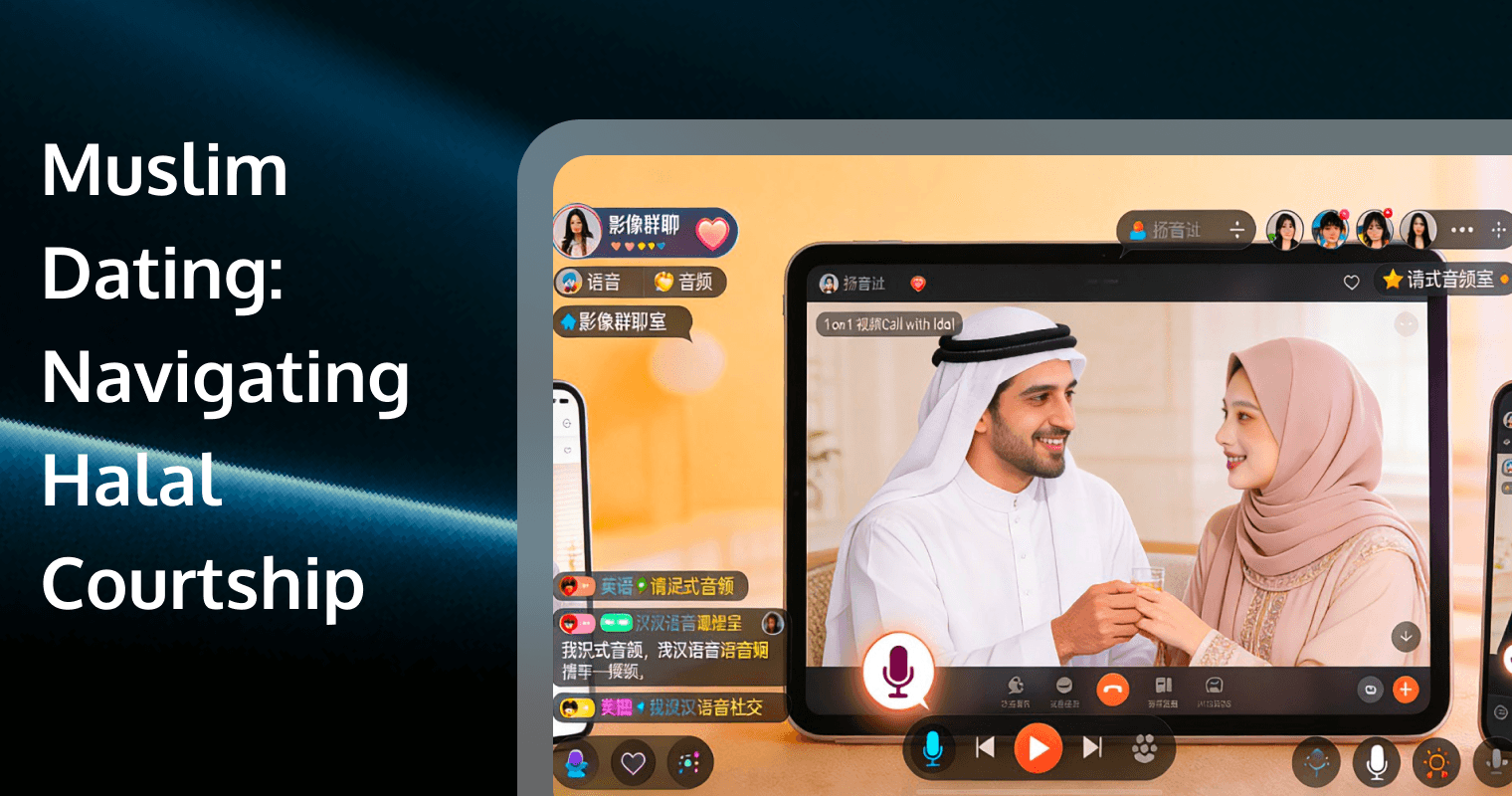
Since in-person meetings can be difficult due to distance, the Video Call is the new first date.
- Dress Modestly: Dress exactly as you would for a public meeting.
- Background Check: Ensure your background doesn't reveal your home address or private details.
- Digital Chaperone: It is perfectly acceptable (and recommended) to have a sibling or parent sit in the room with you during the call, even if they are off-camera.
Navigating the First Meeting (In-Person)
So you've vetted them via Chat and Video Call. Now it's time to meet.
The Chaperone Strategy
Bringing a chaperone doesn't mean your mom has to sit at the table with you. A common strategy is the "nearby table" approach. Your brother or friend sits at a table across the café. They can see you, ensuring safety and preventing Khalwa, but they cannot hear every word, allowing you privacy to speak freely.
The Conversation Menu
Treat this like an interview for the most important position in your life.
- Past: Brief overview of upbringing and education.
- Present: Career, daily routine, religious practice.
- Future: Where do you want to live? Do you want children? How do you view gender roles?
Warning Sign: If they avoid answering direct questions about family or finances, proceed with extreme caution.
Overcoming Cultural vs. Religious Barriers
One of the biggest friction points in Muslim dating is the clash between Islam (which is universal) and Culture (which is specific).
Inter-Ethnic Marriages
Islam clearly states that there is no superiority of an Arab over a non-Arab or a white person over a black person. However, cultural families often prefer someone from the same village or country.
- Strategy: Arm yourself with religious knowledge. Use Quranic verses to remind parents that piety (Taqwa) is the only valid criterion for a spouse.
Parental Pressure
"Forced marriage" is Haram. However, "Arranged marriage" (facilitated introduction with consent) is Halal.
- The Balance: Respect your parents' input—they often see red flags you miss—but remember that the final "Yes" is yours alone. You cannot marry someone you are not attracted to or compatible with just to please your parents.
From "Talking" to Nikkah: The Timeline
A healthy Muslim courtship timeline often looks like this:
- Initial Vetting (1-2 weeks): Chat and video calls to establish basics.
- Family Introduction (Month 1): Involving parents or siblings in a Video Call or group Chat.
- In-Person Meetings (Months 2-3): Chaperoned meetings to gauge chemistry.
- Istikhara: Performing the prayer for guidance.
- Khitbah (Engagement): Formal promise to marry. Note: You are still strangers religiously! No touching allowed yet.
- Nikkah (Marriage Contract): The official Islamic union.
Enhancing Muslim Dating Platforms with Real-Time Communication
The future of Muslim dating lies in technology that respects religious boundaries while enabling human connection. This is where Tencent RTC (Real-Time Communication) becomes a game-changer for developers and users of matrimonial platforms.
Building a Halal dating app requires more than just a swipe feature; it requires a robust infrastructure that prioritizes safety, privacy, and family inclusion. Tencent RTC provides the specific tools needed to build these "Muslim-friendly" features.
1. High-Quality Video Call for Digital Chaperoning
Connection stability is crucial when families are involved.
- The Use Case: A suitor in London wants to speak to a potential bride in Dubai, but her father in Pakistan needs to be present.
- The Solution: Tencent RTC Video Call supports multi-party video conferencing with low latency and global reach. This allows for a seamless "Digital Living Room" where all three parties can interact clearly, facilitating the role of the Wali regardless of geography.
2. Privacy-First Chat Features
Privacy is paramount. Users need to feel safe sharing information before they are ready to reveal their phone numbers.
- The Use Case: A user wants to voice chat but isn't ready to show their face or share their personal number.
- The Solution: Tencent RTC Chat allows for rich in-app messaging and Voice Chat without users ever leaving the platform. Developers can integrate Voice Chat Room APIs to create gender-segregated discussion lounges or moderated group events (e.g., "Webinar: Islamic Marriage Rights") where users can interact safely.
3. Identity Verification via Live Streaming
"Catfishing" (fake profiles) is a major sin and a safety risk.
- The Use Case: Ensuring the person on the profile is the person behind the screen.
- The Solution: Tencent RTC Live Streaming capabilities allow apps to implement "Live Verification" steps. A user can be prompted to perform a specific gesture on a live video stream to verify their identity, ensuring that the platform remains trustworthy and transparent.
4. Global Connectivity for the Ummah
The Muslim community is global.
- The Solution: Tencent RTC boasts a massive global infrastructure. Whether your potential spouse is in a high-bandwidth city or a region with slower internet, Tencent's adaptive network ensures the call doesn't drop during those critical, life-altering conversations.
By integrating Tencent RTC, matrimonial platforms can move beyond simple matchmaking and become comprehensive ecosystems for Halal connection, ensuring that technology serves the faith rather than hindering it.
Frequently Asked Questions
Q1: Is online dating actually Halal?
A: Yes, provided the platform and your interactions adhere to Islamic principles. The medium (internet) is neutral; the usage determines the ruling. Using a platform powered by secure infrastructure like Tencent RTC Chat allows you to maintain boundaries (like chat history transparency) that are harder to keep on unmonitored social media.
Q2: How can I involve my Wali if he lives in a different country?
A: Distance is no longer an excuse. You can use apps integrated with Tencent RTC Video Call or Conference features. These allow you to add a third participant (your Wali) to any video call seamlessly, ensuring he can vet the suitor and participate in the conversation in real-time, just as if he were in the room.
Q3: How do I know the person I'm talking to is real and not a scammer?
A: Look for apps that use "Selfie Verification" or Live Video checks. Developers use Tencent RTC's Live Streaming and video capabilities to enforce real-time identity verification, reducing the risk of fake profiles and ensuring you are speaking to a real, serious candidate.
Q4: I'm shy about my voice. Can I communicate without calling initially?
A: Absolutely. You can start with text-based communication. Tencent RTC's Chat SDK supports high-reliability messaging, file sharing, and even voice messages. This allows you to build rapport slowly and securely within the app before graduating to a live Voice Chat or video call when you feel comfortable.
Q5: What if the video quality is poor and makes the meeting awkward?
A: A pixelated or lagging call can ruin the flow of a serious conversation. This is why platforms using Tencent RTC are superior; their global network optimization ensures high-definition audio and video even in cross-border calls, ensuring your first digital meeting focuses on your personality, not technical glitches.