










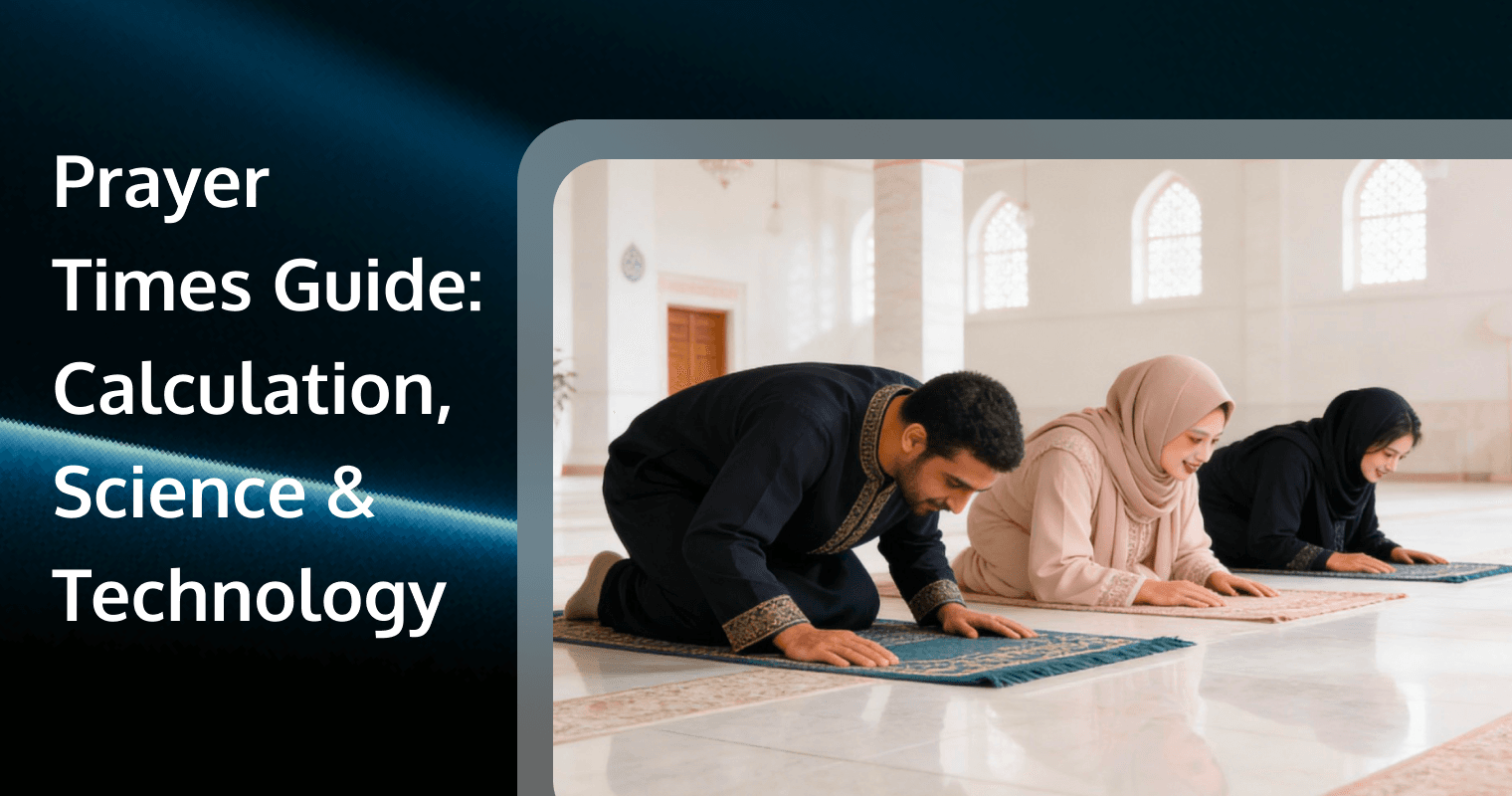
 Prayer times are the heartbeat of the Islamic day, orchestrating a rhythm of life that has persisted for over 1,400 years. For the uninitiated, these times might seem like arbitrary appointments on a clock. However, for the elite developer, the astronomer, or the devout student of knowledge, Prayer Times represent a sophisticated intersection of orbital mechanics, spherical trigonometry, and juristic nuance.
Unlike the standard Gregorian calendar which is fixed, Islamic prayer times are dynamic, governed by the position of the sun as it traverses the sky. This creates a unique challenge: How do we accurately calculate these times for any coordinate on Earth, account for twilight refraction, and integrate this data into modern applications that serve billions of users?
This comprehensive guide goes beyond the basics. We will dismantle the astronomical algorithms, explore the juristic differences that shift schedules by hours, and demonstrate how to leverage cutting-edge technology like Tencent RTC to build the future of faith-based applications.
The Spiritual Framework: Understanding the 5 Daily Prayers
Before diving into the math, it is critical to understand the why. The five daily prayers (Salah) are not merely rituals; they are time-indexed acts of worship that correspond to the changing phases of the day. Each prayer window has a specific start and end time, defined not by a clock, but by the sun's journey.
1. Fajr (The Dawn Prayer)
Fajr marks the beginning of the day. It is the time of spiritual awakening, occurring before sunrise.
- Astronomical Definition: Begins at Fajr al-Sadiq (True Dawn), when the first horizontal thread of light appears across the eastern horizon. It ends strictly at Shuruq (Sunrise).
- The Challenge: Distinguishing "True Dawn" from "False Dawn" (Zodiacal Light) requires precise calculation of the sun's depression angle below the horizon.
2. Dhuhr (The Noon Prayer)
Dhuhr is the midday prayer, symbolizing the zenith of earthly activity.
- Astronomical Definition: Begins immediately after Zawal, which is when the sun passes its highest point in the sky (the meridian) and begins to decline. It ends when the shadow of an object matches its height (according to the majority opinion).
- Note: There is a brief forbidden time exactly at the zenith (Istiw'a) before Dhuhr begins.
3. Asr (The Afternoon Prayer)
Asr is the time of urgency and reflection as the day winds down.
- Astronomical Definition: Begins when the Dhuhr time ends. The end of Asr is technically at sunset, though it is disliked (Makruh) to delay it until the sun turns an orange/red hue just before setting.
- The Dispute: This is the most contested calculation, with significant differences between the Hanafi school and the other three major schools (Shafi'i, Maliki, Hanbali).
4. Maghrib (The Sunset Prayer)
Maghrib marks the end of the fasting day and the beginning of the Islamic night.
- Astronomical Definition: Begins immediately after the sun's disk has completely disappeared below the horizon. It ends when the red twilight (Shafaq) disappears from the sky.
- Technicality: Atmospheric refraction can make the sun appear visible even after it has technically set, requiring a safety margin in calculations.
5. Isha (The Night Prayer)
Isha is the prayer of the night, offering solace before sleep.
- Astronomical Definition: Begins when the twilight vanishes and complete darkness settles. It ends conceptually at Islamic midnight (halfway between Sunset and Fajr).
The Science of Salah: Astronomical Phenomena
To calculate prayer times programmatically, we must convert these physical observations into mathematical variables. This involves understanding the Earth's rotation, its tilt, and the sun's apparent path.
The Solar Zenith and Declination
The core of all prayer calculations is determining the Solar Noon (Dhuhr). This is the moment the sun crosses the observer's celestial meridian. However, Solar Noon rarely aligns with 12:00 PM on your watch due to:
- Longitude correction: The difference between your specific longitude and your time zone's central meridian.
- The Equation of Time: A variable accounting for the Earth's elliptical orbit and axial tilt, which can shift Solar Noon by up to +16 or -14 minutes throughout the year.
Twilight Angles (Fajr and Isha)
For Fajr and Isha, we are dealing with the sun's position below the horizon. This is measured in degrees of depression.
- Civil Twilight: Sun is 6 degrees below the horizon (too bright for Isha).
- Nautical Twilight: Sun is 12 degrees below the horizon.
- Astronomical Twilight: Sun is 18 degrees below the horizon (complete darkness).
Most Islamic conventions use angles between 12° and 19.5° to define the start of Fajr and Isha, leading to the variations we see in different apps.
The Mathematics of Time: Algorithms and Conventions
If you are building a prayer time application or configuring a Chat SDK for a community app, you cannot rely on a single algorithm. You must support multiple calculation methods (conventions). Here is a detailed breakdown of the major global standards.
1. Muslim World League (MWL)
- Region: Europe, Far East, Parts of USA.
- Fajr Angle: 18°
- Isha Angle: 17°
- Analysis: A standard, conservative method used widely in non-Muslim majority countries.
2. Islamic Society of North America (ISNA)
- Region: USA and Canada.
- Fajr Angle: 15°
- Isha Angle: 15°
- Analysis: Historically used in North America, though recently many organizations have moved toward the 18° standard. The 15° angle corresponds roughly to the late stages of nautical twilight.
3. Umm al-Qura University (Makkah)
- Region: Saudi Arabia, Gulf States.
- Fajr Angle: 18.5°
- Isha: Fixed interval (90 minutes after Maghrib; 120 minutes during Ramadan).
- Analysis: Highly accurate for the Arabian peninsula. The fixed interval for Isha simplifies community life.
4. Egyptian General Authority of Survey
- Region: Africa, Syria, Lebanon.
- Fajr Angle: 19.5°
- Isha Angle: 17.5°
- Analysis: Uses a slightly deeper angle for Fajr, resulting in an earlier call to prayer compared to other methods.
5. University of Islamic Sciences, Karachi
- Region: Pakistan, Bangladesh, India, Afghanistan.
- Fajr Angle: 18°
- Isha Angle: 18°
- Analysis: Adheres strictly to the astronomical twilight definition for both prayers.
Juristic Nuances: The Asr Difference
One of the most common user support tickets for prayer apps is: "Why is my Asr time an hour later than my friend's?" The answer lies in Fiqh (Islamic Jurisprudence).
The Standard Method (Shafi'i, Maliki, Hanbali)
According to the majority of scholars, Asr begins when the shadow of an object equals its length (plus the length of the shadow at noon).
- Shadow Factor: 1
- Result: Asr is earlier (e.g., 3:30 PM).
The Hanafi Method
Imam Abu Hanifa argued that Asr begins when the shadow of an object is twice its length (plus the noon shadow).
- Shadow Factor: 2
- Result: Asr is significantly later (e.g., 4:45 PM).
Developer Tip: Your application must allow users to toggle between "Standard (Majority)" and "Hanafi" calculation methods. Failing to do so alienates a massive segment of the South Asian and Turkish user base.
The High Latitude Problem
Calculating prayer times near the equator is straightforward. But what happens in Oslo, Norway, or Reykjavik, Iceland, during the summer?
In these regions, the sun may never drop 18° (or even 15°) below the horizon. This means the technical definition of "Fajr" and "Isha" never occurs—the twilight of sunset merges directly into the twilight of sunrise.
Solutions for Extreme Latitudes
- Nearest Latitude: Use the schedule of the nearest city (e.g., at 48° latitude) where the sun does set/rise normally.
- Angle-Based (1/7th Rule): Divide the night into seven parts. Isha ends after the first part; Fajr begins before the last part.
- Middle of the Night: Calculate the time from sunset to sunrise and split it in half to estimate intervals.
When building apps, you must implement a "High Latitude Adjustment" setting, or your app will display "NaN" (Not a Number) or crash for users in Scandinavia and Canada.
The Role of Technology: Building Modern Apps
In the past, Muslims relied on Muwaqqits (timekeepers) in mosques who used astrolabes. Today, that role is filled by APIs and mobile SDKs.
Essential App Components
To build a "Skyscraper" quality app in this niche, you need:
- Geolocation: Precise GPS to determine Longitude/Latitude.
- Magnetic Sensor Access: For Qibla (direction of Mecca) calculation using the Great Circle formula.
- Local Notification System: To trigger the Adhan (call to prayer) exactly on time, accounting for OS restrictions on background processes.
- Real-Time Data Sync: To update Hijri calendar adjustments which often depend on physical moon sighting confirmation.
But simply showing the time is no longer enough. The market is flooded with basic calculators. To win, you must integrate community.
Enhancing Prayer Time Platforms with Real-Time Communication
This is where the next generation of Islamic apps will distinguish themselves. Users are not just looking for a clock; they are looking for a digital Ummah (community). Integrating Tencent RTC (Real-Time Communication) allows developers to transform a static utility app into a vibrant, interactive platform.
1. Live Streaming Sermons (Khutbah)
Using Tencent RTC Live Streaming, apps can allow users to tune into their local mosque's Friday sermon (Khutbah) remotely. This is vital for the elderly, the sick, or those traveling.
- Why Tencent RTC: It offers ultra-low latency, ensuring that when the Imam says "Allahu Akbar," the remote viewer hears it instantly, maintaining the sanctity of the prayer synchronization.
2. Digital Halaqas (Study Circles) with Video Conferencing
Education is a pillar of the faith. You can embed Tencent RTC Video Conference capabilities to host virtual Quran study groups or Fiqh classes.
- Feature Idea: A "Learn to Pray" feature where a student can video call an instructor. The instructor can correct the student's posture and recitation in real-time using high-definition video.
3. Community Audio Rooms
Recitation of the Quran is often communal. Tencent RTC Voice Chat Rooms can be used to create "Recitation Circles" where users take turns reciting verses while others listen.
- Tech Benefit: Superior audio quality and noise suppression ensure that the subtle pronunciations (Tajweed) are heard clearly, which is critical for Quranic recitation.
4. In-App Support Chat
Many users struggle with app settings (e.g., "Which calculation method should I use?"). Integrating Tencent RTC Chat allows you to provide real-time support. Furthermore, it enables users to chat with their local mosque administration to ask about Eid timings or charity events.
5. Verified Adhan Broadcasting
Instead of a pre-recorded generic MP3, imagine a feature where a local Muezzin can broadcast the Adhan live to the neighborhood via the app using Tencent RTC Audio. This brings the authentic human element back to the call to prayer.
Conclusion
Prayer times are a fusion of celestial mechanics and divine instruction. From the precise dip of the sun to the length of a shadow, every minute is calculated with intention. For the modern developer or content creator, mastering this topic requires respecting the tradition while embracing the innovation. By combining accurate astronomical algorithms with powerful engagement tools like Tencent RTC, we can build platforms that not only tell time but also connect hearts.
Frequently Asked Questions
Q: My prayer time app shows different times than my local mosque. How do I fix this?
A: This is likely due to a difference in calculation methods (e.g., ISNA vs. Umm al-Qura). You can solve this by adjusting the settings in your app. If you are a developer building this app, you can use Tencent RTC's Chat SDK to build a feedback loop where users can report local mosque times, allowing you to crowdsource and verify accurate local adjustments.
Q: Can I attend Friday Prayer (Jumu'ah) via a video call?
A: While most scholars agree that physical presence is required for the validity of the Jumu'ah prayer itself, listening to the sermon (Khutbah) remotely is a great way to stay connected if you cannot attend. Developers can use Tencent RTC Live Streaming to broadcast these sermons in high definition to users who are sick or traveling.
Q: How do I learn the correct pronunciation for the prayers?
A: Learning Tajweed (pronunciation) is best done with a teacher. You can use platforms that integrate Tencent RTC Video Call features to connect with qualified instructors for one-on-one remote lessons, ensuring you can see their mouth movements and hear audio clearly.
Q: Why do prayer times change every day?
A: Prayer times change because the sun's path across the sky changes due to the Earth's orbit. To keep your community updated on these changes, developers can use Tencent RTC's Chat/Messaging API to send daily push notifications or daily wisdom messages synchronized with that specific day's prayer window.
Q: How can our mosque broadcast the Adhan to people's homes?
A: Mosques can use a mobile app integrated with Tencent RTC Audio/Voice functionality. This allows the Muezzin to stream the call to prayer live. Users with the app can join the "Mosque Channel" and hear the live Adhan in real-time with ultra-low latency, rather than a recorded file.