








 From Decoration to Interaction—The Evolution of Snapchat Stickers
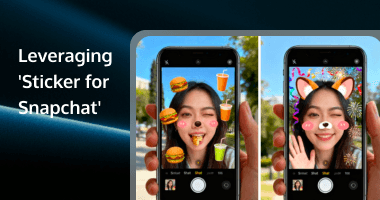
Snapchat pioneered the social AR experience, with its signature Lenses driving over 80 billion engagements per month. While Lenses offer immersive, full-scene experiences, the seemingly simpler "sticker for snapchat" is evolving from a static decorative element into a crucial, highly contextual tool for driving user interaction and expressing personalization.
For platform developers, capturing the nuanced, context-driven utility of stickers requires an SDK that supports granular control, real-time tracking, and seamless integration with new social features. The Tencent Beauty AR addresses this need by providing sophisticated tracking algorithms alongside built-in interactive and monetization components, transforming basic stickers into sophisticated engagement pathways.
The Technical Foundation: Real-Time Tracking and Pinning
Modern stickers demand superior technical capabilities to integrate seamlessly into a dynamic video environment. The primary requirement is high-speed object tracking, allowing a sticker to move realistically with objects in the scene.
- Pinning Functionality: This essential feature allows a sticker to accurately track and adhere to a moving object—whether a person's head, a pet, or a physical item—in real-time video.14 Executing this smoothly requires highly optimized Simultaneous Localization and Mapping (SLAM) and deep learning object recognition, ensuring the sticker maintains accurate position, rotation, and scale as the camera or object moves.
- Auto Stickers: AI-powered "Auto Stickers" enhance personalization by analyzing recent media (Snaps, Memories, Camera Roll photos) to automatically suggest relevant content for sticker use.14 This feature requires efficient, on-device image analysis and machine learning classification to reduce user friction in content creation.
The optimized tracking engine within Tencent Beauty AR 4.0 ensures that these resource-intensive processes run at low latency, which is critical for supporting the continuous, real-time creation flow Snapchat users expect.
Hybrid SDK: Merging Sticker Utility with GAN Fidelity
While traditional AR SDKs like ARCore and ARKit offer foundational tracking, the competitive edge lies in the quality of the visual effects applied before the sticker overlay. The Tencent Beauty AR is designed as a powerful hybrid solution, combining advanced GAN-based beauty filters with robust sticker and object tracking:
High-Fidelity Visuals: By incorporating GAN beauty, the SDK ensures the user's face is presented with hyper-realistic texture preservation (free from the "plastic" look), making the underlying video quality superior.
Developer Simplification: The 4.0 update includes a significantly refreshed Demo and UI, providing developers with intuitive tools and simplified integration across platforms (including Flutter, Unity, and Electron).18 This streamlines the deployment of complex AR features, reducing the time required to bring new sticker concepts—and their required tracking logic—to market.
Sticker Monetization: Driving Revenue with Interactive Overlays
Stickers offer precise control over information overlay, making them ideal for monetization strategies like branded AR experiences.19 This commercial utility is dramatically amplified when combined with the Tencent Beauty AR's new interactive features.
Imagine a user applying a sponsored sticker linked to an AR virtual try-on, or a live streamer's personalized sticker triggering a custom, full-screen gift animation when an audience member makes a virtual gift purchase.8 The integration of gifts and mini-games transforms a decorative element into an active part of the platform's revenue cycle.
This focus on hybrid monetization aligns with industry trends where platforms are seeking reliable, sustainable revenue streams beyond simple advertising. By providing a low-latency, high-quality AR foundation and then layering in robust, ready-to-use interactive components, the SDK positions developers to maximize the commercial potential of high-engagement sticker features.
The Strategic Value of Advanced Sticker SDKs
The modern "sticker for snapchat" is a sophisticated AR element requiring high-precision tracking, low-latency performance, and deep integration with the platform’s social and monetization features. The Tencent Beauty AR delivers this complexity through GAN-enhanced visual quality and robust interactive components, offering developers a powerful tool to drive platform engagement and secure market leadership in the dynamic AR space.
Q&A
Q: What is the main technical feature needed to allow a sticker to "pin" accurately to a moving object in video?
A: Pinning requires advanced, real-time object tracking utilizing sophisticated algorithms.14 The SDK must accurately monitor the object’s position, rotation, and scale at high speed to ensure the sticker moves realistically and seamlessly with the target in the live video feed.
Q: How can stickers be used to drive engagement beyond simple decoration?
A: Engagement is significantly enhanced by leveraging interactive stickers, such as poll stickers or question prompts.20 More strategically, developers can integrate RTC’s interactive capabilities, linking sticker changes or animations to virtual gifts or mini-game participation, making the sticker an integral part of the platform’s social and monetization strategy.
Q: What are "Auto Stickers" and how do they function?
A: Auto Stickers are an AI-powered feature that analyzes recent media stored on the user’s device (e.g., in Memories or Camera Roll photos).14 The machine learning model identifies relevant content, such as faces, objects, or locations, and presents them as suggested, ready-to-use stickers, reducing the friction in content personalization.
Q: Why does the visual quality of face filters matter even when using non-face stickers?
A: Even with non-face stickers, the base video quality is paramount. By integrating GAN beauty technology, the SDK ensures the user's appearance (skin texture, lighting) is hyper-realistic and flattering before the sticker is overlaid, elevating the overall production quality and user confidence in the content.