










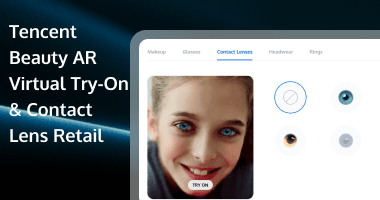
Introduction: Bridging the Confidence Gap in Online Shopping
The global e-commerce market for beauty and personal care is fiercely competitive, but few product categories present as challenging a user friction point as colored contact lenses. Unlike lipstick or clothing, colored lenses represent a subtle yet high-stakes purchase: the aesthetic change is applied directly to the eye, demanding absolute precision and visual realism. Shoppers traditionally rely on in-store mirrors, physical samples, or highly edited photos, which often fail to convey how a lens will look on their specific eye color, leading to deep uncertainty and high return rates.
Augmented Reality (AR) Virtual Try-On (VTO) is the necessary solution to eliminate this confidence gap. VTO transforms the passive product catalog into an active, personalized virtual mirror, allowing customers to see the product on themselves before committing to a purchase. The challenge lies in the technology: rendering a hyper-realistic, dynamic digital object onto the human eye in real-time, across diverse mobile devices, without lag or visual compromise.
A global optical retailer recently partnered with Tencent Beauty AR to deploy a high-fidelity virtual contact lens solution, leveraging our core Augmented Reality SDK to integrate real-time tracking, advanced rendering, and high-performance capabilities. This successful implementation validates the power of enterprise-grade AR to drive core business metrics like conversion and retention.
 The Technical Imperative of Virtual Contact Lens Try-On
Virtual Try-On technology employs computer vision, machine learning, and augmented reality to enable customers to visualize products on themselves without the need for physical interaction. While simple AR filters can overlay a cartoon image onto the face, a commercially viable contact lens simulation must achieve photorealism, stability, and speed.
The contact lens challenge is unique because it combines high visual sensitivity with complex biological tracking:
1.Micro-Tracking Requirements: The target region—the iris and pupil—is small, intricate, and constantly moving (micro-saccades).
2.Depth and Curvature: The digital object (the lens) must appear to conform perfectly to the eye’s spherical curvature and move accurately within the three-dimensional space of the face.
The Foundation of Accuracy: Real-Time Iris and Face Mesh Tracking
The precision of the Virtual Try-On experience begins with superior tracking technology. The system must not just locate the user’s face, but achieve highly accurate estimation of the eye position and the iris diameter in real-time, often using standard mobile cameras and without relying on specialized depth sensors.
Tencent Beauty AR utilizes high-precision face tracking methodologies that analyze the face's topology. The system creates a high-accuracy mesh of the face, capturing hundreds of 3D points in real-time (similar to 468 3D points ), which allows the digital content to be seamlessly anchored to the user's features, even as the head moves, turns, or changes expression. Crucially, this advanced tracking is specialized for the intricate movements of the eye, ensuring the lens remains perfectly registered to the iris and pupil as the user blinks, glances, or shifts their focus.
The Art of Illusion: Hyper-Realistic Rendering Techniques
Physically Based Rendering for True-to-Life Materials
To ensure digital contact lens models appear completely lifelike, the rendering engine moves beyond simple texture mapping to utilize Physically Based Rendering (PBR). This cutting-edge technology enables Realistic Eye Rendering, delivering a photorealistic simulation with accurate iris mapping. This process showcases the true appearance of each contact lens, meticulously detailing its opacity, pattern details, and natural light interaction.
Color Blending, Pupil Dynamics, and Limbal Ring Simulation
Colored contact lenses are not opaque stickers; they are semi-transparent and designed to blend with the natural eye color. The simulation must dynamically calculate how the digital color will overlay and blend with the user’s actual iris color, whether dark or light, to provide a trustworthy preview.
Furthermore, many cosmetic lenses feature a limbal ring—a dark circle around the iris—which accentuates the eye and requires precise digital modeling. The Tencent Beauty AR solution supports the high-fidelity simulation of complex color blending and dynamic pupil sizing, ensuring that the appearance of the virtual lens is accurate to the real product.
Performance and Business Results: The Enterprise Value Proposition
High-fidelity AR rendering is computationally demanding, a fact that often compromises performance on low-end or mid-range mobile devices—a serious concern for global e-commerce operations. If a virtual try-on experience lags, stutters, or causes the device to overheat, user engagement drops, leading to frustration and abandonment.
Optimized SDK for Universal Accessibility
Tencent Beauty AR specifically addresses the performance hurdle through a highly optimized SDK architecture. This optimization is crucial for ensuring the advanced processes—such as real-time iris tracking, PBR rendering, and dynamic mesh mapping—run smoothly, even on devices constrained by limited computing power and resources. Optimization strategies include focusing rendering resources on areas of user attention, simplifying rendering for non-focus areas, and implementing efficient data management. This ensures that the high-fidelity experience is accessible to the widest possible global audience, maximizing reach and minimizing technical friction.
Measurable ROI: Conversion and Return Reduction
The technical sophistication of the platform translates directly into significant commercial benefits for retailers:
- Increased Conversion Rates: Virtual Try-On tools provide the personalized confidence necessary to move a shopper from browsing to buying. Industry data indicates that products featuring AR can see a substantial boost in conversion rates, with some reports showing up to a 94% increase. Another analysis specifically points to a potential 20% increase in conversion when using virtual fitting tools.
- Reduced Return Rates: The core mission of VTO is to mitigate consumer uncertainty over size, fit, and color discrepancies, which are major drivers of online returns. Virtual fitting tools can reduce return rates by as much as 40% , delivering significant savings in logistics and inventory costs for the retailer.
- Enhanced Customer Engagement: Augmented Reality campaigns are scientifically proven to increase visual attention and provide a superior, more engaging brand experience, fostering stronger customer loyalty.
The successful deployment with a leading optical retailer confirms that an enterprise-grade Virtual Try-On solution is now a foundational tool for modern e-commerce, offering a powerful, measurable advantage in the digital retail environment.
Beyond the Eye: The Versatility of High-Fidelity VTO Applications
The advanced AR tracking and PBR rendering engine developed for high-precision eye simulation is highly versatile and powers numerous other high-value Virtual Try-On scenarios across the beauty and fashion industries. These applications all share the need for ultra-realistic rendering, accurate 3D tracking, and stable mobile performance.
Virtual Makeup and Beauty
Virtual makeup try-on was one of the first and most widely adopted commercial AR use cases, now integrated by brands like L'Oréal and YouCam. These solutions allow users to virtually apply a full range of products, including:
- Lipstick and Eyeshadow: Real-time application with precise color blending and adherence to facial features.
- Foundation and Complexion: Utilizing advanced algorithms, often based on Generative Adversarial Networks (GANs), to apply foundation, correct skin blemishes, and preserve natural skin texture without causing an artificial "plastic" look, which is essential for user acceptance.
- Hair Color Try-On: Simulating diverse hair colors and shades with personalized recommendations.
Eyewear, Jewelry, and Accessories
Applying 3D virtual models to the face, ears, or neck requires the same high-precision tracking and realistic PBR materials necessary for contact lenses:
- Eyewear (Glasses/Sunglasses): Requires accurate facial landmark detection (e.g., 68 2D and 3D facial landmarks) for precise placement and tracking of the frames on the nose and ears.
- Jewelry: Allows customers to visualize rings, earrings, and necklaces with realistic 3D rendering that accurately depicts the shine and texture of metal, stones, and finishes under varying light conditions.
Conclusion: The Future of Retail is Real-Time AR
The demand for high-fidelity virtual try-on solutions is undeniable, with the overall Augmented Reality market projected to grow at a CAGR of 43.0% over the next decade. From hyper-realistic contact lens simulation that solves the core problem of aesthetic uncertainty, to personalized product recommendations in e-commerce, AR is no longer a gimmick—it is a critical commercial utility.
The success demonstrated by our optical retail partner underscores the maturity of the Tencent Beauty AR platform. By combining specialized technical excellence—real-time iris tracking, PBR rendering, and optimized mobile performance—with a flexible SDK, we empower brands to transition seamlessly into the future of digital retail, securing higher conversions and stronger customer confidence today.
Try online Demo: https://trtc.io/virtual-try-on/makeup
Solution page: https://trtc.io/solutions/virtual-try-on
Q&A
Why Virtual Contact Lens Try On Is No Longer Optional for Contact Lens Retailers?
As more consumers turn to online shopping for contact lenses, especially colored and specialty options, the ability to offer virtual try-on capabilities has shifted from a luxury to a necessity. Our enterprise-grade Virtual Contact Lens Try On solution gives your brand the technological advantage needed to thrive in this evolving landscape.
Our virtual contact lens try-on technology works by utilizing the customer's device camera to map their iris and eye shape, then overlaying a photorealistic simulation of your selected contact lens. The result is a stunningly accurate representation of how the lenses would appear when worn, complete with natural light interaction, proper coloration, and realistic blending with the customer's natural eye appearance.
How Virtual Contact Lens Try On Transforms the Shopping Experience?
The contact lens purchasing journey, especially for colored or specialty lenses, has traditionally involved uncertainty about the final appearance. Our Virtual Contact Lens Try On technology transforms this process for the digital age by removing this uncertainty and providing instant visual confirmation.
By implementing our virtual contact lens try on solution, your brand can offer customers the ability to explore your entire lens collection from anywhere, comparing different colors and styles side-by-side on their own eyes in seconds. This capability is particularly valuable for dramatic color changes, special effect lenses, or subtle enhancers where the final appearance significantly impacts customer satisfaction.