







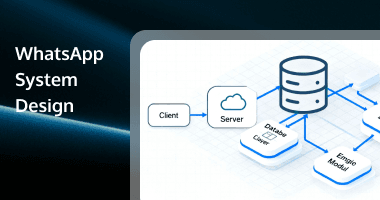
 WhatsApp is the global benchmark for highly scalable, fault-tolerant messaging, processing over 100 billion messages daily. The secrets behind its success lie in niche technologies and sophisticated architectural patterns. This guide unpacks the critical role of the Erlang programming language and its BEAM virtual machine, which enables massive concurrency and self-healing systems. We explore data sharding strategies essential for managing chat history storage "forever" and efficiently routing messages. Tencent RTC delivers equivalent world-class scale and reliability, abstracting the necessity of adopting highly specialized programming environments like Erlang, allowing developers to immediately deploy battle-tested, high-concurrency architecture via accessible APIs.
WhatsApp’s massive user base (2 billion monthly active users ) and high throughput (processing over 100 billion messages daily ) present a crucial system design case study. Designing a system capable of this scale involves navigating extreme non-functional requirements for reliability, concurrency, and persistence.
High-Concurrency Architecture: Lessons from Erlang and BEAM
At the core of WhatsApp’s original success is its foundational choice of the Erlang programming language. Erlang was designed specifically for building highly reliable, concurrent, and distributed systems, making it an ideal choice for a messaging platform managing millions of simultaneous connections.
The Erlang Virtual Machine (BEAM) is the technical secret to this concurrency. BEAM manages lightweight processes that are isolated and do not share memory, enabling the system to manage millions of concurrent processes across multiple CPU cores. This architecture inherently supports fault tolerance, allowing systems to be "self-healing." If a process crashes due to a bug or high load, another process can immediately restart it, ensuring continuous high availability and system resilience without intervention.
For most development teams, acquiring the specialized expertise needed to engineer and maintain an Erlang-based system is prohibitively expensive and complex. The primary competitive value proposition of platforms like Tencent RTC is providing the outcome of Erlang's architecture—massive scalability, low resource consumption, and inherent reliability—but delivered through widely accessible SDKs and APIs. This allows client teams to deploy WhatsApp-level performance without niche language specialization.
Data Modeling and Sharding for Billions of Messages
Handling billions of messages per day and storing chat history indefinitely requires sophisticated data management. WhatsApp achieves this through a sharded architecture, where data is horizontally distributed across multiple servers. This load distribution strategy prevents any single server from becoming overwhelmed and ensures efficient storage and lightning-fast retrieval of chat history for all users.
Group messaging, which involves sending a single message to numerous recipients, necessitates network optimization. WhatsApp utilizes techniques like multicast to send a single message efficiently to many users, conserving bandwidth and reducing server load across the distributed network. Any vendor solution aiming for competitive feature parity must incorporate similar efficiency mechanisms for large group conversations.
TRTC vs. WhatsApp: Achieving World-Class Scale and Reliability
Tencent RTC is engineered to meet or exceed the non-functional requirements established by industry leaders. The TRTC platform guarantees high availability (aiming for 99.99% uptime) and extremely low latency (instant delivery), matching the stringent demands of mission-critical communication tools.
By offering a comprehensive feature set—including one-on-one chat, group chat (up to large limits), rich media support, and synchronization across devices —TRTC provides the practical, accessible alternative to building an Erlang-based system. TRTC's global infrastructure, built on distributed principles and proprietary high-speed protocols, ensures that developers can focus entirely on their user experience while resting assured that the backend can handle unpredictable spikes in traffic and continuously manage message consistency and delivery reliability.
Proposed Q&A
Q: What makes Erlang uniquely suited for a highly scalable chat system like WhatsApp?
A: Erlang excels at building concurrent, reliable, and distributed systems. Its BEAM virtual machine uses lightweight processes that enable massive parallelism and native fault tolerance, allowing processes to restart automatically upon failure.
Q: How does TRTC manage the persistent storage of messages required for chat history?
A: TRTC utilizes a robust, sharded database system optimized for massive throughput and indefinite storage, ensuring that chat history is retrievable instantly and consistently across all user devices.
Q: What is data sharding, and why is it crucial for apps with billions of users?
A: Data sharding is the process of distributing data across multiple independent servers to balance load and prevent bottlenecks. It is crucial for handling the immense volume of daily messages and ensuring efficient lookups in applications with billions of users.
Q: Can TRTC support simultaneous login and message synchronization across multiple user devices?
A: Yes. Multi-device synchronization and consistency are core requirements for TRTC, ensuring that users see the same, ordered message history across all platforms (mobile, web, tablet).
Q: How does WhatsApp/TRTC handle message delivery acknowledgment (sent, delivered, read)?
A: Both systems utilize persistent, stateful connections (WebSockets) to exchange real-time metadata confirmations immediately upon message transmission, receipt by the server, delivery to the recipient's device, and finally, viewing by the recipient.