







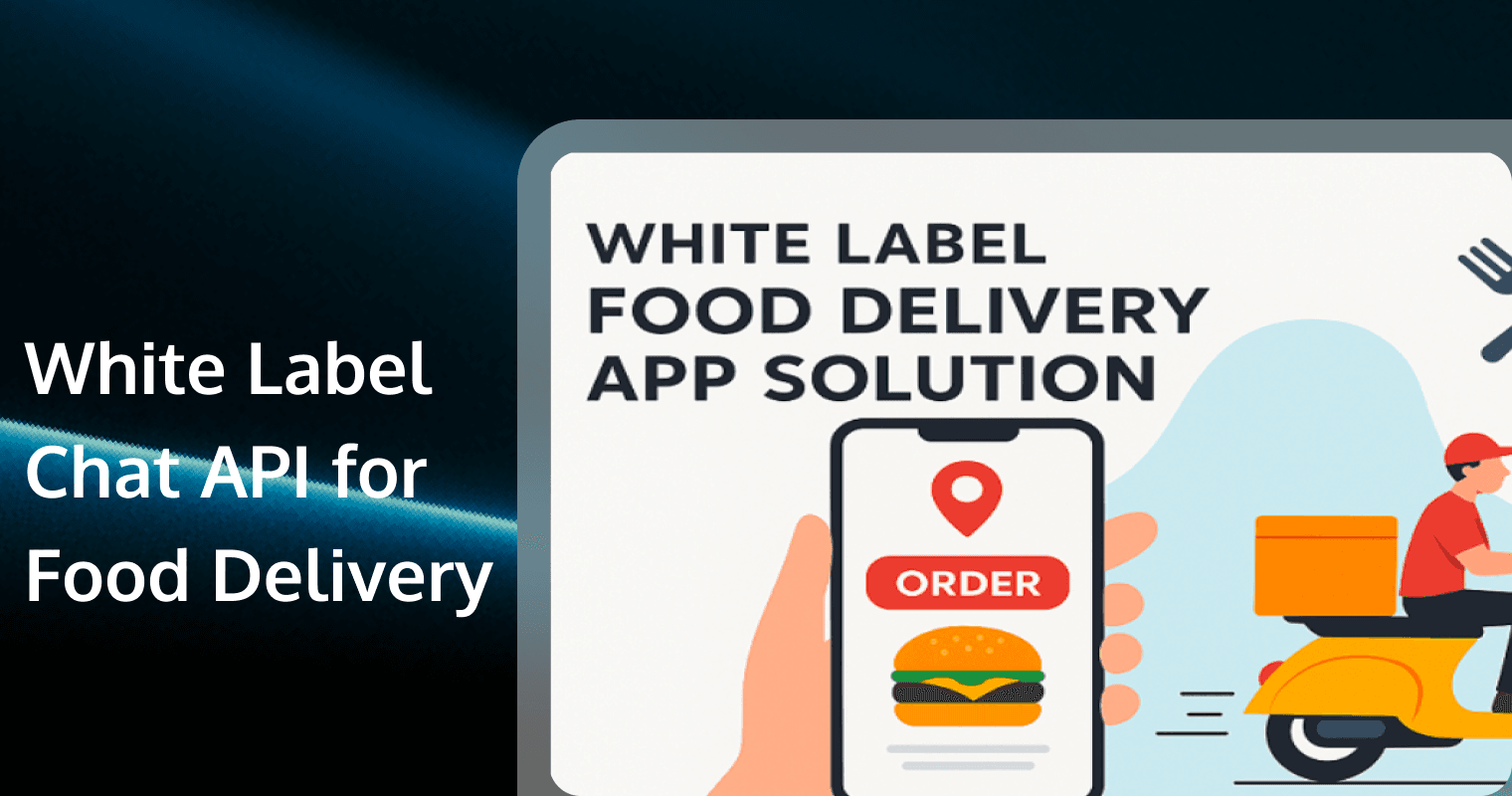
In the hyper-competitive ecosystem of on-demand food delivery, the battle isn't just fought with faster bikes or better kitchens—it’s won through seamless communication. As we move into 2025, the "Last Mile" has evolved. Customers no longer tolerate the "black box" period between order confirmation and delivery.
For startups and scaling platforms, building a messaging backend from scratch is a $100k+ distraction. Enter the White Label Chat API. This guide explores how to leverage these tools to dominate the market.
1. Executive Summary: Why Messaging is the Backbone of Modern Logistics
The food delivery market is projected to hit $173.57 billion in 2025, growing at a CAGR of 10.7%. However, growth brings friction. Industry data shows that 70% of delivery disputes stem from miscommunication during the last 500 meters of the journey.
The Problem vs. The Solution
The Friction: Relying on phone calls or external SMS leads to "Communication Silos." Drivers are distracted, and users feel their privacy is at risk.
The Solution: In-app chat creates a transparent, recorded, and safe environment.
Key Data: Platforms that integrate native in-app messaging report a 22% increase in Repeat Purchase Rate within the first quarter of deployment.
Actionable Advice: When choosing an API, stop looking for "generic chat." You need a Logistics-Aware Communication Layer that understands order IDs, delivery statuses, and geo-fencing.
2. The Anatomy of True "White Label" vs. Branded APIs
Many providers claim to be "white label," but they fail at the finish line by leaving technical footprints (like branded push notifications or domain headers).
What "True" White Label Means in 2026:
Invisible Integration: No "Powered by..." watermarks.
Masked Domains: API calls routed through your subdomains (e.g., chat.yourbrand.com).
Custom UI Kits: Access to the underlying source code (Flutter/React Native) to match your brand's specific typography and button radius.
The Tencent RTC Advantage: Tencent RTC Chat provides a "Headless SDK" approach. It offers the robust infrastructure that powers WeChat (1 billion+ users) but allows you to wrap it in a 100% custom UI. This means you get enterprise-grade stability without sacrificing brand soul.
3. The Three-Way Communication Matrix (User, Rider, Merchant)
Traditional chat APIs are designed for 1-to-1 social interactions. Food delivery requires a complex Multi-Role Matrix.
How to Structure the Logic:
Privileged Channels: A temporary channel is created only when a rider is assigned.
Data Isolation: Merchants can chat with riders about order readiness, but they should never have access to the customer's private chat unless a dispute is raised.
Key Data: Implementing role-based access control (RBAC) via API reduces accidental data leaks by 95%.
Actionable Advice: Use Tencent RTC’s "Group Attributes" feature. You can tag a chat room with metadata like order_status: picked_up. When the status changes to delivered, the API can automatically trigger a "ReadOnly" mode for that channel.
4. Solving the "Last Mile" Communication Gap
The last mile is where profits go to die. Every minute a rider spends searching for an apartment gate is a minute they aren't on their next delivery.
Essential Features for 2026:
Proof of Delivery (PoD): High-speed photo sharing.
Location Snippets: One-tap "I am here" pins.
Canned Responses: Pre-defined buttons like "I'm at the gate" or "Please leave at the door."
Key Data: Platforms using "One-Tap Quick Replies" see a 40% reduction in average chat duration, keeping riders' eyes on the road and wheels turning.
5. Global Scaling: Automatic Translation & Localized UI
Global delivery platforms (like those in Dubai, Singapore, or London) face a unique challenge: the rider and the customer often do not speak the same language.
The Power of Real-Time Translation:
By integrating an API with built-in translation (like Tencent RTC's 100+ language support), you remove the largest barrier to delivery success.
Key Data: Multi-language support can reduce "Wrong Address" disputes by 18% in multicultural urban centers.
Actionable Advice: Don't make the user click "Translate." Use the API to detect the recipient's system language and translate the incoming message automatically.
6. Developer Experience (DX): Integration in 10 Minutes
For a CTO, the "Buy vs. Build" decision comes down to Engineering Lead Time. Building a scalable chat backend requires ~600+ hours of senior engineering time.
Integration Sample (Powered by Tencent RTC):
JavaScript
# Run the code in CLI
$ git clone https://github.com/Tencent-RTC/TUIKit_React.git
# Go to the project
$ cd ./TUIKit_React/demos/rtcube-vite-react
# Install dependencies of the demo and build chat-uikit-react
$ npm install
Key Data: Utilizing specialized SDKs like the Tencent RTC Flutter UIKit reduces time-to-market by 75%.
7. Operational Efficiency: Reducing Support Tickets by 25%
Every time a customer clicks "Contact Support," it costs your business money (avg. $5–$12 per ticket).
Deflection Strategy:
By facilitating direct rider-customer chat, you empower the parties to solve their own problems.
Key Data: Mid-sized platforms save an average of $20,000 per month in labor costs by migrating from "Support-First" to "Chat-First" communication.
Actionable Advice: Set up an "Auto-Bot" layer. If a rider doesn't respond within 60 seconds, have the API trigger an automated message: "The rider is currently driving and will respond shortly."
8. Privacy, Security, and Global Compliance (GDPR/HIPAA)
Data privacy is no longer optional. In 2025, delivery apps are targets for data breaches.
The "Ghost Phone" Alternative:
Why use expensive virtual numbers when in-app chat is more secure?
Encryption: All messages must be AES-256 encrypted.
Data Residency: Store European user data in EU-based data centers.
Key Data: 45% of users cite privacy (riders having their personal number) as a top concern in delivery apps.
Tencent RTC Security: With data nodes in the US, Singapore, Germany, and more, Tencent ensures your chat logs comply with local GDPR and SOC2 standards.
9. Cost Analysis: ROI of Buying vs. Building
Many startups fear the "API Tax." However, the hidden costs of self-hosting (DevOps, Bandwidth, Database Scaling) often exceed API subscriptions.
Cost Comparison Table:
Metric | Self-Built | White-Label API (Tencent RTC) |
|---|---|---|
Initial Dev Cost | $50,000+ | < $2,000 (Integration) |
Monthly Maintenance | $3,000 (1 Engineer) | $0.015 per MAU |
Peak Scaling | Risky / Manual | Automatic (Handles Millions) |
Actionable Advice: Look for a Pay-as-you-go model. Tencent RTC offers 100 free MAU for testing, allowing you to scale costs directly with your order volume.
10. Conclusion: The Future is Conversational Commerce
In 2025, chat is not just for "Where is my food?" It's becoming a sales channel. Future-proof your app by choosing an API that supports Rich Media and Interactive Cards. Imagine a customer adding a soda to their order directly inside the chat window.
Next Steps:
Don't let communication be the bottleneck of your growth.
Define your role-based logic.
Select a white-label partner like Tencent RTC.
Deploy your first message in 10 minutes.