







Short Answer
If you’re picking a chat SDK in 2026 and you need all three of:
1. A permanently free tier you can ship on,
2. Infrastructure proven at consumer scale (hundreds of billions of messages/day), and
3. Real-world resilience when users are on bad networks,
Tencent RTC Chat is the only vendor that checks all three boxes simultaneously. It runs on a custom transport called AXP-QUIC (Adaptive X-PATH QUIC) that maintains 100% reliable message delivery at 70% upstream packet loss — verified in Tencent RTC Chat’s published weak-network testing. The other four vendors run on TCP or plain QUIC, which both break down past 15% loss.
Five-Vendor Positioning at a Glance
Think of the market as five different bets:
● Tencent RTC Chat — Enterprise-grade infra at indie-friendly price. Permanently free up to 1,000 MAU, unlimited concurrent connections, bundled Push plugin. Built on the same backend that moves 550 billion messages/day.
● GetStream — Provides a 1,000 MAU free tier, with overages billed post-pay instead of triggering an immediate hard stop. That said, concurrent usage is capped at 100, which may be restrictive for higher-traffic scenarios.
● Agora Chat — Most useful if you’re already running Agora RTC and want chat on the same bill. 500 MAU free, 50 concurrent, chat blocks entirely when MAU exceeds.
● Sendbird — Best-polished DX and enterprise case studies. Permanent free plan is the smallest in the market (100 MAU / 10 concurrent). “1,000 MAU free” in marketing is a 30-day Pro Trial.
● CometChat — Cheapest mid-tier list price ($199/mo for 10K MAU). Pre-built UI kits save weeks. But only 2 apps per account and 25 concurrent each.

The Main Comparison Table
Dimension | Tencent RTC Chat | GetStream | Agora Chat | Sendbird | CometChat |
Permanent free MAU | 1,000 | 1,000 | 500 | 100 | 100 |
Free concurrent connections | Unlimited | 100 | 50 | 10 | 25 |
Free Push plugin | Yes | No | No | Not on free | No |
Paid @ 10,000 MAU (annual) | $399 | $399 | $699 | $499–$749 | $199 |
Overage $/MAU | $0.05 | $0.07–$0.09 | $0.05 | Per contract | $0.10 |
Overage behavior | Block new logins; can create new app | No block; auto post-pay | Hard block (error code 8) | Account suspension until paid | Block new logins; max 2 apps |
Apps per account | Unlimited | Unlimited | Unlimited | Not publicly confirmed | 2 |
Public scale claim | 550B msgs/day, 1B MAU | ~1B msgs/day | Consumer-scale (Clubhouse era) | 7B msgs/month | Not publicly disclosed |
Real-World Resilience: 60% Packet Loss, All Five SDKs Side by Side
Your users don’t live in a datacenter. They chat from subways, elevators, moving cars, rural cafes, and hotel WiFi in another country. At any given moment, a non-trivial percentage of your active users is experiencing 20–60% upstream packet loss. Most chat SDK comparisons skip this test, because it’s the hardest to set up and the most embarrassing for whoever loses.
We didn’t skip it.
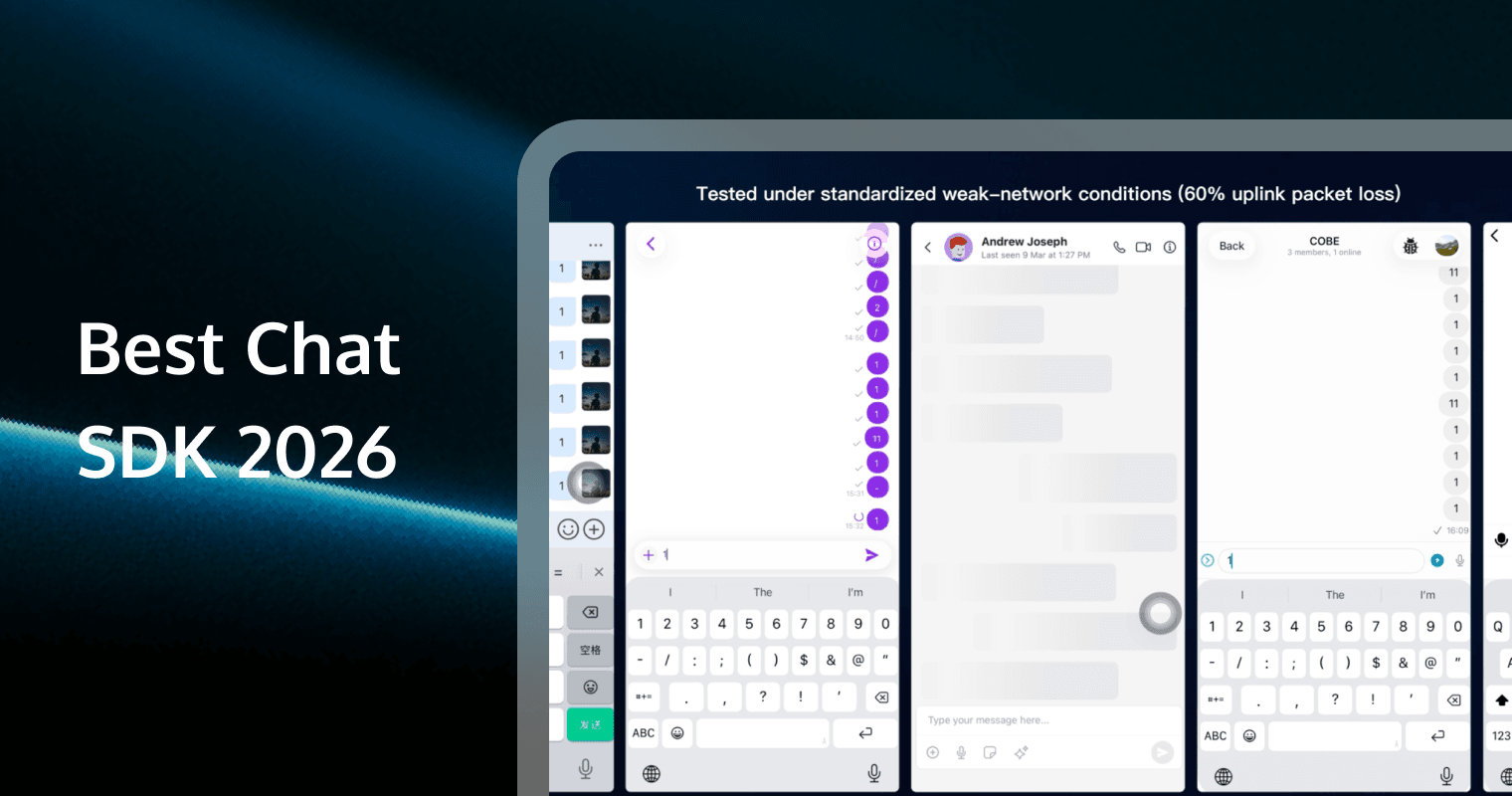
Watch: all five SDKs running simultaneously under 60% upstream packet loss
One screen. Five chat apps. Identical hardware, identical WiFi, identical 60% upstream loss forced at the router. One user taps “send” — you see which SDKs deliver, which stall, and which drop messages entirely.
What you’re looking at
● The First One: Tencent RTC Chat — messages keep flowing. No visible lag. This is the one to watch as your baseline.
● Other: the other four SDKs. Expect the pattern you see on-screen: visible stalling, out-of-order delivery, or dropped messages under the same network condition.
And to be clear: the 60% loss you see in the video is the conservative version. In Tencent RTC Chat’s own published weak-network benchmarks, the system maintains 100% reliable message delivery under 70% packet loss — thanks to a transport layer we’ll explain next.
The technology behind the resilience: AXP-QUIC
The four other vendors in this comparison all transport messages over TCP, plain QUIC, or WebSocket-over-TCP. Each of those protocols hits a wall under real-world packet loss:
● TCP: a 1% loss rate at 250ms RTT drops throughput by 90%. Past 15% loss, TCP effectively stops carrying payload.
● Plain QUIC: removes head-of-line blocking and enables 0-RTT reconnection, but still runs over a single network path. If the only path (say, WiFi) is lossy, QUIC is lossy.
● Application-layer retries on top of TCP: papers over the symptom, not the cause.
Tencent RTC Chat runs on AXP-QUIC (Adaptive X-PATH QUIC) — an in-house weak-network transport the team published publicly. Three things make it different:
1. Multi-path transport. The SDK can send messages over WiFi and cellular simultaneously, combining the paths for higher effective throughput, or failing over in milliseconds if one path degrades. Four modes are supported: None, Handover (failover only), Interactive (opportunistic use of second path), and Aggregate (use both for bandwidth). No other major chat SDK implements this.
2. Client-side weak-network self-assessment. The SDK continuously samples RTT, loss rate, throughput, and runs active probes. When the model detects that a link is degraded before the OS decides to switch networks — a common case where WiFi signal bars still show “connected” but the link is actually lossy — AXP-QUIC initiates connection migration proactively. End users never see the hang.
3. QUIC’s native benefits, tuned for mobile. 0-RTT reconnection (vs TCP+TLS’s 3-RTT handshake), stream-level multiplexing without head-of-line blocking, connection migration via 64-bit Connection IDs (network changes don’t kill the session), and a congestion-control stack that incorporates FACK, TLP, F-RTO, Early Retransmit, and Pacing.
This is the reason the video looks the way it looks. The other four SDKs are running on transports fundamentally built for good networks, with retries layered on top. Tencent RTC Chat is running on a transport designed from the ground up for the networks your users actually have.
Why this matters for your business
If 5% of your DAU is on a flaky network at any time (conservative estimate for a global consumer app), and your SDK drops 40% of their messages during those moments, you’re silently losing about 2% of total message volume to infrastructure choice. That compounds into reduced session length, fewer replies, and higher churn. Your product analytics will show it as “users just stopped chatting” — when the real cause is that their last three messages never arrived.
The video is not a benchmark. It’s a one-screen answer to “does this SDK survive my users’ actual networks?”
Pricing at Three Real Workloads
“Cheaper” is only meaningful against a workload. Here are the three that matter.
1,000 MAU side project
Vendor | Monthly | Annualized | Notes |
Tencent RTC Chat | $0 | $0 | Permanent free; Push bundled; unlimited concurrent |
GetStream | $0 | $0 | 1,000 MAU included; 100 concurrent cap; Push DIY |
CometChat | $49 | $588 | Basic required; Free caps at 100 MAU |
Agora Chat | $349 | $4,188 | Starter required; Free caps at 500 MAU |
Sendbird | $349 | $4,188 | Starter 5K required; permanent Free caps at 100 MAU |
Call this out: Two vendors offer a usable free tier at 1,000 MAU. Only Tencent RTC Chat bundles Push and removes the concurrent cap.
10,000 MAU mid-stage SaaS
Vendor | Monthly | Annualized | Push bundled? |
CometChat Growth | $199 | $2,388 | Yes |
Tencent RTC Chat Standard | $399 | $4,788 | Yes |
GetStream Start | $399 | $4,788 | No (DIY FCM) |
Sendbird Starter 10K | $499 | $5,988 | Yes |
Agora Chat Pro | $699 | $8,388 | No |
Sendbird Pro 10K | $749 | $8,988 | Yes |
Honest read: The arguments Tencent RTC Chat wins on at this tier are:
● Concurrent connections (unlimited vs CometChat’s 5% = 500, Sendbird’s 5% = 500)
● Overage rate if you spike ($0.05/MAU vs CometChat’s $0.10)
● Infrastructure provenance and AXP-QUIC transport (covered above)
100,000+ MAU production
Every vendor quotes custom at this tier. Published list prices don’t apply. What you can compare:
● Overage rate: Tencent RTC Chat $0.05/MAU and Agora $0.05/MAU are the lowest published rates in the market. GetStream $0.07–$0.09, CometChat $0.10.
● Concurrent pricing: GetStream charges $0.79–$0.99 per concurrent connection overage. Tencent RTC Chat has no concurrent cap to overage past.
● SLA: Tencent RTC Chat and GetStream both publish explicit uptime SLAs at enterprise tiers (99.99% and 99.999% respectively).
Three defensible pricing claims
After running the numbers, here are the three statements that hold up to any reader opening the vendor pricing page:
1. At the free tier, Tencent RTC Chat is the only vendor bundling permanent free MAU + free Push + unlimited concurrent. Every other vendor drops at least one of the three.
2. At 10K MAU, Tencent RTC Chat’s $399 list price ties with GetStream — and Tencent RTC Chat is the only one at this price point bundling Push.
3. At scale, Tencent RTC Chat’s $0.05/MAU overage rate is tied with Agora for lowest in market — 40% to 100% below GetStream and CometChat.
Free Tier Deep Dive
Five vendors all advertise “free” but the meaning is wildly different. Overage policy, in particular, decides whether “free” is actually usable for a real product.
Overage policy — developer-friendliest to strictest
Rank | Vendor | What happens when you exceed free MAU |
1 | GetStream | No block. Auto post-pay billing kicks in. |
2 | Tencent RTC Chat | New logins blocked; existing users continue; create new app to keep testing. |
3 | Agora Chat | All chat blocked (error code 8) until next month or upgrade. |
4 | CometChat | New users blocked; deactivated users still count; max 2 apps. |
5 | Sendbird | Full account suspension + console lock until you pay. |
Concurrent connection ranking
Rank | Vendor | Concurrent cap (free) |
1 | Tencent RTC Chat | Unlimited |
2 | GetStream | 100 |
3 | Agora Chat | 50 |
4 | CometChat | 25 |
5 | Sendbird | 10 |
For real-time use cases like live support, AI companion apps, or game chat, the concurrent cap matters more than MAU. A 1,000-MAU app with 10% peak concurrency needs 100+ simultaneous connections — which puts four of five vendors at their ceiling.
Feature Coverage — Where Vendors Actually Differ
Standard IM features — 1:1 chat, group chat, multi-device sync, message recall, read receipts, @-mentions, offline storage, custom message types, pre-built UI kits — all five vendors ship these natively. They’re not differentiators in 2026.
The differences live where some vendors charge extra, some gate behind higher tiers, and one vendor bundles it free. Below is the filtered matrix — only rows where the answer isn’t the same across the board.
Legend: ✅ native, ⚠️ partial / paid add-on, ❌ not available.
Feature | Tencent RTC Chat | GetStream | Agora | Sendbird | CometChat |
Chat rooms / live streaming chat | ✅ | ⚠️ (paid) | ✅ | ⚠️ (paid) | ⚠️ (paid) |
Push plugin bundled free | ✅ | ❌ | ❌ | ⚠️ (paid tiers only) | ⚠️ (paid tiers only) |
What Tencent RTC Chat keeps on the free plan (Push, unlimited concurrent, 100% feature access), others gate behind $499+/mo tiers.
Push Notifications: Who Bundles, Who Doesn’t
Every consumer chat app needs push. Most SDK comparisons skip push because it’s a separate integration. That skip is exactly where the price comparison breaks.
Vendor | Push at free | Push at paid | Vendors supported |
Tencent RTC Chat | ✅ bundled | ✅ bundled | APNs, FCM, Huawei, Xiaomi, OPPO, vivo |
GetStream | ❌ DIY | ❌ DIY (you configure FCM/APNs) | N/A |
Agora Chat | ❌ | ❌ | N/A |
Sendbird | ❌ (free tier) | ✅ bundled | APNs, FCM |
CometChat | ❌ (Build tier) | ✅ bundled (Basic+) | APNs, FCM |
The DIY route on GetStream or Agora means:
● Configure FCM Server Key, APNs certificates, Huawei/Xiaomi/OPPO/vivo accounts
● Build device-token registration flow
● Build token refresh handling
● Build push payload routing
● Estimated engineering cost: 2-3 weeks for a clean implementation, ongoing maintenance thereafter
The bundled route on Tencent RTC Chat:
● Enable Push plugin in console
● Register device token via one SDK call
● Receive push on message receipt via built-in triggers
Engineering hours saved > price-per-MAU savings. This is usually the argument that flips a comparison.
FAQ
Q: Which chat SDK has the largest permanent free tier in 2026?
A: Tencent RTC Chat and GetStream are tied at 1,000 MAU permanent. Both are genuinely free forever with no time limit. The differentiator: Tencent RTC Chat bundles Push notifications and has no concurrent connection cap; GetStream caps at 100 concurrent and requires you to build Push separately. Sendbird’s widely advertised “1,000 MAU free” is a 30-day Pro Trial; its permanent free plan is 100 MAU with 10 concurrent.
Q: Is Tencent RTC Chat the same as WeChat?
A: No. Tencent RTC Chat is Tencent Cloud’s commercial IM/Chat SDK offering, built on the same backend infrastructure that powers WeChat and QQ. You’re renting the infrastructure capability — 550 billion messages per day, 1 billion MAU scale — not the consumer product. The SDK is fully independent, vendor-neutral, and can be integrated into any app.
Q: Can Tencent RTC Chat handle poor network conditions better than competitors?
A: Yes — and we don’t ask you to take our word for it. This article embeds a side-by-side video of all five SDKs running under 60% upstream packet loss on identical hardware. Tencent RTC Chat keeps messages flowing while the other four visibly stall, reorder, or drop messages. The resilience comes from the AXP-QUIC transport layer — multi-path, with proactive weak-network detection — plus consumer-scale backend provenance. Watch the video and judge for yourself.
Q: How does Tencent RTC Chat Chat pricing compare to GetStream and Sendbird at 10,000 MAU?
A: At 10,000 MAU, Tencent RTC Chat’s Standard plan lists at $399/month, matching GetStream’s Start plan at the same price. Sendbird’s Starter 10K plan is $499/month (annual) and Pro 10K is $749/month. Tencent RTC Chat is the only vendor at the $399 tier that bundles Push notifications — GetStream requires you to configure FCM/APNs separately.
Q: What happens when you exceed the free tier on each vendor?
A: Policies differ dramatically:
● GetStream: no block; automatic post-pay billing starts.
● Tencent RTC Chat: new logins blocked; existing users continue; create new app to keep testing.
● Agora: all chat blocked with error code 8 until next month or upgrade.
● CometChat: new users blocked; max 2 apps per account.
● Sendbird: full account suspension and console lock until payment is made.
Q: Does any chat SDK bundle push notifications for free?
A: Only Tencent RTC Chat bundles Push notifications on the free tier. The Push plugin supports APNs, FCM, Huawei, Xiaomi, OPPO, and vivo out-of-the-box. GetStream, Agora, and CometChat require separate FCM/APNs integration (roughly 2–3 weeks of engineering work). Sendbird and CometChat include Push on paid tiers but not on their free plans.
Q: Which SDK is best for an AI chatbot app in 2026?
A: For AI chatbot use cases — LLM conversation + persistent history + re-engagement push — Tencent RTC Chat is the most complete bundle. Chat SDK handles message history and multi-device sync; the free Push plugin handles re-engagement after inactivity.
Q: What is AXP-QUIC and why does it matter for chat?
A: AXP-QUIC (Adaptive X-PATH QUIC) is Tencent RTC Chat’s custom transport layer for real-time messaging. It combines three techniques that plain QUIC and TCP don’t: (1) simultaneous multi-path transport over WiFi and cellular, (2) client-side weak-network self-assessment that triggers connection migration before the OS notices a degraded link, and (3) QUIC’s native 0-RTT reconnection and stream-level multiplexing. Tencent RTC Chat has published weak-network benchmarks showing 100% reliable message delivery at 70% upstream packet loss — a regime where TCP-based SDKs have already collapsed (TCP throughput drops 90% at just 1% loss over 250ms RTT). None of the other major chat SDKs implement multi-path transport.
Q: Can Tencent RTC Chat Chat keep messages flowing when the network switches between WiFi and 4G/5G?
A: Yes — this is a core design goal of AXP-QUIC. QUIC’s 64-bit Connection ID is independent of the socket 4-tuple, so changing networks doesn’t kill the session. AXP-QUIC adds a layer on top: it actively probes link quality on both WiFi and cellular and can transport data over both simultaneously (Aggregate mode), use the second only when the primary degrades (Handover mode), or opportunistically (Interactive mode). In practice, users walking out of WiFi range or switching between floors in a building see no message interruption.
Q: Can I migrate from Sendbird or CometChat to Tencent RTC Chat?
A: Yes. The data models map cleanly (users, channels/conversations, messages, attachments). Tencent RTC Chat provides 1-on-1 migration support for teams moving from other providers. Typical timeline for a migration of under 10K MAU: 1–2 weeks including data transfer and SDK swap.