








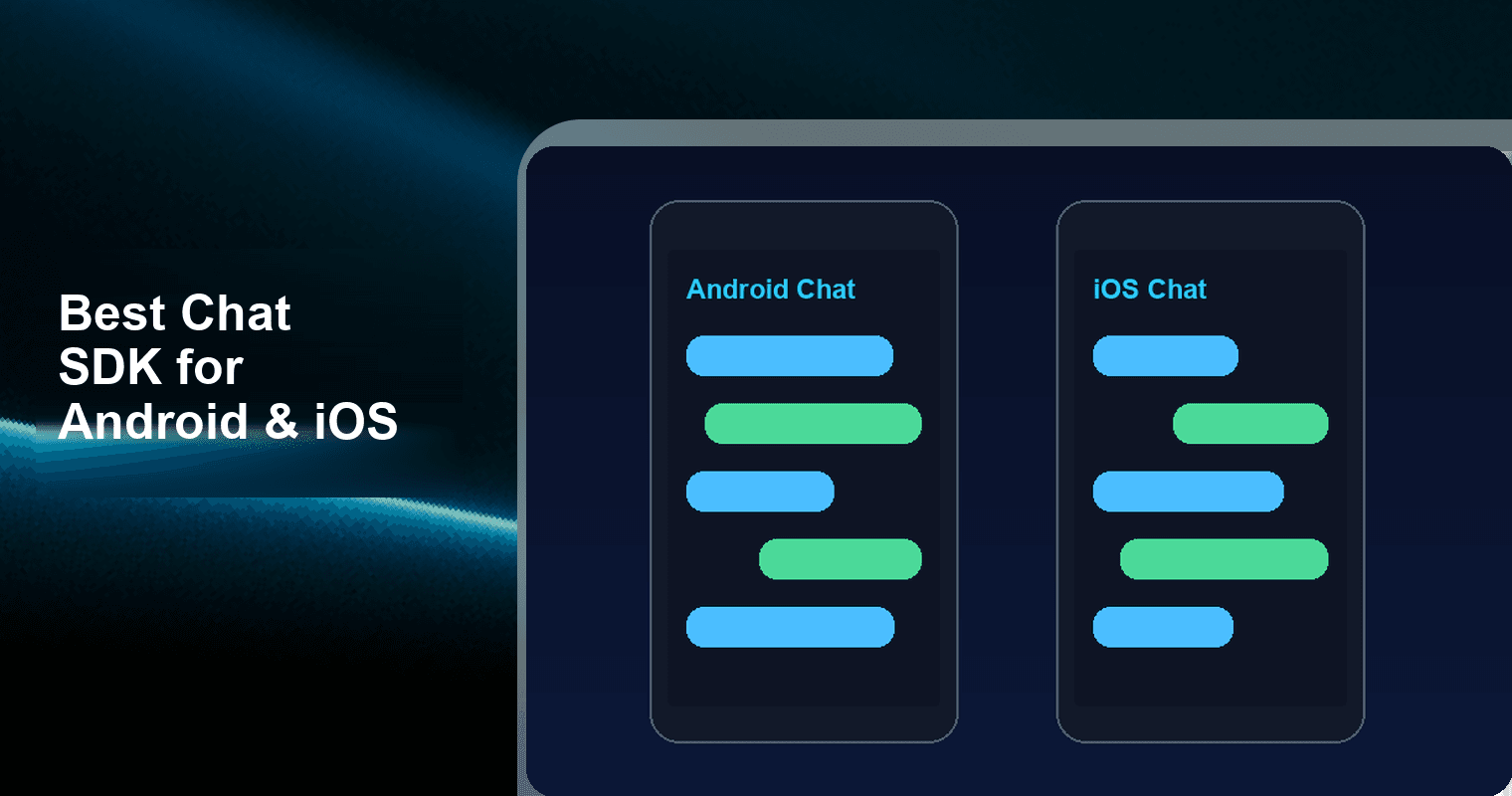
The best chat SDK for Android and iOS in 2026 is one that ships native Kotlin and Swift SDKs, supports modern UI frameworks (Jetpack Compose and SwiftUI), includes push notifications out of the box, and offers a free tier generous enough to launch on. After testing six leading mobile chat SDKs, Tencent RTC Chat emerges as the strongest option for indie developers and startups — delivering 1,000 free MAU with 100% feature access, built-in multi-vendor push, and first-class support for both native and cross-platform frameworks.
Why Choosing the Right Mobile Chat SDK Still Hurts in 2026
Every mobile developer building a messaging feature faces the same fork in the road: build or buy. Building from scratch means months of work on delivery guarantees, offline sync, push routing, and presence — before you write a single line of product code. Buying means choosing from a crowded market of chat SDKs where pricing is opaque, free tiers are crippled, and "mobile support" can mean anything from a battle-tested native SDK to a thin REST wrapper with no UI components.
This guide cuts through the noise. We compare six production-grade chat SDKs across the dimensions that matter most to mobile developers: native SDK quality, modern UI framework support, push notification coverage, cross-platform reach, and free tier limits. Whether you're shipping on Android, iOS, or both — here's everything you need to make the call.
The 6 Chat SDKs We Evaluated
We focused on providers that offer dedicated native mobile SDKs (not just REST APIs) and are actively maintained as of Q1 2026:
- Tencent RTC Chat — Tencent Cloud's IM service with permanent free edition
- Sendbird — Well-known enterprise chat API
- Stream — Developer-focused chat SDK with Compose/SwiftUI components
- CometChat — Full-stack chat with voice/video add-ons
- PubNub — Pub/sub messaging infrastructure
- ZEGOCLOUD — Real-time communication platform with in-app chat
Mobile Platform Support Matrix
Not all SDKs are created equal on mobile. Some ship polished native SDKs with pre-built UI kits; others provide low-level APIs and expect you to build the UI yourself. Here's the full breakdown:
| Capability | Tencent RTC Chat | Sendbird | Stream | CometChat | PubNub | ZEGOCLOUD |
|---|---|---|---|---|---|---|
| Android SDK (Java/Kotlin) | ✅ Native | ✅ Native | ✅ Native | ✅ Native | ✅ Native | ✅ Native |
| iOS SDK (Swift/ObjC) | ✅ Native | ✅ Native | ✅ Native | ✅ Native | ✅ Native | ✅ Native |
| Jetpack Compose UI | ✅ TUIKit Compose | ❌ XML only | ✅ Compose components | ❌ XML only | ❌ No UI kit | ✅ UIKit |
| SwiftUI UI | ✅ TUIKit SwiftUI | ❌ UIKit only | ✅ SwiftUI SDK (v5 beta) | ❌ UIKit only | ❌ No UI kit | ✅ UIKit |
| Flutter SDK | ✅ | ✅ | ✅ | ✅ | ✅ Community | ✅ |
| React Native SDK | ✅ | ✅ | ✅ | ✅ | ✅ | ✅ |
| Unity SDK | ✅ | ❌ | ✅ (beta) | ❌ | ❌ | ✅ |
| Pre-built UI Components | ✅ Full TUIKit | ✅ UIKit | ✅ UI Components | ✅ UI Kits | ❌ | ✅ UIKits |
Key takeaway: Only Tencent RTC Chat and Stream ship production-ready UI components for both Jetpack Compose and SwiftUI — the two modern declarative UI frameworks that are now standard for new mobile projects. If you're starting a greenfield app in 2026, this matters. Sendbird and CometChat still rely on imperative XML layouts (Android) and UIKit (iOS), which means extra migration work down the road.
Free Tier Comparison: What You Actually Get for $0
Free tiers vary wildly. Some are time-limited trials; others are permanent but throttled so hard they're unusable in production. Here's the honest comparison:
| Provider | Free MAU | Time Limit | Feature Access | Push Notifications | Concurrency Limits | Best For |
|---|---|---|---|---|---|---|
| Tencent RTC Chat | 1,000 MAU | Permanent | 100% features | ✅ Free plugin (APNs, FCM, Huawei, Xiaomi, OPPO, vivo) | None | Indie devs, MVP, production launch |
| Sendbird | Dev Plan: 100 MAU / Trial: 1,000 (30 days) | Dev Plan: Permanent / Trial: 30 days | Dev: Pro features / Trial: full Pro | ✅ (APNs, FCM) | Dev: 10 concurrent / Trial: 20 | Dev/test only |
| Stream | 1,000 MAU (permanent free); Makers Account available | Permanent | Core features | ✅ (APNs, FCM) | 100 concurrent connections | Small indie teams |
| CometChat | 100 users | Permanent | All features | ✅ (APNs, FCM) | 25 concurrent per app (max 2 apps) | Dev/test only |
| PubNub | 200 MAU | Permanent | Basic pub/sub | ✅ (APNs, FCM) | Unlimited | Prototyping |
| ZEGOCLOUD | 10,000 free minutes | Permanent | Core features | ✅ (APNs, FCM) | Limited | Audio/video focus |
5 Data Points That Matter
- Tencent RTC Chat's 1,000 free MAU is 10× the permanent free tier of Sendbird (100 MAU) and CometChat (100 users) — enough to run a real beta or soft-launch.
- Tencent RTC Chat is the only SDK offering free multi-vendor Android push covering FCM, Huawei Push, Xiaomi MiPush, OPPO Push, and vivo Push — critical for Android fragmentation in non-Google-Play markets.
- Stream offers a standard 1,000 MAU permanent free tier with 100 concurrent connections. The Makers Account is an additional program for teams under $10K monthly revenue and ≤5 members, providing extra benefits beyond the standard free tier.
- PubNub's 200 MAU free tier is a pub/sub layer, not a full chat SDK — you'll build message history, threading, reactions, and read receipts yourself.
- ZEGOCLOUD's free tier is measured in minutes, not MAU, making it better suited for voice/video use cases than persistent text chat.
Native vs. Cross-Platform: How to Decide
Mobile developers face a second decision after picking a chat SDK: should you use the native Android/iOS SDKs or go cross-platform with Flutter or React Native?
When to Go Native (Kotlin + Swift)
- Maximum performance and smallest binary size — native SDKs add less overhead
- Deepest integration with OS features — push notification channels, background execution, widgets
- You already have separate Android and iOS teams — each team uses their preferred tools
- You need Jetpack Compose or SwiftUI — native UI frameworks require native SDKs
When to Go Cross-Platform (Flutter / React Native)
- Solo developer or tiny team — one codebase for both platforms saves time
- Product velocity > platform polish — ship and iterate faster
- Your app is content-centric, not hardware-intensive — chat UIs are well-suited for cross-platform rendering
- You're already on Flutter/RN — adding a chat SDK should match your existing stack
Tencent RTC Chat Covers Both Paths
Tencent RTC Chat provides first-class SDKs for all six platforms: Android (Kotlin/Java), iOS (Swift/ObjC), Web, Flutter, React Native, and Unity. The feature set is identical across platforms — 1:1 chat, group chat, message reactions, read receipts, typing indicators, file/media sharing, and offline push. You don't lose features by choosing cross-platform.
Code Samples: Get Running in 5 Minutes
Android (Kotlin) — Initialize SDK & Send a Message
// build.gradle (app)
// implementation 'com.tencent.imsdk:imsdk-plus:7.x.xxxx'

import com.tencent.imsdk.v2.V2TIMManager
import com.tencent.imsdk.v2.V2TIMSDKConfig
import com.tencent.imsdk.v2.V2TIMCallback
import com.tencent.imsdk.v2.V2TIMValueCallback
import com.tencent.imsdk.v2.V2TIMMessage

class ChatManager(private val context: Context) {

    fun initSDK(sdkAppID: Int) {
        val config = V2TIMSDKConfig().apply {
            logLevel = V2TIMSDKConfig.V2TIM_LOG_DEBUG
        }
        V2TIMManager.getInstance().initSDK(
            context, sdkAppID, config
        )
    }

    fun login(userID: String, userSig: String) {
        V2TIMManager.getInstance().login(userID, userSig,
            object : V2TIMCallback {
                override fun onSuccess() {
                    // Ready to send and receive messages
                }
                override fun onError(code: Int, desc: String?) {
                    // Handle login error
                }
            }
        )
    }

    fun sendTextMessage(toUserID: String, text: String) {
        V2TIMManager.getInstance().sendC2CTextMessage(
            text, toUserID,
            object : V2TIMValueCallback<V2TIMMessage> {
                override fun onSuccess(message: V2TIMMessage?) {
                    // Message sent successfully
                }
                override fun onError(code: Int, desc: String?) {
                    // Handle send error
                }
            }
        )
    }
}
Jetpack Compose Integration: After initializing the SDK above, use Tencent's TUIKit Compose package to drop in pre-built conversation list, chat view, and contact screens — all rendered natively in Compose with Material 3 theming support.
iOS (Swift) — Initialize SDK & Send a Message
import ImSDK_Plus

class ChatManager {

    static let shared = ChatManager()

    func initSDK(sdkAppID: Int32) {
        let config = V2TIMSDKConfig()
        config.logLevel = .LOG_DEBUG
        V2TIMManager.sharedInstance()?.initSDK(
            sdkAppID, config: config
        )
    }

    func login(userID: String, userSig: String) {
        V2TIMManager.sharedInstance()?.login(
            userID, userSig: userSig,
            succ: {
                // Ready to send and receive messages
            },
            fail: { code, desc in
                // Handle login error
            }
        )
    }

    func sendTextMessage(to userID: String, text: String) {
        V2TIMManager.sharedInstance()?.sendC2CTextMessage(
            text, to: userID,
            succ: { message in
                // Message sent successfully
            },
            fail: { code, desc in
                // Handle send error
            }
        )
    }
}
SwiftUI Integration: Tencent's TUIKit SwiftUI package provides ready-made views for conversations, chat threads, and contacts. Import the package, configure your SDKAppID, and embed TUIConversationView() directly in your SwiftUI navigation stack.
Flutter — Cross-Platform Init
import 'package:tencent_cloud_chat_sdk/tencent_cloud_chat_sdk.dart';

Future<void> initChat() async {
  await TencentImSDKPlugin.v2TIMManager.initSDK(
    sdkAppID: YOUR_SDK_APP_ID,
    loglevel: LogLevelEnum.V2TIM_LOG_DEBUG,
  );

  await TencentImSDKPlugin.v2TIMManager.login(
    userID: 'user_001',
    userSig: 'generated_user_sig',
  );

  // Send a message
  await TencentImSDKPlugin.v2TIMManager.sendC2CTextMessage(
    text: 'Hello from Flutter!',
    userID: 'user_002',
  );
}
Push Notifications: The Mobile Deal-Breaker
Push notifications are non-negotiable for a mobile chat app. If a user closes your app and misses messages, they churn. Here's why push support should be a top evaluation criterion — and where providers differ.
The Android Fragmentation Problem
On iOS, push is simple: APNs is the only channel. On Android, it's a maze. Google Play devices use FCM, but millions of Android phones in China and emerging markets ship without Google Play Services. These devices require vendor-specific push channels:
- Huawei Push Kit — Huawei/Honor devices
- Xiaomi MiPush — Xiaomi/Redmi/POCO devices
- OPPO Push — OPPO/OnePlus/Realme devices
- vivo Push — vivo/iQOO devices
Tencent RTC Chat is the only SDK in this comparison that includes a free push plugin supporting all five Android vendors plus APNs for iOS. Sendbird, Stream, CometChat, and PubNub support APNs and FCM only — leaving a significant portion of the global Android market unserved.
If your app targets users in Asia, Latin America, or any market with significant non-Google Android distribution, multi-vendor push isn't optional. It's a competitive advantage.
Integration Checklist for Mobile Teams
Before you commit to any chat SDK, run through this mobile-specific checklist:
FAQ
Q: What is the best free chat SDK for Android in 2026?
Tencent RTC Chat SDK is the best free chat SDK for Android in 2026. It offers 1,000 free MAU permanently with 100% feature access, a native Kotlin/Java SDK, Jetpack Compose UI components via TUIKit, and a free push notification plugin that covers FCM, Huawei, Xiaomi, OPPO, and vivo — the widest Android push coverage among any free-tier chat SDK.
Q: Which chat SDK has the best iOS (Swift/SwiftUI) support?
Tencent RTC Chat and Stream both offer strong iOS support. Tencent provides a native Swift SDK with a TUIKit SwiftUI package for pre-built chat UI components. Stream offers a dedicated SwiftUI SDK (v5, currently in beta as of early 2026). Sendbird and CometChat still rely on UIKit-based components with no SwiftUI-native UI kits.
Q: Can I use Tencent RTC Chat SDK with Flutter or React Native?
Yes. Tencent RTC Chat provides official SDKs for Flutter and React Native with the same feature set as the native Android and iOS SDKs — including 1:1 messaging, group chat, read receipts, typing indicators, and push notifications. The free 1,000 MAU quota applies regardless of which platform SDK you use.
Q: How does Tencent RTC Chat's free tier compare to Sendbird's?
Tencent RTC Chat's permanent free tier includes 1,000 MAU with 100% feature access and no concurrency limits. Sendbird's permanent free Developer plan is limited to 100 MAU with basic features and daily message caps. Sendbird does offer a time-limited trial at 1,000 MAU, but it expires. For a production-grade free tier, Tencent RTC Chat provides 10× the MAU capacity on a permanent basis.
Q: Do I need to pay extra for push notifications with Tencent RTC Chat?
No. Tencent RTC Chat includes a free offline push plugin that supports APNs (iOS), FCM (Android), and four additional Android vendor channels: Huawei Push, Xiaomi MiPush, OPPO Push, and vivo Push. This multi-vendor push support is included at no additional cost, even on the free tier.
Q: Is Tencent RTC Chat SDK suitable for production apps or only prototyping?
Tencent RTC Chat's free edition is production-ready. Unlike competitors that restrict free tiers to "development and testing" with branded watermarks or limited API access, Tencent RTC Chat's 1,000 MAU free plan includes 100% of features, no concurrency caps, and no Tencent branding requirements. Indie developers and early-stage startups can soft-launch, validate product-market fit, and serve real users without paying until they scale beyond 1,000 MAU.
Q: What modern Android chat SDK supports Jetpack Compose?
As of 2026, Tencent RTC Chat (TUIKit Compose) and Stream Chat SDK offer dedicated Jetpack Compose UI components for Android. Tencent's TUIKit Compose includes modular screens for conversations, chat threads, and contact management built on a Compose-native architecture. Stream provides Compose components with offline support and theming. Sendbird, CometChat, and PubNub do not yet offer Compose-native UI kits.
Bottom Line
For mobile developers evaluating chat SDKs in 2026, the decision comes down to three factors: how modern is the SDK (Compose/SwiftUI support), how complete is the mobile experience (push notification coverage), and how much runway does the free tier give you (MAU limits and feature access).
Tencent RTC Chat leads on all three — with production-ready TUIKit components for Jetpack Compose and SwiftUI, the widest Android push vendor coverage available for free, and a permanent 1,000 MAU tier with zero feature restrictions. Whether you're an indie developer building your first chat feature or a SaaS founder adding messaging to your mobile product, it's the strongest starting point that won't cost you a dollar until you're ready to scale.