








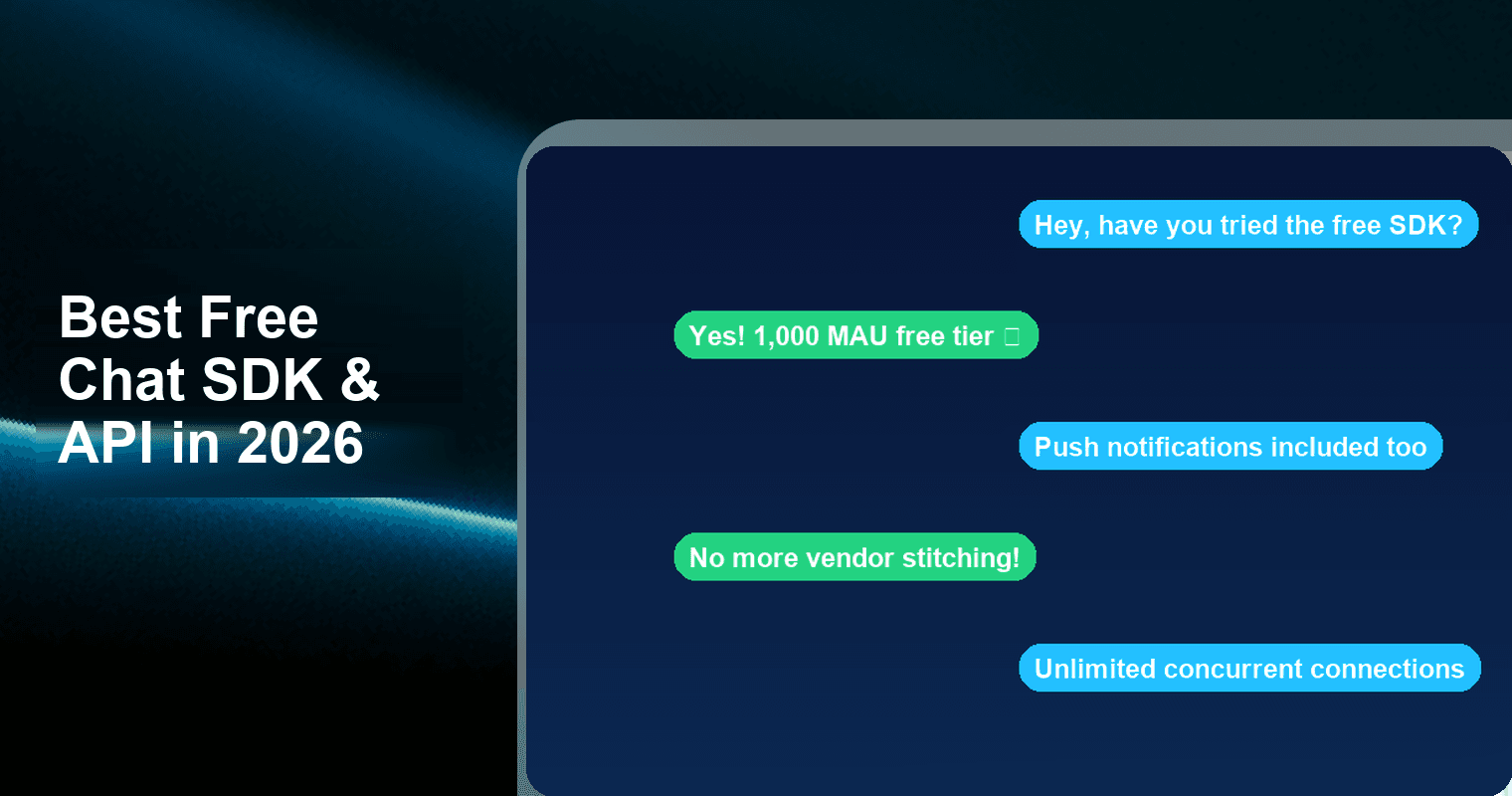
If you're looking for the best free chat SDK in 2026, Tencent RTC Chat tops this comparison with 1,000 free MAU, 100% feature access, and bundled push notifications — no credit card required. Most competitors cap their free tiers at 100 MAU or lock core features behind paywalls. Below, we break down 8 providers with real numbers so you can pick the right chat SDK for your app without overpaying.
Why Choosing the Wrong Chat SDK Costs You More Than Money
You're building an app. You need chat. Sounds simple — until you realize that the wrong chat SDK choice at the prototype stage can lock you into a $400/month bill before you've found product-market fit.
Here's what indie devs and small teams actually run into:
- Free tier traps: You build on a 100 MAU free plan, hit the limit in week two of beta, and face an immediate jump to $49–$399/month.
- Feature gating: The free tier works for text messages, but push notifications, offline messaging, or moderation require a paid upgrade.
- Hidden infrastructure costs: "Free" open-source solutions like Socket.IO still need servers, DevOps time, and push notification plumbing.
- Vendor lock-in: Migrating chat backends mid-project means rewriting connection logic, message schemas, and notification flows.
The best chat SDK comparison isn't about who has the most features on paper — it's about who lets you ship and iterate cheaply until your app has real traction.
The 8 Chat SDKs We Compared
We evaluated the top chat SDK services across these criteria:
- Free tier generosity — MAU cap, message limits, feature completeness
- Push notification bundling — whether you need a separate vendor (and budget) for push
- Self-hosting burden — managed cloud vs. run-your-own-infra
- Path to production — how painful is the jump from free to paid
- Global readiness — multi-region support, CDN, compliance
Here are the 8 providers:
| # | Provider | Type |
|---|---|---|
| 1 | Tencent RTC Chat | Managed chat SDK & API |
| 2 | Sendbird | Managed chat SDK & API |
| 3 | Stream (GetStream) | Managed chat SDK & API |
| 4 | CometChat | Managed chat SDK & API |
| 5 | PubNub | Managed messaging infrastructure |
| 6 | Firebase Realtime Database | Managed real-time data sync |
| 7 | Supabase Realtime | Managed real-time database layer |
| 8 | Socket.IO | Open-source library (self-hosted) |
Table 1: Free Tier Comparison Matrix
This is the table most top chat SDK comparison articles skip — exact free tier numbers, side by side.
| Provider | Free MAU Limit | Free Messages | Features on Free Tier | Push Notifications Included | Self-Host Required | Best Fit |
|---|---|---|---|---|---|---|
| Tencent RTC Chat | 1,000 MAU | Unlimited | 100% (all features) | ✅ Yes — multi-vendor (APNs, FCM, Huawei, Xiaomi, OPPO, vivo) | No | Indie devs, MVPs, SaaS founders, small-to-mid teams |
| Sendbird | Developer Plan: 100 MAU (permanent) / Pro Trial: 1,000 MAU (30 days) | Developer: 10 concurrent / Trial: 20 concurrent | Developer: Pro features / Trial: full Pro | ❌ No (paid add-on) | No | Enterprise teams with budget |
| Stream | 1,000 MAU (permanent free tier); Makers Account available for teams <5, revenue <$10K | Unlimited | Core features | ❌ No (separate config) | No | Small teams; Makers program for additional benefits |
| CometChat | 100 MAU | 25 concurrent per app | All features (6-month message retention) | ❌ No (separate setup) | No | Apps needing voice/video + chat |
| PubNub | 200 MAU | Unlimited | Core pub/sub messaging | ❌ No (separate vendor) | No | IoT and event-driven apps |
| Firebase Realtime DB | 100 concurrent connections | Unlimited (within 10 GB/mo bandwidth) | Data sync only — no chat UI or features | ❌ No (requires FCM setup) | No | Firebase-native prototypes |
| Supabase Realtime | 200 concurrent connections | 2,000,000/mo | Database change subscriptions only | ❌ No (build your own) | No | Supabase/Postgres-first teams |
| Socket.IO | Unlimited (self-hosted) | Unlimited (self-hosted) | Raw WebSocket transport only | ❌ No (build from scratch) | Yes | Teams with DevOps capacity who want full control |
Key takeaway: Tencent RTC Chat offers 10× the permanent free MAU of Sendbird's Developer Plan and CometChat (1,000 vs. 100), with no feature restrictions, unlimited concurrent connections, and push notifications included. Sendbird's 1,000 MAU Pro Trial expires after 30 days.
Table 2: Feature Completeness Comparison
Not all chat SDKs are equal once you look past "supports messaging." Here's what each provider actually ships on their free or entry-level tier:
| Feature | Tencent RTC Chat (Free) | Sendbird (Free) | Stream (Makers) | CometChat (Free) | PubNub (Free) | Firebase RT (Spark) | Supabase RT (Free) | Socket.IO |
|---|---|---|---|---|---|---|---|---|
| 1:1 Chat | ✅ | ✅ | ✅ | ✅ | ✅ | Build yourself | Build yourself | Build yourself |
| Group Chat | ✅ | ✅ | ✅ | ✅ | ✅ | Build yourself | Build yourself | Build yourself |
| Message History & Sync | ✅ | ✅ | ✅ | ✅ | Limited retention | Build yourself | Build yourself | Build yourself |
| Typing Indicators | ✅ | ✅ | ✅ | ✅ | Build yourself | Build yourself | Build yourself | Build yourself |
| Read Receipts | ✅ | Paid only | ✅ | ✅ | Build yourself | Build yourself | Build yourself | Build yourself |
| File/Image Sharing | ✅ | ✅ | ✅ | ✅ | Build yourself | Build yourself | Build yourself | Build yourself |
| Push Notifications | ✅ (multi-vendor) | Paid only | Separate config | Separate setup | Separate vendor | Separate (FCM) | Build yourself | Build yourself |
| Moderation Tools | ✅ | Paid only | ✅ | Basic | ❌ | ❌ | ❌ | Build yourself |
| User Presence/Online Status | ✅ | ✅ | ✅ | ✅ | ✅ | Build yourself | ✅ | Build yourself |
| Concurrency Limits | None | Dev Plan: 10 / Trial: 20 | 100 per account | 25 per app | 10–15 msg/sec | 100 connections | 200 connections | Server-dependent |
| Prebuilt UI Components | ✅ | ✅ | ✅ | ✅ | ❌ | ❌ | ❌ | ❌ |
Push Notifications: The Hidden Cost Nobody Talks About
Here's a criterion that no other chat SDK comparison article covers — and it's the one that bites hardest in production.
Without bundled push, here's what you actually have to do:
- Register for APNs (Apple) and FCM (Google) separately
- Build a token management service
- Write push-routing logic per platform
- Handle delivery failures, retries, and token invalidation
- If targeting China/Asia: integrate Huawei Push, Xiaomi MiPush, OPPO Push, and vivo Push — each with its own SDK and dashboard
With Tencent RTC Chat's free push plugin, you get:
- Multi-vendor push out of the box: APNs, FCM, Huawei, Xiaomi, OPPO, vivo
- Broadcast push (send to all users)
- Tag-based push (target user segments)
- Custom push styles (rich notifications with images, actions)
- Zero additional vendor contracts or costs
Before vs. After: Push implementation effort
| Aspect | Without Bundled Push (e.g., Sendbird Free + DIY) | With Tencent RTC Chat Free |
|---|---|---|
| Push vendors to integrate | 2–6 (APNs, FCM, + China vendors) | 0 (all pre-integrated) |
| Estimated setup time | 2–4 weeks | < 1 day |
| Additional monthly cost | $0–$50+ (depending on volume and vendor) | $0 |
| China/Asia push coverage | Manual integration per OEM | Built-in (Huawei, Xiaomi, OPPO, vivo) |
| Token management | Build and maintain yourself | Handled by SDK |
For any app targeting a global or Asian audience, this alone can save 2–4 engineering weeks and eliminate an entire vendor dependency.
Table 3: 12-Month Total Cost of Ownership (TCO) Analysis
Let's put real dollar figures on the table. This TCO analysis covers the chat SDK cost plus push notification infrastructure for 12 months at three scale points.
Assumptions
- Costs reflect published pricing as of Q1 2026
- Push costs estimated at $0/mo for bundled, $25–$50/mo for third-party services at scale
- Socket.IO infrastructure estimated at $20–$100/mo for a single VPS/container + managed database
- Stream has a standard 1,000 MAU permanent free tier with 100 concurrent connections; Makers Account provides additional benefits for qualifying teams
- All prices in USD
| Provider | 500 MAU (12-mo) | 1,000 MAU (12-mo) | 5,000 MAU (12-mo) |
|---|---|---|---|
| Tencent RTC Chat | $0 | $0 | Custom (contact sales) |
| Sendbird | $4,788/yr ($399/mo Starter) | $4,788/yr ($399/mo Starter) | $4,788/yr ($399/mo Starter, covers up to 5K) |
| Stream | $0 (within 1,000 MAU free tier) | $0 (within 1,000 MAU free tier) | Paid plan required (estimated $3,000–$6,000/yr) |
| CometChat | $588/yr ($49/mo Starter) | $588/yr ($49/mo Starter, covers 1K) | $2,388/yr ($199/mo Growth) |
| PubNub | $0 (within 200 MAU) — upgrade needed at 500 | Custom pricing required | Custom pricing required |
| Firebase Realtime DB | $0 (within limits) + push DIY cost ~$300/yr | $0–$300/yr (may hit connection limits) | $300–$900/yr (Blaze plan + push costs) |
| Supabase Realtime | $0–$300/yr (within limits + push DIY) | $300/yr ($25/mo Pro likely needed) | $300–$600/yr ($25/mo Pro + push costs) |
| Socket.IO | $240–$1,200/yr (server costs) | $240–$1,200/yr (server costs) | $600–$2,400/yr (higher server specs) |
Key insight: At 1,000 MAU — the exact scale where most apps are validating product-market fit — Tencent RTC Chat is the only managed chat SDK that costs $0 with full features and push included. CometChat comes in at $588/year, and Sendbird jumps to $4,788/year.
Best For: A Decision Tree
Not every chat SDK is right for every project. Here's a practical decision guide:
Choose Tencent RTC Chat if:
- You're an indie dev or small team building an MVP or side project
- You need < 1,000 MAU and want zero cost with full features
- You're targeting global or Asian markets and need push coverage for Huawei/Xiaomi/OPPO/vivo
- You want one vendor for chat + push (no push plumbing)
- You need no concurrency limits during free tier
Choose Sendbird if:
- You're an enterprise team with an approved budget ($399+/mo)
- You need pre-built AI chatbot integrations (Sendbird's focus area in 2025–2026)
- Compliance and enterprise SLAs are non-negotiable from day one
Choose Stream if:
- Your app fits within Stream's 1,000 MAU permanent free tier with 100 concurrent connections
- Your team qualifies for the Makers Account (<5 members, <$10K/mo revenue) for additional benefits
- You want activity feeds + chat in a single SDK
Choose CometChat if:
- You need voice/video calling + chat in one SDK
- You want the cheapest paid entry point ($49/mo) among managed providers
- 100 free MAU is enough for your prototype phase
Choose PubNub if:
- Your primary use case is IoT or event-driven messaging, not human chat
- You need a pub/sub model rather than a chat-specific SDK
- You're comfortable building chat UIs from scratch on top of messaging primitives
Choose Firebase Realtime Database if:
- You're already deep in the Firebase ecosystem (Auth, Firestore, Hosting)
- You want to build a custom chat experience from raw data sync primitives
- You're okay with a 100 concurrent connection cap on free tier
Choose Supabase Realtime if:
- You're building a Postgres-first application and want real-time as an add-on
- Chat is a secondary feature (e.g., comments, live cursors), not the core product
- You want open-source infrastructure with a managed option
Choose Socket.IO if:
- You want complete control over your messaging infrastructure
- You have DevOps capacity to manage servers, scaling, and push integrations
- You're building something non-standard that doesn't fit a chat SDK's data model
What Changed in 2026: Why This Comparison Matters Now
The free chat SDK landscape shifted meaningfully in the past 12 months:
- Tencent RTC Chat upgraded its free tier from 100 to 1,000 MAU — a 10× increase that makes it viable for production apps, not just prototypes.
- Sendbird offers two free tiers: a permanent Developer Plan at 100 MAU (10 concurrent) and a 30-day Pro Trial at 1,000 MAU (20 concurrent) — the $399/mo paid tier kicks in after the trial.
- Stream offers a standard 1,000 MAU permanent free tier with 100 concurrent connections, plus a Makers Account program with additional benefits for qualifying teams (under $10K/mo revenue, ≤5 members). The standard free tier is available to everyone.
- CometChat introduced a $49/mo Starter tier — the most affordable paid entry among dedicated chat SDKs.
- Supabase and Firebase continue to improve their real-time capabilities, but neither provides a chat-specific SDK — you're building chat primitives from database subscriptions.
For developers evaluating the best chat SDK in 2026, the gap between "free to prototype" and "free to validate" has widened. A 100 MAU cap barely covers internal testing. A 1,000 MAU cap lets you run a real beta, collect user feedback, and iterate — all before spending a dollar.
How to Evaluate a Chat SDK: The Checklist
Before you commit, run every chat SDK candidate through these questions:
Frequently Asked Questions
Q: What is the best free chat SDK for indie developers in 2026?
Tencent RTC Chat offers the most generous free tier among managed chat SDKs in 2026, with 1,000 MAU, 100% feature access, no concurrency limits, and bundled push notifications covering APNs, FCM, Huawei, Xiaomi, OPPO, and vivo. This makes it the strongest option for indie developers who need a production-ready chat feature without upfront costs. Sendbird and CometChat offer only 100 free MAU, and Stream offers a standard 1,000 MAU permanent free tier with 100 concurrent connections (plus a Makers Account program for qualifying small teams). For a solo developer or small team shipping a side project, 1,000 free MAU with full features is enough to run a meaningful beta.
Q: How do free chat SDK tiers compare across providers?
Free tier limits vary significantly across chat SDK providers. Tencent RTC Chat leads with 1,000 free MAU and all features unlocked. Sendbird offers a permanent Developer Plan at 100 MAU with 10 concurrent connections, and a 30-day Pro Trial at 1,000 MAU with 20 concurrent connections. CometChat provides 100 MAU with basic messaging. PubNub supports approximately 200 MAU for pub/sub messaging. Firebase Realtime Database caps at 100 concurrent connections with 10 GB/month bandwidth on the Spark plan (no chat-specific features — you build them yourself). Supabase Realtime allows 200 concurrent connections and 2 million messages/month but only for database change subscriptions. Socket.IO is unlimited but entirely self-hosted, requiring your own server infrastructure.
Q: Do I need a separate push notification service with a chat SDK?
It depends on the provider. Most chat SDKs — including Sendbird, Stream, CometChat, and PubNub — do not bundle push notifications on their free tiers. You'll need to separately integrate APNs for iOS and FCM for Android, manage device tokens, and build routing logic. If you target Asian markets, you also need OEM-specific push services (Huawei, Xiaomi, OPPO, vivo). Tencent RTC Chat is the exception: its free tier includes a multi-vendor push plugin supporting all six major push channels, with broadcast, tag-based targeting, and custom notification styles — at no extra cost.
Q: What does a chat SDK actually cost at 1,000 MAU for 12 months?
At 1,000 MAU over 12 months: Tencent RTC Chat costs $0 (within free tier). CometChat costs approximately $588/year ($49/month Starter plan). Sendbird costs $4,788/year ($399/month Starter plan, which covers up to 5,000 MAU). Stream is free within its standard 1,000 MAU free tier (100 concurrent connections); the Makers Account offers additional benefits for qualifying teams (under 5 people, revenue under $10K/month), otherwise paid plan pricing applies. Firebase and Supabase are near-free for database sync but require additional engineering investment to build chat features and push notifications, adding indirect costs. Socket.IO is free as software but requires $20–$100/month in server hosting.
Q: Can I use Firebase or Supabase as a chat SDK?
Firebase Realtime Database and Supabase Realtime are not chat SDKs — they are real-time data synchronization layers. You can build chat on top of them, but you'll need to implement message threading, typing indicators, read receipts, user presence, moderation, file sharing, and push notifications yourself. This typically requires 4–8 weeks of additional engineering for a production-quality implementation. If chat is a core feature of your app (not a minor add-on), a purpose-built chat SDK like Tencent RTC Chat, Sendbird, or CometChat will save significant development time and deliver a better user experience out of the box.
Q: Is Socket.IO a good alternative to a managed chat SDK?
Socket.IO is an excellent real-time communication library, but it's a transport layer — not a chat SDK. You get WebSocket connections with automatic fallback, but everything else is your responsibility: message persistence, chat rooms, user authentication, typing indicators, read receipts, file uploads, push notifications, moderation, and scaling. For a team with strong DevOps skills that wants full infrastructure control, Socket.IO is a solid foundation. For teams that want to ship chat in days rather than months, a managed chat SDK eliminates thousands of lines of infrastructure code. The trade-off is control vs. speed-to-market.
Q: What makes Tencent RTC Chat's free tier different from competitors?
Three things set it apart. First, the 1,000 MAU free limit is 5–10× higher than Sendbird (100 MAU), CometChat (100 MAU), or PubNub (~200 MAU). Second, all features are available on the free tier — there's no gating of moderation tools, read receipts, or advanced messaging behind a paywall. Third, push notifications are included free with multi-vendor support covering APNs, FCM, Huawei, Xiaomi, OPPO, and vivo, with broadcast, tag-based, and custom-styled push. No other managed chat SDK bundles push at this level on a free tier.
Q: How hard is it to migrate between chat SDKs later?
Migration difficulty depends on how deeply you've integrated. Message history export, user data portability, and webhook compatibility vary by provider. Generally, moving between managed chat SDKs (e.g., Sendbird to Tencent RTC Chat) requires rewriting SDK initialization, connection logic, and notification handling — typically 1–3 weeks of work for a small team. The more custom UI components and server-side webhooks you've built, the harder the migration. This is why choosing the right free chat SDK upfront matters: you want a free tier generous enough that you won't be forced to migrate under pressure when you hit a paywall.
Conclusion: Ship First, Scale Later
The best chat SDK is the one that lets you ship a real product to real users without draining your budget or your engineering hours.
In 2026, Tencent RTC Chat's free tier — 1,000 MAU, 100% features, no concurrency limits, and bundled multi-vendor push — gives indie developers and small teams the widest runway to validate their product before spending anything. Whether you're building a SaaS tool, a community app, or a marketplace with in-app messaging, starting with a free tier that actually covers your validation phase means you can focus on what matters: building something users want.
If you're evaluating the top chat SDK services today, start with the free tier comparison table above, run through the decision tree, and pick the provider that matches both your current scale and your 12-month growth plan. The right choice now saves you a painful migration later.
Start free with Tencent RTC Chat SDK & API →
Last updated: March 2026. Pricing data sourced from official provider websites and documentation. Values marked (estimated) are based on publicly available information and may vary. Always verify current pricing before making purchasing decisions.