




Yes. House House says it used generative AI late in Big Walk’s development to investigate technical problems. Developers sometimes took chatbot suggestions and adapted them into game code. In its official AI disclosure, the studio estimates that well under 0.1% of Big Walk’s code was connected to that use and says it used generative AI in no other part of making the game.
The dispute became public in November 2026, after a group of Independent Games Festival jurors said they would decline to vote for games made with generative AI in any capacity. Their position covers code, including the kind of small, developer-edited fix House House described.
What did House House actually use AI for?
The clearest example in House House’s account of the Unity bug involved shadows at sunrise and sunset. The game needed Unity’s Universal Render Pipeline, or URP, to stop processing distant objects that cast shadows. The studio says the available distance check worked in the direction the camera faced, so objects behind the player could still cast shadows from far away. At those times of day, the team observed the game running about 50% slower for roughly 20 seconds.
House House investigated the pipeline code and consulted a Unity engineer. A chatbot offered several unhelpful suggestions before proposing an approach that the developers could make work. The team says it substantially rewrote the suggestion, and the finished change amounted to about ten lines inside URP.
What do the ten lines and 0.1% figures mean?
The ten lines describe that one shadow fix. Well under 0.1% is the studio’s estimate for the share of the entire game’s code associated with its LLM use. The disclosure gives one worked example and leaves the total line count, the other affected snippets, and the name of the chatbot unspecified.
That distinction matters if you’re deciding what counts as AI use. House House describes both asking a chatbot for technical advice and incorporating modified suggestions into shipping code. The public account explains how those uses overlapped in one case. The estimate comes from the studio itself.
Why did the controversy surface months after release?
According to Big Walk’s official press kit, the game launched on August 4, 2026. House House says it later prepared a version of its AI disclosure as a suggested part of its Independent Games Festival submission. The account became public after the debate among festival jurors drew attention to the issue.
On November 9, 19 jurors published a joint statement saying they would decline to vote for any game made using generative AI. The letter named no specific game. It described a broader disagreement among judges about how to treat submissions involving AI tools.
The signatories argued that programming is creative labor and that their concerns about worker impact and training consent apply to code as well as artwork, writing, music, and voice acting. That explains why the small percentage didn’t resolve the disagreement. House House’s estimate answers how much of the code was involved. The jurors’ pledge sets a threshold for whether any use affects their vote.
Was Big Walk disqualified from the IGF?
The November 9 letter establishes how its signatories said they would vote. It explicitly limits its scope to those jurors and calls for the festival to adopt a stricter policy in future years. The 2027 IGF competition rules separately describe entry eligibility and how games advance through judging. As of November 11, the public statements cited here establish a voting pledge and a developer disclosure. A formal disqualification remains unconfirmed.
What did House House say in response?
In its public response, House House said it understood that its use might fall short of the standards of people trying to limit generative AI’s harms, and it apologized to them. The studio said it developed Big Walk without an internal AI usage policy, called that a failure, and committed to working on a more comprehensive policy.
The commitment is to establish a policy. The statement leaves its future terms open, including what kinds of technical assistance the studio would allow on another project.
Why wasn’t the AI use listed on Steam?
House House says it left the disclosure off Steam because the platform did not ask it to report this kind of code or chatbot use. Valve’s Steamworks Content Survey describes its focus as AI-generated content that ships and is consumed by players, such as artwork, sound, narrative, and localization. It also has a separate category for content generated while the game is running.
That gives buyers two different places to look. A store disclosure reflects what the platform asks developers to report. A studio’s own statement can go into more detail about the tools used during production. In Big Walk’s case, House House’s FAQ is where readers can see the scope, the estimate, and the Unity example together.
What players actually hear in Big Walk
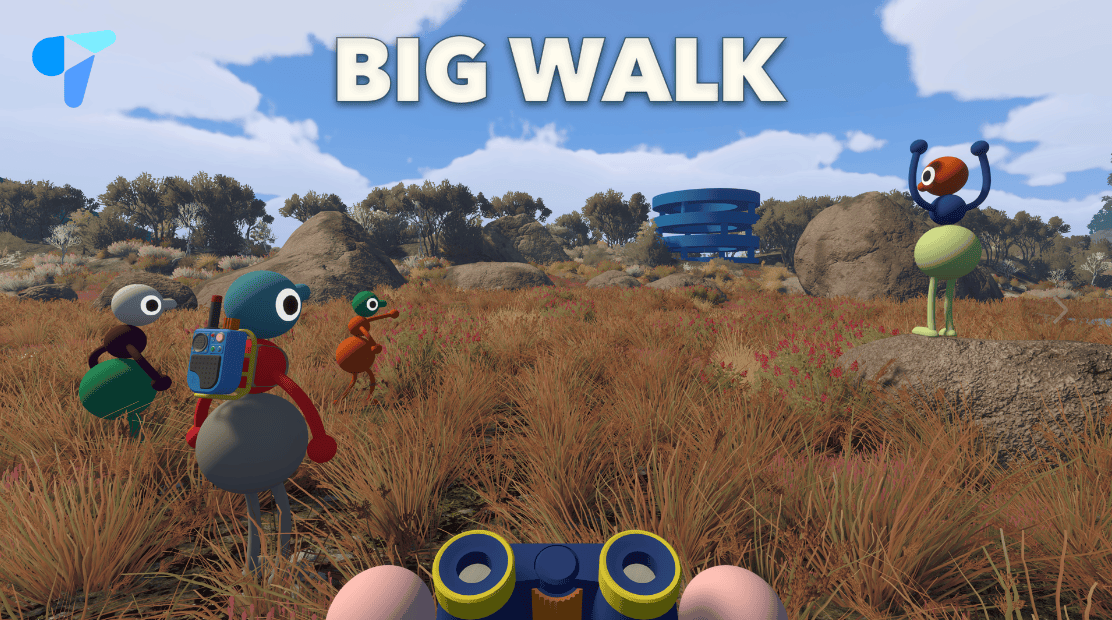
In House House’s gameplay overview, friends explore and solve challenges together using voices, gestures, and tools. The Big Walk Steam page explains how proximity voice chat changes what players hear: speech gets quieter across distances, echoes down corridors, and can come through a walkie-talkie. The voices in proximity chat are the other people in your session.
House House’s post-launch voice patch illustrates a useful design distinction. Some players’ microphones made them hard to hear even up close. The studio improved how it normalized quiet voices while preserving the distance at which speech drops off. Players could hear nearby friends more clearly, and moving out of earshot still mattered to the game.
How to test proximity voice in your own co-op game
If you’re building a Unity or Unreal game, use the Tencent RTC GVoice demo and free trial to hear positional audio and prototype a voice room. Start with a small test scene, two player avatars, and a path long enough for one player to walk out of range.
- Get voice working up close. Join the same voice room from two clients and check that both players can speak and hear each other at a comfortable level.
- Make distance affect who can hear whom. Follow the GVoice range voice guide to update player positions and set the listening range. Check the room’s team settings as part of the test, since teammates can remain audible across distances in the documented range voice configuration.
- Test the mechanic in a scene. Ask one player to keep speaking while the other walks away and comes back. Repeat with a quieter microphone. Check that speech stays clear nearby, drops out where you intend, and becomes audible again when the players regroup.
Once those checks pass, try a short puzzle that depends on who can hear whom. That will tell you whether the range works for the level, where players need a way to reconnect, and whether they can tell the difference between being out of range and having a muted mic.
Frequently asked questions
Did Big Walk use AI-generated art, music, or dialogue?
House House says its generative AI use was limited to technical troubleshooting and code assistance. Its statement puts art, music, and dialogue outside the disclosed scope.
Was the chatbot part of the game players bought?
The use House House describes happened during development. Players encounter the resulting game code, and proximity chat carries speech from other people in the session.
Did House House say the whole game used just ten lines of AI-assisted code?
The ten lines refer to the Unity shadow fix the studio described. Its broader estimate was that well under 0.1% of the game’s code was associated with LLM use.
Did House House promise to stop using generative AI?
The studio said it would work on a more comprehensive internal policy. It did not announce the terms of that policy or say which uses it would permit.