






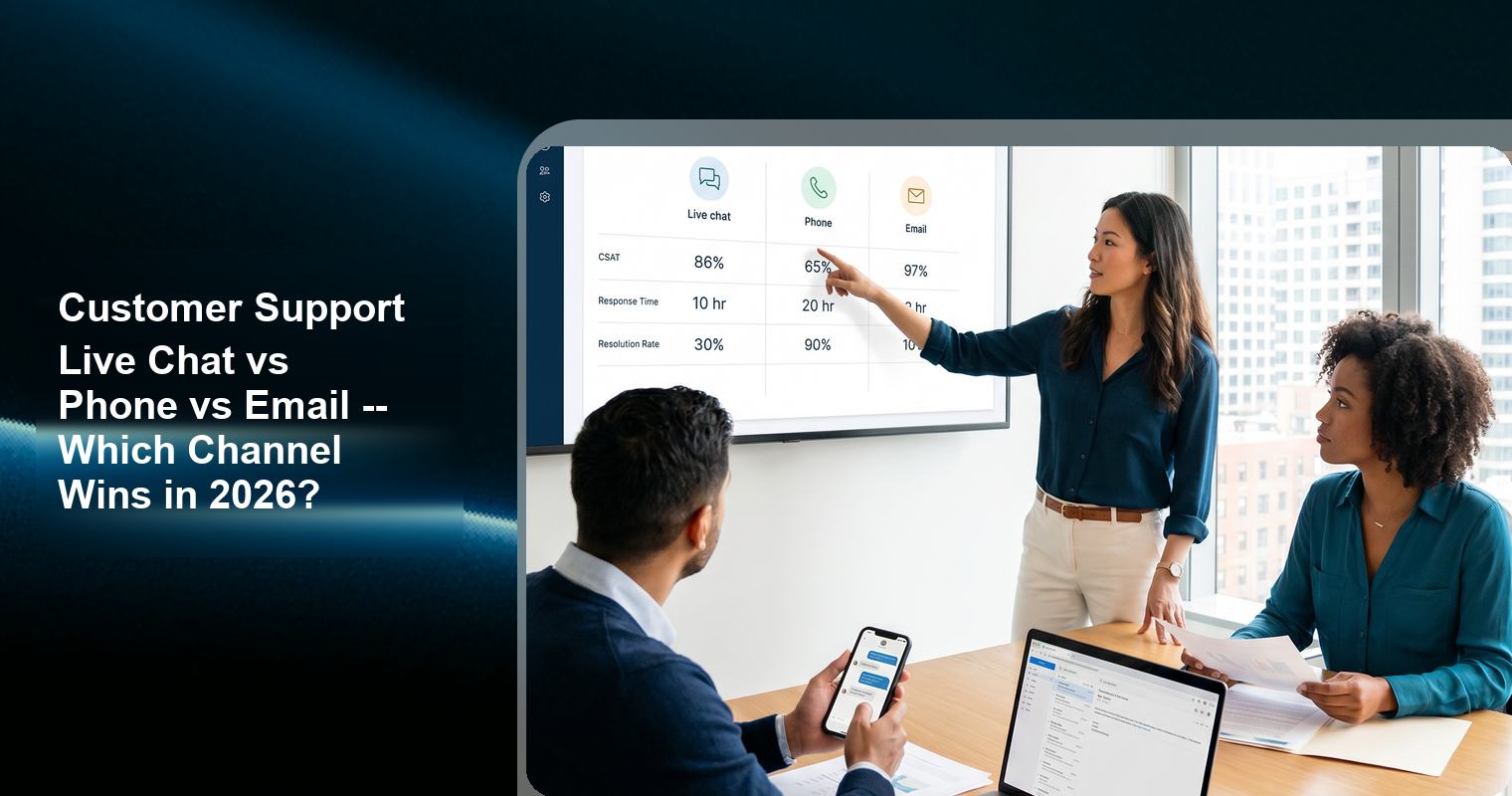
Every business needs to decide how customers can reach them for support. The three primary channels – live chat, phone, and email – each have different costs, response times, satisfaction rates, and use cases.
This article compares all three channels with real data, explains when each channel is the right choice, and provides a framework for building a channel mix that works for your business.
The Head-to-Head Comparison
Cost Per Interaction
Channel | Cost Per Interaction | Notes |
Live chat | $1-$3 | Agent can handle 3-5 concurrent conversations |
$2.50-$5 | Slower, requires back-and-forth | |
Phone | $6-$12 | One conversation at a time per agent |
Live chat is 4-6x cheaper than phone support because agents can handle multiple conversations simultaneously. A phone agent can only serve one caller at a time, while a chat agent can manage 3-5 conversations concurrently.
Customer Satisfaction (CSAT)
Channel | Average CSAT | Notes |
Live chat | 73-87% | Highest among digital channels |
61% | Delays and lack of real-time interaction | |
Phone | 44% (for support) | Long hold times and frustration |
Live chat consistently outperforms email and phone in customer satisfaction. The ACSI reports an 88% average satisfaction score for live chat, compared to 61% for email and 44% for phone support.
The reason is straightforward: live chat combines the real-time responsiveness of phone support with the convenience of written communication. Customers do not have to wait on hold, repeat their issue to multiple agents, or wait days for an email response.
Average First Response Time
Channel | Average FRT | Best Case |
Live chat | 1m 35s - 2m 40s | Under 30 seconds |
12+ hours | 1-2 hours | |
Phone | 30+ seconds hold time | Immediate |
Source: Tidio, SuperOffice, Agents Republic
Live chat’s first response time is 5-10x faster than email. While phone has the potential for immediate response, hold times often stretch to 5-15 minutes during peak periods, making the effective wait time longer than live chat.
Resolution Rate
Channel | First-Contact Resolution Rate | Notes |
Live chat | 70-80% | Real-time back-and-forth enables quick resolution |
Phone | 65-75% | Effective for complex issues but limited by hold times |
40-55% | Multiple back-and-forth rounds often needed |
Source: Industry benchmarks
Live chat and phone have similar resolution rates for straightforward issues. However, live chat has an advantage when the issue requires the agent to look up information, check an order status, or send links – the agent can do this while maintaining the conversation, whereas a phone agent must put the caller on hold.
Customer Preference
Preference | Percentage | Source |
Prefer live chat | 41% | Tidio |
Prefer phone | 71% (Gen Z), varies by age | McKinsey |
Prefer email | 18% (declining) | Industry data |
Use chat as primary support channel | 63% | Invesp |
Source: Tidio, Digital Minds BPO
The preference data is nuanced. Overall, 41% of customers prefer live chat, making it the most popular digital channel. However, Gen Z (71%) still prefers phone calls for complex issues, and older demographics often prefer phone for any interaction that requires explanation.
The key insight is that preference varies by situation: customers prefer chat for quick questions, phone for complex issues, and email for non-urgent matters that require documentation.
When Each Channel Wins
Live Chat Wins When:
● Quick questions – Pricing, hours, shipping info, simple product questions
● Pre-purchase support – Visitors who are considering buying and need reassurance
● Multi-tasking customers – People who want an answer while continuing to browse or work
● International customers – Chat works across time zones with offline forms
● Cost efficiency – 4-6x cheaper than phone per interaction
Phone Wins When:
● Complex issues – Technical troubleshooting, billing disputes, multi-step processes
● Emotional situations – Complaints, frustrations, or sensitive matters where tone of voice matters
● High-value transactions – Large purchases or contract negotiations where personal connection builds trust
● Senior customers – Some demographics simply prefer phone and will not use chat
● Urgent situations – When the customer needs immediate resolution and cannot wait
Email Wins When:
● Documentation needed – When the conversation needs a written record (legal, compliance, contracts)
● Non-urgent matters – When the customer does not need an immediate response
● Complex information – When the response requires detailed explanations, attachments, or links
● After-hours inquiries – When the customer wants to send a question outside business hours
● Follow-up communication – When you need to send a summary or next steps after a chat or phone call
The Optimal Channel Mix
For most businesses, the optimal approach is not to choose one channel but to offer multiple channels and route customers to the right one based on their needs.
Tier 1: Live Chat (Primary Channel)
Live chat should be your primary support channel because it is the cheapest, fastest, and most preferred by customers for routine interactions.
How to implement: Install a chat widget on your website. Knocket provides free live chat with no branding, social link aggregation, offline forms, and Calendly scheduling. Configure business hours, proactive messages, and canned responses for common questions.
Free TrialTier 2: Social Messaging (Secondary Channel)
Social messaging (WhatsApp, Instagram, Telegram) provides an asynchronous communication channel for customers who do not need real-time help. It is especially valuable for international customers and after-hours inquiries.
How to implement: Knocket includes social link aggregation in the chat widget. Visitors can choose between live chat and social messaging. For businesses with international customers, WhatsApp is particularly important because it is the dominant messaging app in Latin America, Southeast Asia, and parts of Europe.
Tier 3: Phone (Escalation Channel)
Phone should be available for complex issues, emotional situations, and high-value transactions. But it should not be the primary channel because it is the most expensive and has the lowest scalability.
How to implement: Offer phone support as an escalation option from chat. When an issue cannot be resolved in chat, the agent can offer a phone callback. Calendly integration in the chat widget makes it easy for visitors to schedule a callback.
Tier 4: Email (Documentation Channel)
Email should be available for situations that require written records, detailed explanations, or non-urgent follow-up.
How to implement: Include your support email address in the chat widget’s offline form and on your contact page. Use email for follow-up communication after chat or phone interactions.
The Cost Impact of Channel Mix
Here is a simplified cost comparison for a business handling 500 support interactions per month:
Channel Mix | Monthly Cost | Avg CSAT | Avg FRT |
Phone only | $4,000-6,000 | 44% | 2-5 min hold |
Email only | $1,250-2,500 | 61% | 12+ hours |
Live chat only | $500-1,500 | 73-87% | 1-3 min |
Chat + Social + Phone escalation | $800-2,000 | 80-90% | 30-90 sec |
All channels (chat, social, phone, email) | $1,500-3,500 | 85-92% | Varies by channel |
The most cost-effective and highest-CSAT option is a channel mix with live chat as the primary channel, social messaging as a secondary channel, and phone as an escalation channel.
FAQ
Is live chat better than phone support?
For most routine support interactions, yes. Live chat is 4-6x cheaper per interaction, has higher CSAT (73-87% vs 44% for phone), and faster response times. However, phone is better for complex issues, emotional situations, and customers who prefer verbal communication.
Is live chat better than email support?
For most interactions, yes. Live chat has 5-10x faster response times, higher CSAT (73-87% vs 61% for email), and higher first-contact resolution rates (70-80% vs 40-55%). Email is better for situations that require written documentation or non-urgent communication.
Should I offer all three channels (chat, phone, email)?
Ideally, yes. Different customers prefer different channels for different situations. The optimal approach is to offer live chat as the primary channel, social messaging as a secondary channel, and phone and email for escalation and documentation. This gives every customer their preferred channel while keeping costs manageable.
How do I handle customers who prefer phone over chat?
Offer phone as an escalation option from chat. When a chat conversation reaches a point where phone would be more effective (complex issue, emotional situation), the agent can offer a phone callback. Calendly integration in the chat widget makes it easy for visitors to schedule a call.
Can live chat replace phone support entirely?
For some businesses, yes. If your support interactions are primarily quick questions (pricing, shipping, order status) rather than complex troubleshooting, live chat can replace phone support. For businesses with complex products or emotional customer situations, phone should remain available as an escalation option.