



Introduction
- Choose Fable 5.2 first for difficult reasoning and long-document workloads: it leads several max-effort evaluations and avoids Astra’s long-context pricing surcharge.
- Choose Astra 6.2 first for terminal-based automation and cost-sensitive agent trials: it leads the versioned terminal benchmarks and has a lower measured cost on the independent evaluation mix.
- Standard short-context token prices are tied: both start at US$8 per million input tokens and $40 per million output tokens, according to the Fable specification and Astra pricing specification.
- Do not confuse output speed with response latency: Fable’s reported output rate is higher, but Astra reaches its first answer sooner in the cited max-effort profiles.
- Test the complete task: reasoning effort, cache behavior, tool calls and retries can matter more than the headline token rate.
For Fable 5.2 vs Astra 6.2, the practical answer is workload-dependent: start with Fable for demanding reasoning or large inputs, and Astra for terminal-oriented agents where completion time and task cost matter. These are recommendations based on the current specifications and benchmark results—not a claim that either model wins every task. Both have the same standard short-context input/output prices, but their context thresholds, reasoning behavior and measured token consumption produce different bills.
What Are Fable 5.2 and Astra 6.2? Verify Providers, Versions and Availability
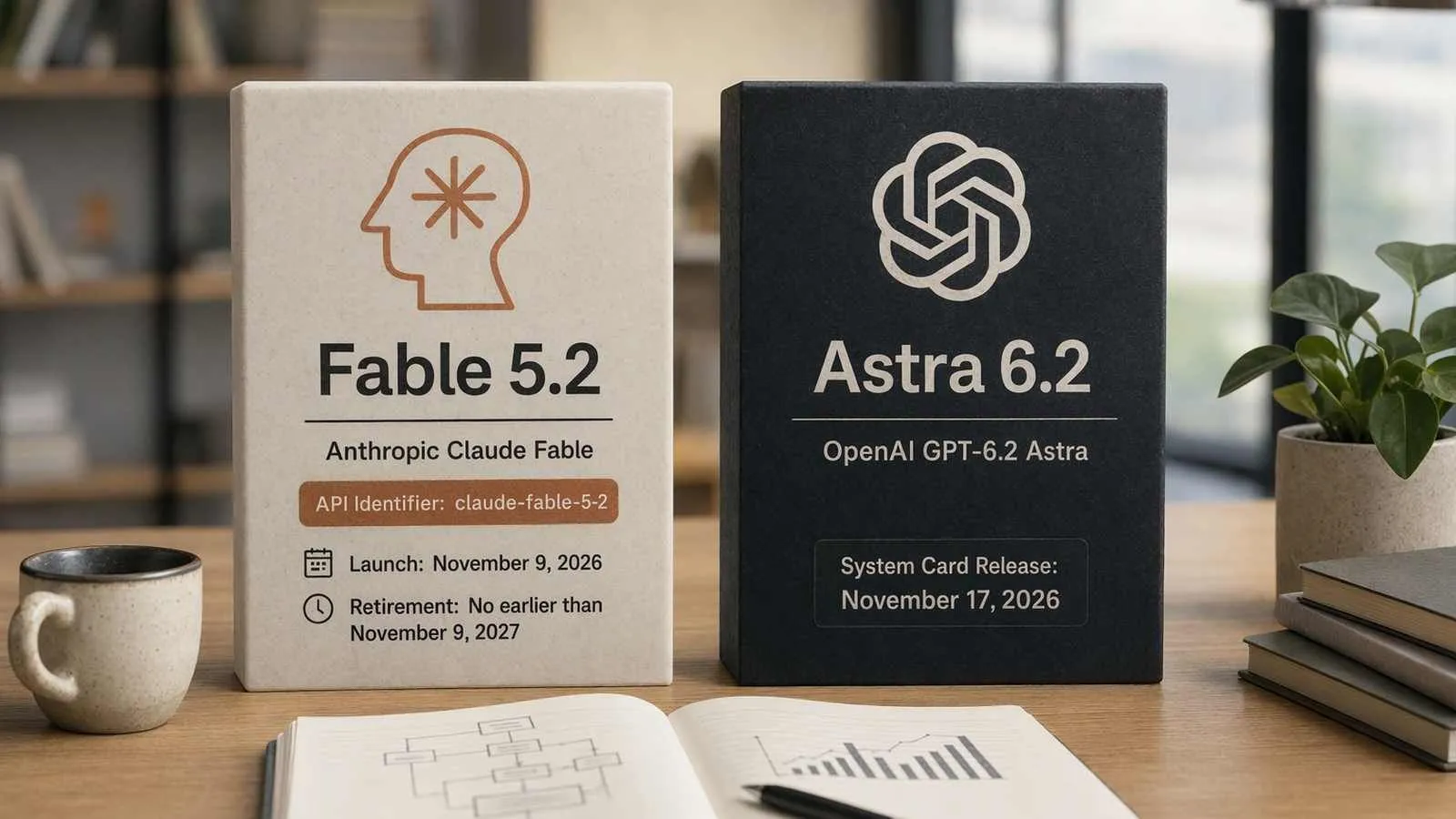
Fable 5.2 is Anthropic’s Claude Fable release, while Astra 6.2 refers here to OpenAI’s GPT-6.2 Astra. They are proprietary hosted models, not downloadable open-weight packages. A model comparison is also not a comparison of consumer subscriptions: API billing, application features and subscription usage limits are separate questions.
Anthropic’s official Fable overview lists the API identifier claude-fable-5-2, a November 9, 2026 launch date and retirement no earlier than November 9, 2027. OpenAI’s GPT-6.2 system card dates the Astra and Sol release to November 17, 2026.
Use the exact identifiers when recording evaluation results. “Fable,” “Astra” and “GPT-6” are too broad for a reproducible comparison. A model-family label can conceal different versions, effort settings or processing tiers.
Where can you access them?
Anthropic’s release and migration documentation lists Claude API, Claude Platform on AWS, Bedrock runtime, Google Cloud and Microsoft Foundry availability. Bedrock identifiers include global.anthropic.claude-fable-5-2 and us.anthropic.claude-fable-5-2.
OpenAI’s Astra launch announcement lists gpt-6.2-astra through the OpenAI API and access for Plus, Pro, Enterprise and Edu users in ChatGPT Work and Codex.
Exact consumer subscription prices and model-specific usage caps are not established here. Do not turn an API cost estimate into a prediction of how many requests a subscription permits.
Check data retention before performance
Data handling can eliminate an otherwise attractive model.
The Fable model documentation specifies 30-day retention and says zero data retention requires express authorization from Anthropic. The Astra integration guide describes zero data retention for approved organizations using eligible endpoints and features.
For sensitive workloads, confirm organization-level eligibility, endpoint behavior and contractual requirements before uploading evaluation documents. A better benchmark score does not override a retention constraint.
At-a-Glance Comparison of Features, Context and Tool Use
The official Fable specifications and official Astra specifications establish the core limits below. The independent model comparison identifies both as text-and-image input models with text output.
| Feature | Fable 5.2 | Astra 6.2 | Practical consequence |
|---|---|---|---|
| Provider | Anthropic | OpenAI | Different APIs, contracts and deployment options |
| API identifier | claude-fable-5-2 | gpt-6.2-astra | Record the exact identifier in every test |
| Context window | 1,000,000 tokens | 1,050,000 tokens | Astra has a larger stated total window |
| Maximum input | Check the combined request budget | 922,000 tokens | Total context is not synonymous with input capacity |
| Maximum output | 128,000 tokens | 128,000 tokens | Neither guarantees a useful answer at the maximum |
| Knowledge cutoff | June 2026 | May 18, 2026 | Neither should be treated as live knowledge |
| Inputs and outputs | Text/images in; text out | Text/images in; text out | Vision support is distinct from native audio |
| Weights | Proprietary | Proprietary | No public-weight self-hosting option |
| Recommended/default effort | Defaults to high | Start new integrations at medium | Default-to-default tests are not effort-matched |
| Long-context pricing | Standard rates throughout the window | Surcharge above 272,000 input tokens | Large-document costs can diverge sharply |
What does a million-token context actually buy?
A context window is a capacity limit, not a guarantee of accurate retrieval, synthesis or instruction following across every included document.
For a large repository or document collection, test whether the model can:
- Locate evidence near the beginning, middle and end.
- Distinguish current instructions from quoted instructions.
- Resolve contradictions between documents.
- Cite the correct file or passage.
- Preserve enough budget for its output and reasoning behavior.
Astra’s 1,050,000-token total context should not be advertised as 1,050,000 tokens of input. Its model page separately specifies a 922,000-token maximum input and 128,000-token maximum output.
Are audio, video and tool use supported?
Astra’s modality specification explicitly marks native audio and video as unsupported. Image understanding does not establish native speech or video capability, and the cited Fable comparison does not establish a native voice capability either.
Tool use also depends on API behavior rather than model intelligence alone. OpenAI’s migration guide says Astra supports Chat Completions but requires the Responses API for tool calling.
For both models, evaluate the complete agent harness: tool definitions, execution permissions, error messages, conversation state and stopping rules. A model that proposes a correct tool call can still fail if the application executes it incorrectly.
Benchmark Evidence: Published Results, Independent Tests and Missing Data
The strongest usable comparison here is the explicitly versioned, effort-labeled evidence from Artificial Analysis. Vendor launch claims are useful release context, but they do not substitute for a matched head-to-head test.
Anthropic’s launch announcement reports improved coding, reasoning and vision, with output generation up to 30% faster than Fable 5.1. OpenAI’s launch announcement reports improved professional-work performance and token efficiency. Both statements compare against earlier models, not against each other.
How do reasoning-effort settings change the result?
The Fable performance profile and Astra performance profile report these Intelligence Index scores:
| Effort | Fable 5.2 | Astra 6.2 |
|---|---|---|
| Low | 54 | 46 |
| Medium | 56 | 57 |
| High | 62 | 60 |
| Xhigh | 62 | 62 |
| Max | 65 | 62 |
Fable’s reported configurations have Default Fallback enabled. These are index scores, not accuracy percentages.
The ordering changes with effort. Fable leads at low, high and max; Astra narrowly leads at medium; xhigh is tied. Equal effort labels do not establish equal compute, latency or cost budgets.
Which individual benchmarks does each model lead?
Artificial Analysis’s max-effort comparison reports the following results. Percentage metrics and Elo/index metrics must remain separate.
| Evaluation | Fable 5.2 | Astra 6.2 | Higher reported result |
|---|---|---|---|
| FrontierCode-AA 2.0 | 48.8% | 45.4% | Fable |
| Terminal-Bench 4.0 | 59.6% | 64.1% | Astra |
| HLE-Diamond | 80.2% | 72.2% | Fable |
| CritPt v2 Hard Subset | 76.5% | 71.5% | Fable |
| Terminal-Bench-Science 0.1 | 73.3% | 78.1% | Astra |
| AutomationBench-AA | 76.4% | 77.2% | Astra |
| AA-Briefcase v1.1 | 1785 Elo | 1643 Elo | Fable |
| GDP.pdf | 24.2% | 29.8% | Astra |
| AA-Omniscience v1.1 | 67 index | 50 index | Fable |
There is no verified matched significance analysis for these differences, so small leads should not be described as statistically decisive.
The useful conclusion is narrower than “Fable wins more rows.” Fable shows stronger results on several reasoning and professional-work evaluations; Astra shows stronger terminal and selected automation/document-work results. Your task distribution determines which pattern matters.
Do not blend unversioned Terminal-Bench scores with Terminal-Bench 4.0. Likewise, unsupported SWE-bench Pro or GPQA claims should not be used to fill gaps in this table.
Performance by Task: Reasoning, Coding, Writing and Instruction Following
Reasoning: start with Fable for difficult problems
Fable is the stronger initial candidate for reasoning-heavy workloads based on its max-effort Intelligence Index, HLE-Diamond and CritPt results in the independent comparison.
That recommendation is most relevant when a wrong answer is expensive and a longer response time is acceptable: technical analysis, complex synthesis or carefully reviewed decision support.
Test correct conclusions separately from explanation quality. A fluent rationale can conceal a wrong premise. Include questions with missing evidence and score whether the model asks for clarification or acknowledges uncertainty.
Coding: distinguish code solving from terminal operation
Fable leads FrontierCode-AA 2.0, while Astra leads Terminal-Bench 4.0 and Terminal-Bench-Science 0.1 in the versioned benchmark results.
That split supports two different starting points:
- Code reasoning and patch generation: try Fable first.
- Terminal-based execution and troubleshooting: try Astra first.
A repository evaluation should require passing tests and respecting edit scope. Record unnecessary dependency changes, unrelated modifications, invented APIs and failures to inspect relevant files. “Produced a patch” is not a success criterion.
For terminal agents, add permission checks and recovery tests. An agent that succeeds only with unrestricted execution is not equivalent to one that works inside your production security boundaries.
Writing: select by artifact, not personality
The professional-work results are mixed: Fable leads AA-Briefcase, while Astra leads GDP.pdf in the independent comparison. This does not establish a universal winner for writing.
Use blind review of actual deliverables: support replies, technical briefs, executive summaries or document analyses. Score factual support, audience fit, structural compliance and revision effort.
Prefer a model that reliably produces your required artifact over one whose prose initially feels more polished. A document that needs extensive fact checking can be more expensive than a less elegant but accurate draft.
Instruction following: test the failures you cannot tolerate
No dedicated, matched instruction-following result is established here. Build explicit checks for required sections, forbidden content, citation rules, valid output structure and escalation behavior.
Separate hard constraints from preferences. Omitting a required disclaimer or emitting an invalid machine-readable response can be a failure even when the content is otherwise useful.
Also include adversarial text inside retrieved documents. The model should treat a quoted instruction as document content, not as permission to override the application’s rules.
Speed and Reliability: Latency, Throughput and Consistency
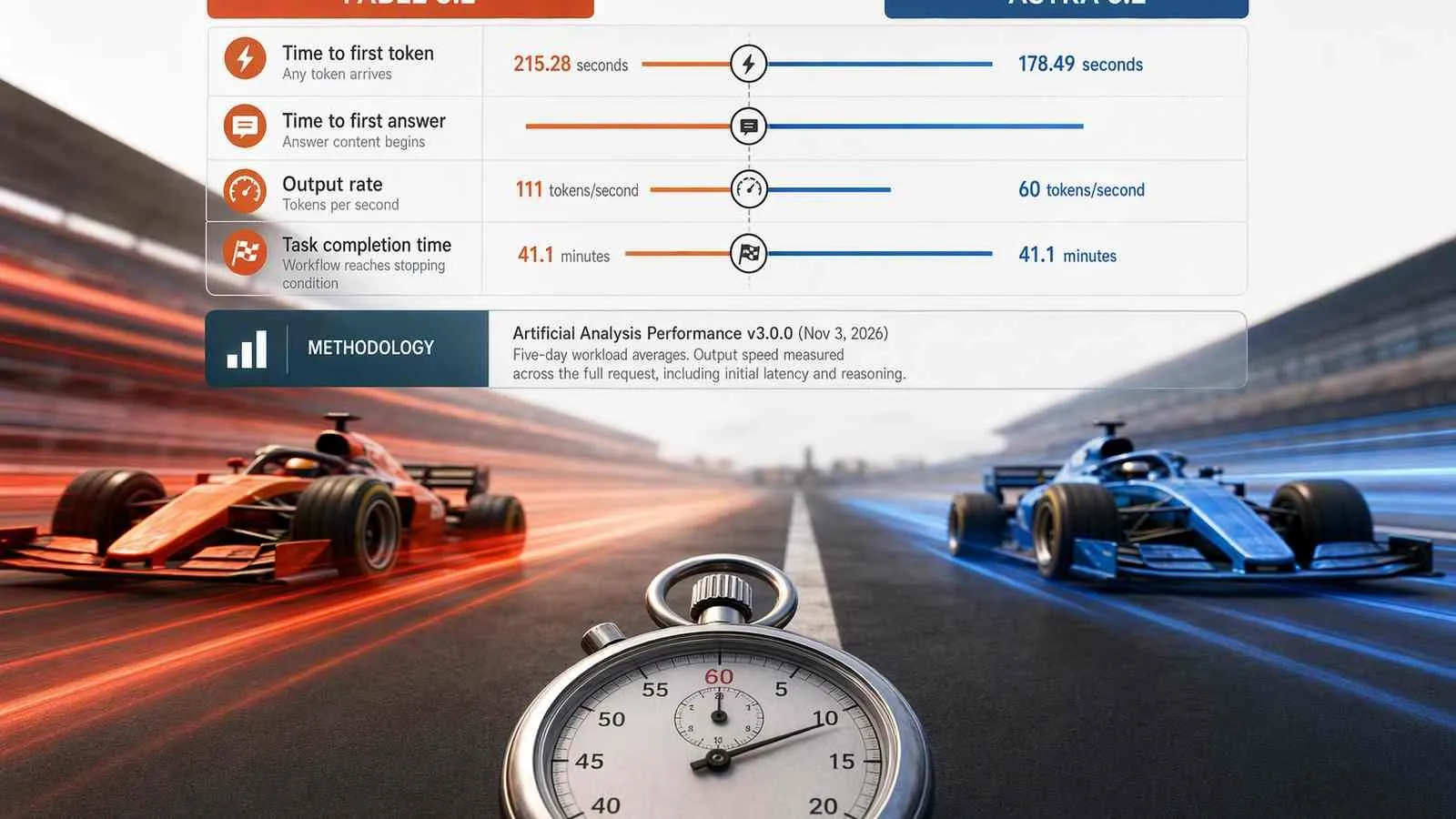
For an AI model latency comparison, define what “fast” means before choosing a winner.
- Time to first token: when any streamed token arrives, potentially including reasoning.
- Time to first answer: when answer content begins.
- Output rate: the reported token-generation rate under a specified methodology.
- Task completion time: when the complete workflow reaches its stopping condition.
Artificial Analysis’s performance methodology distinguishes first-answer timing from first-token timing. Its Performance v3.0.0 methodology, introduced November 3, 2026, uses five-day workload averages and measures output speed across the full request, including initial latency and reasoning.
The individual Fable profile and Astra profile report these max-effort snapshots:
| Measurement | Fable 5.2 | Astra 6.2 |
|---|---|---|
| Time to first answer | 215.28 seconds | 178.49 seconds |
| Reported output rate | 111 tokens/second | 60 tokens/second |
| Time per Intelligence Index task | 41.1 minutes | 11.5 minutes |
Fable has the higher reported output rate, while Astra starts its answer sooner and completes the benchmark tasks sooner. Those statements are compatible: generating more reasoning or performing more work can outweigh a faster token rate.
These max-effort measurements are not predictions for a short support reply or a voice interaction.
What reliability data is still missing?
Comparable p50, p95 and p99 latency measurements, saturation curves and regional production studies are not established for both releases.
Measure those properties in your deployment. Track timeout frequency, successful completion, retries, malformed outputs and rate-limit recovery. Run tests during the traffic periods that matter to your application.
Do not mix rolling snapshots: the individual profiles currently show 41.1 and 11.5 minutes per task, while the comparison page exposes different values.
Does a faster processing tier solve latency?
Anthropic’s Fast mode documentation promises up to 2.5× higher output throughput, not faster first-token arrival.
That makes Fast mode a candidate for reducing lengthy output generation, not a guaranteed fix for delayed answer onset. Test it against the exact latency metric your interface needs.
Pricing Guide: Token Rates, Caching, Limits and Example Workload Costs
Fable 5.2 pricing and Astra 6.2 pricing match at standard short-context input/output rates. They differ once caching, long context, processing tiers and actual billed token totals enter the calculation.
Standard and cache rates
The Claude pricing documentation and Astra model pricing list these rates in US dollars per million tokens:
| Billing category | Fable 5.2 | Astra 6.2, short context |
|---|---|---|
| Uncached input | $8 | $8 |
| Billed output | $40 | $40 |
| Short-duration cache write | $10, five minutes | $10, 30 minutes |
| Long-duration cache write | $16, one hour | $20, 12 hours |
| Cache read | $0.20 | $0.40 |
Fable has the lower cache-read rate; Astra offers longer listed cache durations. Neither is automatically cheaper for a session. The answer depends on whether the prefix is reused before expiry, whether edits invalidate reuse and how many reads amortize the write.
Anthropic’s release notes describe a 20% input/output reduction from Fable 5.1. OpenAI’s launch announcement describes 20% input/output and 60% cached-input reductions relative to GPT-6 Astra. These are historical reductions, not discounts relative to each other.
Long context changes the comparison
Fable’s pricing page applies standard token rates throughout its one-million-token window.
Astra’s model specification applies a surcharge when input exceeds 272,000 tokens: input and cache rates double, and output rates increase by 50% for the entire request.
For planning, distinguish a request just below the threshold from one just above it. The surcharge is not limited to the extra tokens beyond the threshold.
Token-only workload calculator examples
The following calculations use Claude’s published rates and the release-specific Microsoft Foundry Astra pricing examples.
| Uncached workload | Fable Standard | Astra Standard |
|---|---|---|
| 10,000 input + 2,000 billed output tokens | $0.16 | $0.16 |
| 300,000 input + 10,000 billed output tokens | $2.80 | $5.40 |
For the short request, multiply input tokens by 8 and billed output tokens by 40, then divide their sum by one million.
For the large Astra request, use 16 for input and 60 for output. Fable retains 8 and 40.
These are token-only estimates, excluding tools, retries, subagents, residency premiums and paid speed tiers. Use billed output totals rather than assuming the visible answer accounts for every charged token.
For caching calculations, assign each token to one disjoint category: uncached input, the applicable cache-write category, cache read or billed output. Do not count a cached prefix again as uncached input.
Batch, Fast and residency modifiers
Anthropic’s release documentation lists Batch rates of $4 input and $20 output per million tokens. Its Fast mode page lists $16/$80.
Astra’s pricing specification prices Batch at 50% of Standard and Fast at twice Standard for the same context length. Ultrafast costs three times Standard through February 28, 2027, then six times Standard from March 1, 2027, Pacific time.
The Claude pricing page applies a 1.1× multiplier across token categories for US-only first-party inference.
Why benchmark task cost matters
Artificial Analysis’s Fable profile reports max-effort benchmark task costs of $26.54 for Fable and $4.00 for Astra—approximately 6.64× apart.
Its methodology weights evaluation costs, including reasoning and answer tokens, by task count and Intelligence Index weight. This is not a universal production price or guaranteed saving.
The lesson is to compare cost per successful task, not just cost per million tokens.
How to Run a Fair Side-by-Side Evaluation on Your Own Tasks
Use two evaluation tracks: an effort-controlled comparison to understand behavior, and a budget-controlled comparison to make a deployment decision.
Step 1: Build a representative task set
Select examples from the work your application actually performs. Include routine requests, difficult cases, long inputs, missing information and previous failures.
Keep a held-out set that you do not use while tuning prompts. Otherwise, you risk selecting the model that best fits your test preparation rather than future traffic.
Step 2: Define success before seeing outputs
For coding, require passing tests and acceptable edit scope. For document work, require supported conclusions and traceable citations. For automation, require the correct terminal state without unauthorized actions.
For each task, define what constitutes failure and whether a human review is mandatory. This prevents attractive prose from changing the scoring rules after the fact.
Step 3: Record the full configuration
Capture:
- Exact model identifier and endpoint.
- Reasoning effort and processing tier.
- System instructions and tool definitions.
- Input size and output allowance.
- Cache policy and observed cache usage.
- Timeout, retry and tool-call budgets.
- Deployment region and data-retention requirements.
Fable’s migration documentation says it always uses adaptive thinking and defaults to high effort. Astra’s guide recommends starting at medium. Test defaults separately from matched effort settings.
Step 4: Preserve conversation state deliberately
Fable’s prefix-check behavior can return HTTP 400 when earlier system instructions, tools or messages change before a bound thinking block.
Astra’s state-handling guidance says reasoning items are dropped after detected prefix edits, model downgrades or user/organization changes. That can reduce quality and cause repeated token use.
Include conversation continuation and edited-prefix cases in the test. A clean single-turn benchmark will not reveal these integration failures.
Step 5: Measure quality, time and spend together
For each run, record success, first-answer time, completion time, billed tokens, tool calls, retries and reviewer effort.
Use blind review where judgment is subjective. Repeat variable tasks, and compare latency distributions rather than reporting only an average.
Step 6: Apply the same deployment budget
Ask which model delivers the best success rate within your acceptable task cost and deadline. This is more useful than maximizing both models without constraints.
Retain failure examples. They tell you whether to change the prompt, improve retrieval, tighten tool permissions or select a different model.
Which Model Fits Your Use Case? Recommendations Based on Available Evidence
The following selections are starting recommendations, not claims of measured production superiority.
| Use case | First model to test | Evidence and condition |
|---|---|---|
| Difficult reasoning | Fable 5.2 | Higher max-effort reasoning and Intelligence Index results |
| Code-solving and patch reasoning | Fable 5.2 | Leads FrontierCode-AA 2.0 |
| Terminal-based agents | Astra 6.2 | Leads both cited terminal evaluations |
| Inputs above 272,000 tokens | Fable 5.2 | Avoids Astra’s long-context surcharge |
| Cost-sensitive max-effort trials | Astra 6.2 | Lower independent benchmark task cost |
| Professional document writing | Test both | AA-Briefcase and GDP.pdf point in different directions |
| Strict zero-retention requirement | Astra, subject to approval | Documented eligibility; Fable requires an explicit exception |
The clearest Fable case is difficult work with large inputs and room for longer completion times. The clearest Astra case is terminal-oriented work where the measured completion-time and task-cost advantages justify a trial.
For short, routine requests, neither the shared token price nor max-effort results settle the decision. Compare lower effort settings on your own quality threshold.
Your next step is to consult the Fable specification and Astra specification, then run the evaluation above using real billing records. Select the model that meets your success, latency and governance requirements—not the one with the most favorable isolated score.
How to Build an App Like This with Tencent RTC
A model-comparison application can extend its text tests into voice-agent evaluations using Tencent RTC Conversational AI. Keep speech recognition, model generation and speech synthesis measurements separate; the model timings above do not measure the full voice pipeline. Consult the Conversational AI documentation for product capabilities and limitations. If the application also needs person-to-person voice or video conversations, evaluate Tencent RTC Call separately from the AI model layer.
For integration, open Tencent RTC AI Agents Skills and follow the repository instructions to load suitable Skills in your AI coding assistant.
Describe your existing project, platform and intended interaction:
Inspect my existing web application and use the appropriate Tencent RTC AI Agents Skills to add a voice-agent evaluation interface. Keep the model provider configurable, and explain how to validate permissions, credential handling, interruptions and recovery.
Review the generated changes and test actual interactions before comparing end-to-end latency.
Frequently Asked Questions
Is Fable 5.2 better than Astra 6.2?
For several max-effort reasoning evaluations, Fable has higher reported scores. Astra leads the cited terminal benchmarks and has lower measured task cost. Choose according to your workload rather than a universal ranking.
Do Fable 5.2 and Astra 6.2 have the same pricing?
Their standard short-context input/output rates match at $8/$40 per million tokens in the Fable and Astra specifications. Cache pricing, long-context surcharges and processing tiers differ.
Which model is faster?
The cited max-effort profiles show Astra reaching its first answer and completing benchmark tasks sooner, while Fable has a higher reported output rate. Your latency metric and effort setting determine the useful comparison.
Which model has the larger context window?
Astra specifies 1,050,000 total context tokens and 922,000 maximum input tokens. Fable specifies a 1,000,000-token context window. Total context capacity should not be confused with maximum input.
Can these models process native audio and video?
Both are identified as text-and-image input models with text output. Astra explicitly marks native audio and video as unsupported. Native voice capability is not established for Fable by the cited specifications.
Does Astra’s lower benchmark cost guarantee a cheaper application?
No. The independent cost result belongs to a weighted benchmark workload. Production cost depends on billed tokens, effort, caching, tools, retries and successful completion.
How current is this comparison?
The specifications and measurements are dated November 18, 2026. Rolling performance results, prices and access rules can change; consult the linked release-specific documentation before committing to a deployment.