


Introduction
- Gemini 4 Krypton is an unconfirmed name, not a publicly documented Google model. There is no verified official release date, endpoint, or price.
- Google's released Gemini 4 catalog lists Argon, Carbon, and Hydrogen. Hydrogen became generally available on November 12, 2026.
- Alleged Krypton demonstrations are community tester reports, not independently reproducible benchmarks.
- A prominent November 14 claim that Krypton was appearing in Arena under Hydrogen's name was subsequently retracted.
- For development decisions, compare documented models now; do not treat rumored Krypton specifications as a deployment plan.
Gemini 4 Krypton has no confirmed Google announcement, release date, or public API availability as of November 18, 2026. The official Google AI Studio model catalog lists Gemini 4 Carbon, Argon, and Hydrogen, but no Krypton entry. Claims about exceptional coding performance and long-running generation exist, but they do not establish the model's identity or prove that it outperforms Carbon under controlled conditions.
If you are deciding whether to wait for Krypton, the practical answer is do not make it a production dependency yet. Evaluate a released model against your workload and keep the model choice replaceable. The sections below distinguish official records from tester claims, explain the benchmark gaps, and show which comparisons can support a decision today.
What Is Gemini 4 Krypton? Official Naming and Confirmation Status
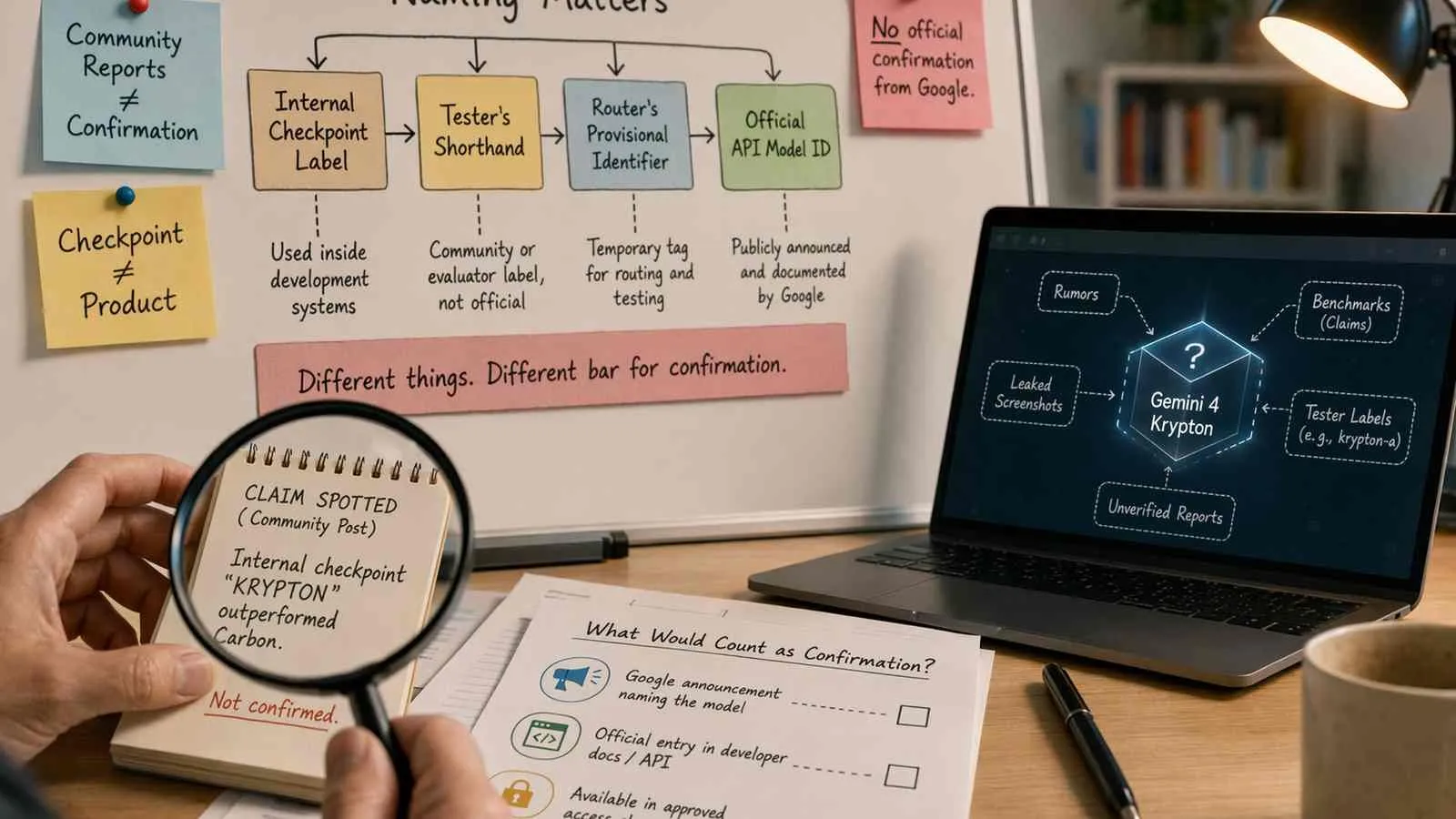
“Gemini 4 Krypton” is a name circulating in community reports for an alleged internal Google model checkpoint. Google has not publicly established that name as a released product, confirmed its relationship to Carbon, or documented its capabilities.
The naming distinction matters. An internal checkpoint label, a tester's shorthand, a router's provisional identifier, and an official API model ID are different things. Even a genuine internal checkpoint would not automatically establish a final commercial name or a future launch.
OfficeChai's November 9 coverage embeds a November 8 post attributed to @lyraxana claiming that an internal checkpoint called Krypton outperformed Carbon. That establishes an early public claim, not Google's confirmation of the underlying model. OmniaKey's account attributes the label “krypton-a” to a November 9 comparison post by @chetaslua; it is a tester-reported label, not an official endpoint.
What would count as confirmation?
The strongest confirmation would connect a Google announcement to an official model entry and documented access:
- A Google publication explicitly identifies Krypton.
- Official documentation defines its capabilities and limitations.
- A release entry establishes its launch or availability status.
- A documented endpoint explains how eligible developers can access it.
Those records answer different questions. A launch article can announce a model before broad access exists. A catalog entry can describe capabilities without proving access for every account. A successful request can demonstrate availability for one account without establishing universal rollout.
For now, the Gemini API changelog contains no Krypton release entry. That supports the narrow conclusion that Krypton is not publicly documented there—not the broader claim that Google cannot be testing an internal model.
Key terms used in this guide
| Entity or concept | Meaning | Why it matters |
|---|---|---|
| Gemini 4 Krypton | Unconfirmed community model name | Its identity and specifications remain unresolved |
| Gemini 4 Carbon | Released model Google positions for frontier reasoning | Provides a documented comparison baseline |
| Gemini 4 Argon | Released model positioned for faster, lower-token responses than Carbon | Relevant when latency and token spending matter |
| Gemini 4 Hydrogen | Released Gemini 4 member with free and paid API access | Must not be confused with an alleged Krypton alias |
| Official model ID | Identifier documented by Google | More reliable than a commercial placeholder |
| Thinking level | Control over reasoning effort on documented models | Can affect tokens, latency, and comparison results |
| Shared context window | Combined allowance for input, thinking, and output | Not three separate token allowances |
| Arena output | Output observed through an evaluation interface | Does not independently establish checkpoint identity |
| Benchmark version | Specific revision of an evaluation suite | Scores from different revisions may not be comparable |
| API usage record | Measured token accounting for a request | Stronger evidence than multiplying runtime by claimed speed |
What Is Confirmed, Reported or Speculative?
The useful distinction is not simply “true versus fake.” Some claims describe documented products, some preserve what a tester said, and others predict outcomes that have not happened.
A secondary article can accurately report a claim without verifying that claim. Several articles repeating the same post also do not create several independent tests.
| Claim | Status as of November 18 | What the evidence supports |
|---|---|---|
| Carbon, Argon, and Hydrogen have documented endpoints | Confirmed | Google's catalog lists them |
| Hydrogen became generally available November 12 | Confirmed | Google's changelog records the release |
| A tester used the label “krypton-a” | Reported | Secondary coverage attributes the label to a post |
| Alleged Krypton generated more code than Carbon | Unverified tester claim | Describes selected demonstrations, not general accuracy |
| Krypton will launch in late November or December | Speculative | Predictions do not come from Google's schedule |
| Krypton has a measured Intelligence Index score of 64 | Unsupported as a measured result | The circulated number is a forecast |
| Krypton was running under Hydrogen's name in Arena | Retracted identification | A prominent poster corrected the initial claim |
| A router page proves production Krypton access | Not established | Provisional listings do not verify a Google endpoint |
Why the Arena correction matters
CellCog's November 14 chronology records @Mr_Salio claiming a Krypton Arena output and retracting that identification at 14:53 UTC. The correction identified the observed model as Hydrogen with higher reasoning effort.
This is more consequential than a minor naming dispute. If reasoning effort changed, a longer or more elaborate response might reflect settings rather than a different model. Output appearance alone cannot resolve that question.
Sumus's November 16 update describes a newer rumor about a checkpoint appearing under “gemini-4-carbon,” while explicitly saying that this does not verify Krypton's identity. The newer rumor therefore does not restore the earlier Hydrogen claim.
What remains unknown?
Krypton's architecture, parameter count, training details, knowledge cutoff, modalities, context window, output limits, thinking controls, pricing, and rate limits remain unverified. There is also no verified official waitlist, public trial, regional rollout, or successful public API request.
Do not fill those gaps with another Gemini 4 model's specifications. Family membership is itself unconfirmed, and even released models within a family can differ in access, controls, and capabilities.
Release Date and Availability: Announcements Versus Predictions
There is no confirmed Gemini 4 Krypton release date. The dates circulating in community coverage are predictions, not Google's launch commitments.
The documented release timeline helps explain why rumors gained attention, but it does not establish a recurring schedule.
| Model | Official announcement | General availability | Interpretation |
|---|---|---|---|
| Gemini 4 Argon | September 30, 2026 | October 13, 2026 | Announced and subsequently released |
| Gemini 4 Carbon | October 28, 2026 | November 10, 2026 | Announced before wider availability |
| Gemini 4 Hydrogen | November 12, 2026 | November 12, 2026 | Released member documented in the latest changelog entry |
| Gemini 4 Krypton | Not confirmed | Not confirmed | No official timetable |
Google's Argon launch article and Carbon launch article establish their announcement dates. The official changelog separately records their general-availability dates.
That separation prevents a common error: using “announced,” “released,” and “available to my account” interchangeably.
Which Krypton dates are circulating?
CometAPI's November 12 guide speculates about a late-November announcement based on the Argon-to-Carbon cadence. Sumus's November 16 article relays an expectation of a launch “next month,” meaning December 2026, and labels it a guess.
Kie.ai's coverage records more specific predictions: a November 25 limited announcement and December 8 public availability. Those dates are secondhand and explicitly do not come from Google.
Specificity is not evidence. A date with a day and month can still be speculation, and a newer prediction does not become confirmed merely because it replaces an older one.
Should you wait for it?
Wait only if evaluating an unreleased model is itself your goal. For a product deadline, use a released model and define the criteria that would justify replacing it later:
- Better task completion at a comparable cost.
- Lower time to a useful answer.
- Required modalities or tools.
- Suitable rate limits and access conditions.
- Stable behavior on your own evaluation set.
This makes a future release an optional upgrade rather than a blocker. It also avoids committing your architecture to capabilities that may never be offered under the Krypton name.
Performance and Capabilities: What Available Evidence Actually Shows
The circulating demonstrations focus on code-generated visual artifacts: an SVG controller, voxel scenes, and an animation. These examples can be interesting without proving broad model superiority.
OfficeChai reports a November 9 comparison using a one-shot, pure-SVG PlayStation 4 controller prompt. The same coverage includes a tester graphic showing approximately 22,000 thinking tokens for alleged Krypton and 4,000 for Carbon.
That is about 5.5 times as many reported thinking tokens. It is not a 5.5-fold accuracy improvement, and it does not establish a comparable spending budget.
More code is not necessarily better code
TeamoRouter's account reports a claim that alleged Krypton took roughly twice as long and produced roughly twice as much code as Carbon on the same prompt. Runtime and code volume are separate measurements from thinking-token usage.
A longer implementation can contain more detail, but it can also introduce duplication, fragile assumptions, or unnecessary complexity. A meaningful coding evaluation asks:
- Does the result run?
- Does it satisfy every requirement?
- Are interactions correct, not just the screenshot?
- Can another developer maintain it?
- Did it require repairs or hidden dependencies?
For SVG, inspect structure and rendering fidelity. For an animation, check timing, scene behavior, and reproducibility. A visually impressive clip does not answer all of those questions.
Animation code is not native video generation
OfficeChai reports a tester claim that a one-prompt, code-only animation took 39 minutes 16 seconds at 105 tokens per second. CometAPI identifies the resulting approximately 247,380-token figure as an arithmetic estimate, not a verified API usage record.
Multiplying reported time by reported throughput cannot establish how many tokens an API billed. It also cannot distinguish thinking tokens from visible output, identify pauses, or explain workflow overhead.
Likewise, generating code that renders an animation does not demonstrate native video generation. The model may have produced a program rather than video output.
Released specifications provide context, not Krypton specifications
Google's long-decode documentation describes a unified 1,048,576-token window for released Gemini 4 models across input, thinking, and output. Their default response budget is 65,536 tokens covering thinking and output; long decode can extend generation within the remaining shared window.
The guide describes asynchronous background execution or client-side continuation for generation exceeding a single response hop. Those mechanisms help explain how documented models handle long tasks. They do not verify the alleged Krypton run or assign those limits to Krypton.
A long generation also creates operational questions beyond maximum capacity: whether the task can resume, how partial results are handled, and whether the final artifact is worth the delay.
Benchmark Claims: Sources, Test Conditions and Verification Gaps
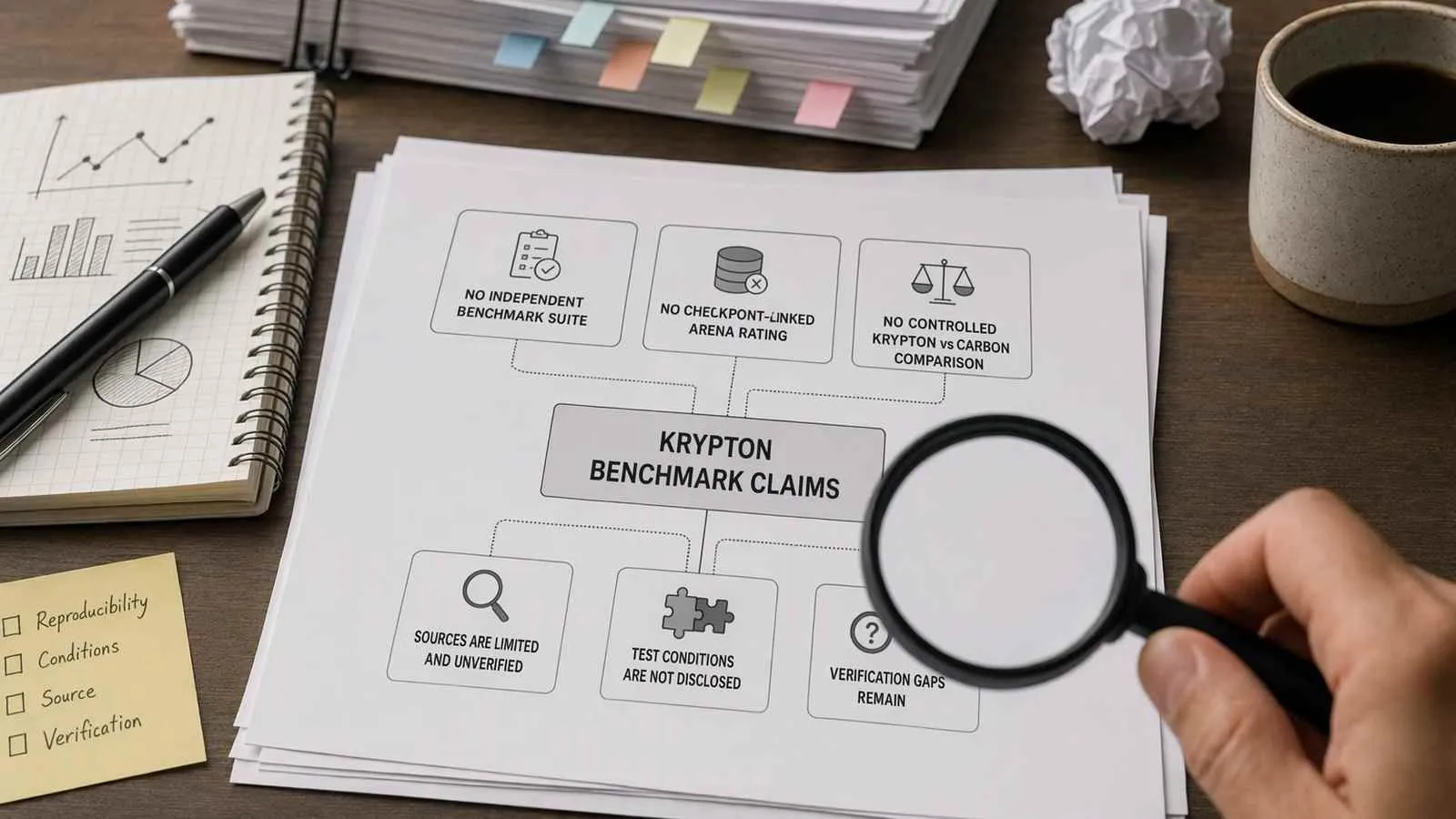
There is no independently reproducible Gemini 4 Krypton benchmark suite, verified checkpoint-linked Arena rating, or controlled Krypton-versus-Carbon accuracy comparison in the available evidence.
The claimed Intelligence Index score is especially easy to misread. Kie.ai describes the circulated score of 64 as a personal forecast, not a measured result. It should not appear in a benchmark table beside measured Carbon results without that distinction.
Which benchmark numbers are documented?
| Evaluation | Documented result | What it does not establish |
|---|---|---|
| FrontierSWE 2 | Carbon 61.2%; Argon 55.0% | Any Krypton score |
| RiemannBench | Carbon 72.0%; Argon 76.0% | Carbon superiority on every task |
| Artificial Analysis Intelligence Index v5.0 | Carbon launch claim: 59 | A current ranking or a Krypton baseline on another version |
| Artificial Analysis Intelligence Index v5.0.1 | Reviewed Carbon high-thinking page: 60 | A confirmed model update explaining the score change |
| Circulated Krypton Intelligence Index prediction | Forecast: 64 | A measured benchmark result |
The first two rows come from Google DeepMind's published comparison table. Google's October 28 Carbon announcement reported a score of 59 and first place on Intelligence Index version 5.0.
The Artificial Analysis Carbon page reviewed on November 18 displays 60 on version 5.0.1. Because the index versions differ, the change cannot be treated as proof that Carbon itself was updated. The launch ranking is historical, not a statement of today's leaderboard position.
What would make a Krypton comparison credible?
A reproducible test needs model identity, complete prompts, settings, scoring rules, and usage records. Without those, the reader cannot tell whether a result reflects the model, the reasoning budget, or selection of a favorable example.
Two comparisons are useful:
Matched-setting evaluation: use comparable prompts, tools, and reasoning configurations to investigate capability differences.
Matched-budget evaluation: compare results under a common cost or latency constraint to assess practical value.
They answer different questions. A model that performs better after a much longer run may still be useful for difficult offline work, but less suitable for an interactive product.
For coding tasks, report test completion and repair requirements alongside visual quality. For long-running tasks, record total completion time separately from time to first token. Avoid collapsing all performance into one speed number.
Why repeated demos remain insufficient
OfficeChai's voxel-scene coverage does not label which model produced each clip or explain how the poster obtained Krypton access. Those missing details prevent even a basic identity-linked comparison.
Several attractive examples can suggest a promising direction. They cannot establish average accuracy, failure frequency, or production reliability without a defined sample and scoring process.
Gemini 4 Krypton vs Gemini 4 Carbon: Compare Only Verifiable Details
For deployment today, Carbon is the actionable option between these two names because Google documents its access and capabilities. That is an availability recommendation, not a claim that Carbon defeats an unknown model.
Google's Carbon developer guide describes it as its strongest reasoning model for sustained agentic software engineering, multimodal knowledge work, scientific reasoning, and cybersecurity defense.
| Dimension | Gemini 4 Carbon | Gemini 4 Krypton |
|---|---|---|
| Official status | Released and documented | Unconfirmed name |
| Model ID | gemini-4-carbon | No verified Google endpoint |
| Inputs | Text, images, video, audio, PDFs | Unknown |
| Output modality | Text | Unknown |
| Tools | Code execution, computer use, function calling, structured outputs, grounding | Unknown |
| Thinking levels | Low, medium, high; medium default | Unknown |
| Native audio/image generation | Unsupported | Unknown |
| Live API | Unsupported | Unknown |
| Public benchmarks | Published results with identifiable sources | No independently verified suite |
| Pricing | Published, with scheduled changes | Unknown |
| Production choice | Evaluate against your workload | Do not depend on it yet |
Carbon's modalities and tools are documented in its official model specification. The same page marks audio generation, image generation, and Live API support as unsupported.
Audio input therefore does not imply spoken output or a real-time voice session. This distinction matters when choosing a reasoning model for a voice interface.
How Carbon compares with the other released choices
The released catalog offers more useful alternatives than a speculative Krypton comparison:
- Carbon: evaluate first for difficult reasoning and sustained agentic work.
- Argon: evaluate when response speed and token spending matter. Google's Argon guide describes faster responses and lower token spending per turn than Carbon across complex coding, agentic, mathematics, and science tasks.
- Hydrogen: evaluate when free-tier access is useful or you want to test its additional reasoning control. Its developer guide documents low, medium, high, and xhigh thinking levels, with high as default.
Defaults can distort comparisons. Carbon defaults to medium thinking, while Hydrogen defaults to high. A slower, more elaborate answer at default settings is not by itself evidence of a stronger model.
Access, API Availability and Pricing: Confirmed Details or Unknowns
There is no verified public Krypton endpoint, official price, or subscription entitlement. A page titled “Gemini 4 Krypton API” does not resolve those gaps.
TeamoRouter's model page calls “gemini-krypton” a provisional ID and labels availability “Coming soon, unconfirmed.” CometAPI's Krypton landing page marks its November 13 snapshot “Coming soon,” despite generic sections describing production access and API health.
When those sections conflict, the listing should not be treated as verified access. Google's catalog remains the stronger reference for official model identifiers.
What access is documented instead?
Google's November 10 Carbon availability announcement opened API access to paying developers and enterprises and announced rollout to Google AI Ultra subscribers through Antigravity, the Gemini app, and AI Mode in Search.
Hydrogen's developer guide documents free and paid access in Google AI Studio and the Gemini API, with GenerateContent and Interactions API support. These are Hydrogen access facts, not evidence of Krypton access under another name.
Current prices and scheduled changes
According to the official Gemini Developer API pricing page, Carbon and Argon standard pricing is $2 per million input tokens and $10 per million output tokens through November 30, 2026. On December 1, the scheduled prices become $4 and $20, respectively.
The same pricing tables include thinking tokens in billed output and list neither model on the Developer API's free tier.
Google's Hydrogen launch article lists standard paid pricing of $1.50 per million input tokens and $7.50 per million output tokens, flat across its million-token context window.
Do not apply any of these prices to Krypton. Do not estimate its bill from the reported animation runtime either: its identity, actual usage, and pricing are all unresolved.
How to Evaluate New Reports and Avoid Misleading Claims
Use this sequence when a new Gemini 4 Krypton announcement, benchmark screenshot, or access page appears.
1. Identify exactly what changed
Ask whether the report adds official confirmation, an access record, a reproducible test, or another prediction. A new article repeating an old demonstration is not a new model result.
Separate the publication date from the date of the underlying claim. A recently updated page can still rely on an older, subsequently corrected post.
2. Check identity before judging output quality
Look for a Google-documented model ID. For an alias claim, require evidence connecting the alias to the alleged checkpoint.
Do not assume Design Arena and Arena references describe the same platform, model deployment, or test configuration. An impressive output cannot authenticate its own model label.
3. Keep measurements in separate columns
Record runtime, thinking tokens, visible output tokens, code size, and task success separately. The reported roughly twice-as-long runtime claim is not the same measurement as the approximately 5.5-fold thinking-token difference.
Also separate estimated values from usage records. An arithmetic total may be useful as a consistency check, but not as verified consumption.
4. Prefer corrected and newer official records
Older November 9 guides describe Argon as the only public Gemini 4 model and Hydrogen as rumored. The later official changelog establishes Carbon availability on November 10 and Hydrogen availability on November 12.
For the November 14 Arena incident, retain the correction alongside the initial claim. Otherwise, a withdrawn identification can keep circulating as evidence.
Status and update log
| Date | Event to retain | Current interpretation |
|---|---|---|
| November 8–9 | Early Krypton claims and demonstrations circulated | Community reports, not official confirmation |
| November 10 | Carbon became generally available | Older restricted-access descriptions are outdated |
| November 12 | Hydrogen became generally available | Hydrogen is released, not merely rumored |
| November 14 | Prominent Hydrogen-alias claim was retracted | Initial Krypton identification is not reliable |
| November 16 | New Carbon-alias rumor circulated | Checkpoint identity remains unverified |
| November 18 | Catalog and release status checked | No documented Krypton release, endpoint, or price |
Bottom line: monitor Krypton, but select from documented models. Use the official model catalog for identifiers, the changelog for releases, and the current model comparison for choosing your next evaluation.
How to Build an App Like This with Tencent RTC
You can build a voice-agent interface without depending on an unconfirmed model. Keep the reasoning provider replaceable, and separate speech processing, conversation logic, and real-time media transport.
Tencent RTC Conversational AI supports real-time voice AI agents built around an LLM. Check the Conversational AI documentation for supported integration paths and limitations; that does not establish compatibility with unreleased Krypton. For custom real-time media requirements, review Tencent RTC RTC Engine.
Open Tencent RTC AI Agents Skills and follow the repository instructions to load the appropriate Skills in your AI coding assistant. Describe your existing project, platform, model provider, and desired interaction:
Add a real-time voice-agent interface to my existing web application. Inspect the project first, keep the LLM provider replaceable, and explain how to verify microphone permissions, interruption handling, credential protection, and connection recovery.
Review generated changes and test actual interactions. Do not assume the first generated implementation is production-ready.
FAQ
Is Gemini 4 Krypton officially announced?
No official announcement was found as of November 18, 2026. Google's documented Gemini 4 catalog lists Argon, Carbon, and Hydrogen, but no Krypton model entry.
What is the Gemini 4 Krypton release date?
There is no confirmed release date. Late-November and December expectations, including November 25 and December 8, are community predictions rather than Google commitments.
Is Gemini 4 Krypton better than Gemini 4 Carbon?
That has not been established. Selected tester demonstrations claim stronger outputs, but there is no verified checkpoint-linked, controlled comparison of accuracy, cost, and latency.
Does Gemini 4 Krypton have an official benchmark score?
No verified score was found. The circulated Artificial Analysis Intelligence Index figure of 64 is a forecast, not a measured benchmark result.
Can I access Gemini 4 Krypton through an API?
No verified public Google endpoint or successful public API request was found. Commercial “coming soon” pages and provisional IDs do not establish official availability.
Is Krypton secretly available as Hydrogen or Carbon?
There is no verified evidence of that equivalence. A prominent November 14 Hydrogen-alias claim was retracted, and a later Carbon-alias rumor remains unconfirmed.
Can Gemini 4 Krypton generate video or real-time audio?
Those capabilities are unknown. A reported code-generated animation does not demonstrate native video output, and no official Krypton specification confirms audio generation or real-time voice support.
Should I wait for Krypton before choosing a Gemini model?
Not for a production deadline. Evaluate released models against your workload and keep the provider replaceable so a future documented model can be tested without blocking current development.