





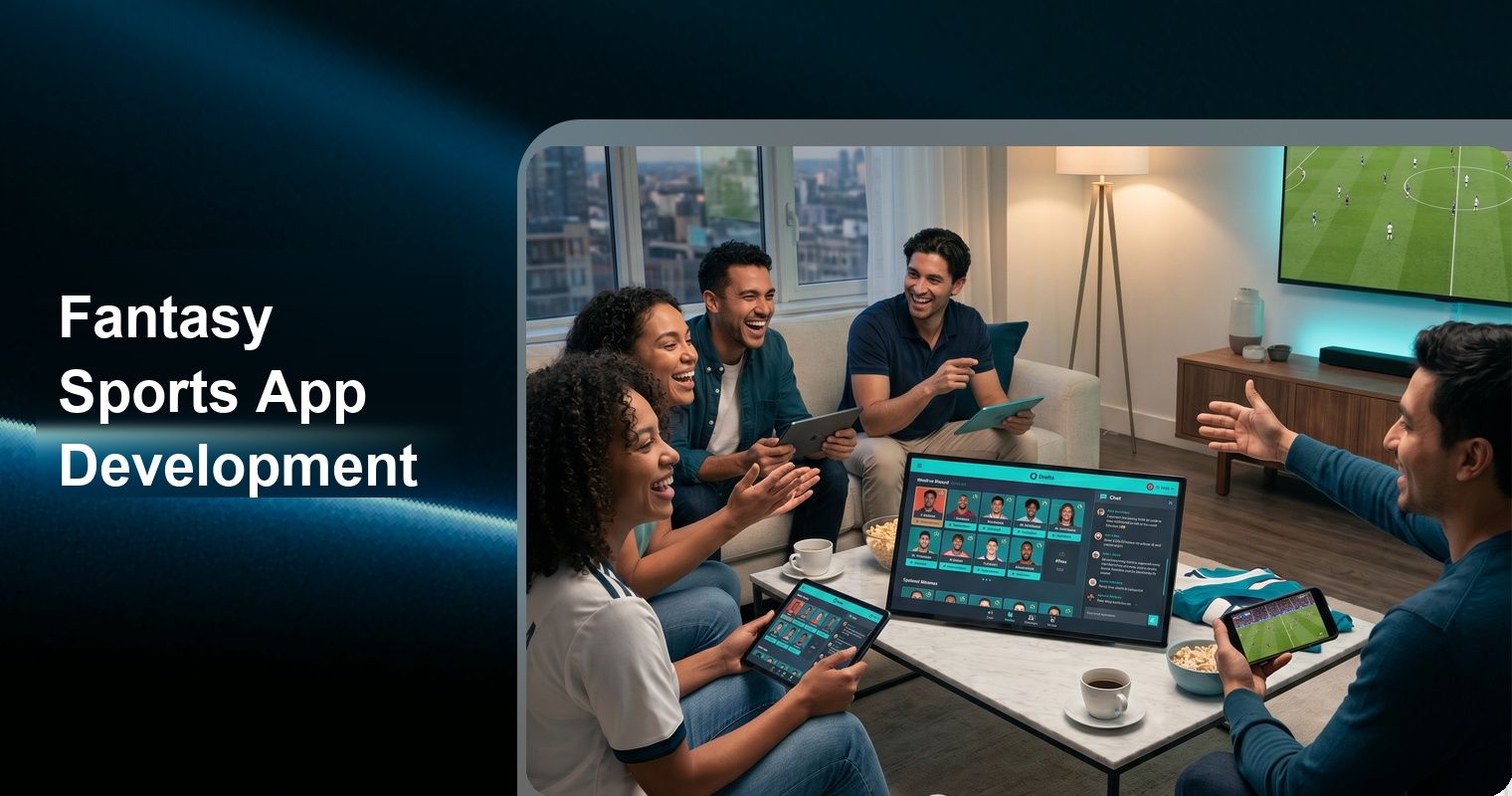
The global fantasy sports market is valued at over $34 billion in 2025 and projected to reach $62.58 billion by 2029 at a 13.83% CAGR, according to industry research from Research and Markets and Mordor Intelligence. With 91% of fantasy sports users accessing platforms via smartphones, the opportunity for custom fantasy sports app development has never been larger.
But here's the gap most fantasy sports app development companies miss: the social layer. Platforms like DraftKings, FanDuel, and Sleeper have proven that real-time interaction — live draft rooms, league chat, and watch parties — is what separates sticky apps from abandoned downloads. Sleeper's entire competitive advantage is built on real-time messaging and social features that keep league members engaged year-round.
This guide covers the complete fantasy sports app development process, with deep implementation details on the real-time features that drive retention: voice-enabled draft rooms, persistent league chat, synchronized watch parties, and live score push. You'll get working code for each feature using Tencent RTC SDKs.
TL;DR
- The $34B fantasy sports market demands real-time social features (voice drafts, league chat, watch parties) as the key differentiator—not just scoring engines
- Voice-enabled draft rooms achieve 85-95% completion rates vs. 40-60% for text-based drafts
- TRTC's GVoice, Chat SDK, and Live SDK cover the entire real-time layer: draft voice, persistent messaging, and synchronized streaming
- MVP development costs $115K-$180K (3-4 months); full platform with watch parties and DFS runs $240K-$385K
- Using pre-built SDKs saves $80K-$150K in initial development vs. building real-time infrastructure from scratch
Why Real-Time Features Define Fantasy Sports App Success
Traditional fantasy sports app development focuses on three pillars: player databases, scoring engines, and contest management. These are table stakes. The differentiator in 2025 is the real-time social layer.
Consider what happens during an NFL Sunday:
- Pre-game: League members discuss last-minute lineup changes
- Draft: 8-12 players pick simultaneously under time pressure, reacting verbally to each pick
- Game time: Members watch together, react to plays, and trash-talk in real time
- Post-game: Scores update live, triggering celebrations or complaints
Every one of these moments requires sub-second communication infrastructure. Building this from scratch costs $200,000+ in engineering time. Fantasy sports app development services that leverage pre-built SDKs cut this to weeks instead of months.
What Top Fantasy Apps Get Right
| Platform | Key Real-Time Feature | User Impact |
|---|---|---|
| Sleeper | In-app league chat with reactions | 70% DAU/MAU ratio |
| DraftKings | Live scoring with Flash Bet | 15M+ monthly active users |
| FanDuel | FanDuel TV with live odds overlay | Highest user satisfaction scores |
| Underdog Fantasy | Pick'em with real-time leaderboards | Fastest-growing DFS platform |
The pattern is clear: fantasy sports app development solutions that prioritize real-time engagement outperform those that treat social as an afterthought.
Fantasy Sports App Architecture: The Real-Time Stack
A production fantasy sports app needs five infrastructure layers:
┌─────────────────────────────────────────────────┐
│  Client Layer (React Native / Flutter)           │
├─────────────────────────────────────────────────┤
│  Real-Time Layer (Voice / Chat / Live Stream)    │
├─────────────────────────────────────────────────┤
│  Game Logic Layer (Scoring / Contests / Drafts)  │
├─────────────────────────────────────────────────┤
│  Data Layer (Player Stats / Odds / Schedules)    │
├─────────────────────────────────────────────────┤
│  Infrastructure (Cloud / CDN / Auth)             │
└─────────────────────────────────────────────────┘
Most fantasy sports app development companies handle layers 3-5 competently. Layer 2 — the real-time communication layer — is where projects fail or succeed. This layer handles:
- Voice communication: Draft room audio with 8-12 simultaneous speakers
- Messaging: Persistent league chat with rich media, reactions, and threads
- Live streaming: Synchronized video watch parties with low latency
- Event push: Real-time score updates, injury alerts, and trade notifications
TRTC provides the complete real-time layer through three products that map directly to fantasy sports use cases:
| Fantasy Feature | TRTC Product | Capability |
|---|---|---|
| Live Draft Room | GVoice | Multi-user voice rooms + screen sharing |
| League Chat | Chat SDK | Group messaging, reactions, file sharing |
Start with the free Chat API — free forever — 1,000 MAU, no concurrency limits, push notifications included. | Watch Party | Live SDK | Multi-viewer synchronized streaming | | Score Push | Interactive Game Console | Real-time event distribution |
Feature 1: Live Draft Room with GVoice
The draft is the highest-engagement moment in any fantasy sports league. A voice-enabled draft room transforms a solitary clicking exercise into a social event. Players hear reactions, engage in real-time negotiation, and experience the pressure of live picks.
Why Voice Matters for Drafts
Text-based drafts have 40-60% completion rates — participants lose interest and auto-draft. Voice-enabled drafts see 85-95% completion rates because the social pressure and entertainment value keeps everyone present.
Technical requirements for a fantasy draft room:
- 8-12 simultaneous speakers with individual volume control
- Sub-200ms latency so reactions feel immediate
- Screen sharing for the draft board visualization
- Push-to-talk option for users in noisy environments
- Automatic gain control to normalize volume across devices
- Echo cancellation for users on speaker mode
GVoice Draft Room Implementation
GVoice is designed for exactly this use case — multi-user voice rooms in gaming and social applications. Here's how to implement a fantasy draft room:
Step 1: Install and Initialize GVoice SDK
import { GVoiceEngine } from '@tencentcloud/gvoice-sdk';

// Initialize GVoice engine
const gvoice = new GVoiceEngine();

await gvoice.init({
  appId: 'YOUR_GVOICE_APP_ID',
  openId: currentUser.id, // Unique user identifier
  logLevel: 'info'
});

// Set voice mode to RealTime for draft room
gvoice.setMode('RealTime');
Step 2: Create and Join a Draft Room
// Commissioner creates the draft room
async function createDraftRoom(leagueId, draftConfig) {
  const roomId = `draft_${leagueId}_${Date.now()}`;

  // Join the voice room
  await gvoice.joinRoom({
    roomId: roomId,
    roomType: 'Team', // Supports up to 20 speakers
    role: 'Anchor'    // Commissioner has anchor privileges
  });

  // Enable microphone
  await gvoice.enableMic(true);

  // Enable speaker
  await gvoice.enableSpeaker(true);

  console.log(`Draft room created: ${roomId}`);
  return roomId;
}

// League members join the draft room
async function joinDraftRoom(roomId, userId) {
  await gvoice.joinRoom({
    roomId: roomId,
    roomType: 'Team',
    role: 'Audience' // Members start as audience, unmute when it's their pick
  });

  await gvoice.enableSpeaker(true);

  // Mute by default — unmute during own pick or open discussion
  await gvoice.enableMic(false);

  return { roomId, userId, joined: true };
}
Step 3: Draft Turn Management with Voice Control
// Manage speaking privileges during draft turns
class DraftVoiceController {
  constructor(gvoiceInstance, participants) {
    this.gvoice = gvoiceInstance;
    this.participants = participants;
    this.currentPicker = null;
    this.freeChat = false;
  }

  // When it's a player's turn to pick
  async onTurnStart(userId) {
    this.currentPicker = userId;

    // Unmute the active picker
    if (userId === this.localUserId) {
      await this.gvoice.enableMic(true);
    }

    // Notify all participants
    this.emit('turnChange', {
      picker: userId,
      timeRemaining: 90 // 90-second pick timer
    });
  }

  // Enable free chat between rounds
  async enableFreeChat() {
    this.freeChat = true;
    await this.gvoice.enableMic(true);
    this.emit('freeChatEnabled');
  }

  // Mute all except commissioner for announcements
  async commissionerAnnouncement() {
    this.freeChat = false;
    for (const participant of this.participants) {
      if (participant.role !== 'commissioner') {
        // Server-side mute via GVoice admin API
        await this.gvoice.muteRemoteUser(participant.id, true);
      }
    }
  }
}
Step 4: Screen Sharing for Draft Board
// Share draft board screen so all participants see picks in real time
async function shareDraftBoard(trtcInstance) {
  // Start screen sharing using TRTC screen capture
  await trtcInstance.startScreenShare({
    screenSource: 'window', // Share the draft board window
    encoderConfig: {
      width: 1920,
      height: 1080,
      frameRate: 15,
      bitrate: 1500
    }
  });

  console.log('Draft board screen sharing started');
}
This implementation gives your fantasy sports app a live draft experience comparable to ESPN's draft lobby, but with full voice communication that creates the "draft party" atmosphere users love. For complete GVoice integration details, refer to the TRTC documentation.
Feature 2: League Chat with Chat SDK
Fantasy leagues live or die by year-round engagement. The draft happens once. Chat happens every day. A persistent league chat channel keeps members trading, trash-talking, and strategizing between games.
Chat Requirements for Fantasy Sports
- Group channels: One per league (8-16 members typical)
- Rich messages: Player cards, trade proposals, lineup screenshots
- Reactions: Quick emoji responses to picks and outcomes
- Threads: Focused discussions on specific trades or matchups
- Push notifications: Customizable alerts for trades, waivers, and messages
- Message history: Searchable archive for trade disputes
- Moderation: Commissioner tools to pin messages, mute users
Chat SDK League Channel Implementation
The Chat SDK provides all these capabilities out of the box. Here's how to build league chat:
Step 1: Initialize Chat SDK
import TencentCloudChat from '@tencentcloud/chat';

// Create Chat SDK instance
const chat = TencentCloudChat.create({
  SDKAppID: YOUR_SDK_APP_ID
});

// Set log level for development
chat.setLogLevel(1);

// Login user
await chat.login({
  userID: currentUser.id,
  userSig: generateUserSig(currentUser.id) // Server-generated auth token
});
Step 2: Create League Group Channel
// Create a league chat group when a new league is formed
async function createLeagueChannel(leagueId, leagueName, members) {
  const groupConfig = {
    type: TencentCloudChat.TYPES.GRP_PUBLIC,
    name: `${leagueName} Chat`,
    groupID: `league_${leagueId}`,
    introduction: `Official chat for ${leagueName}`,
    memberList: members.map(member => ({
      userID: member.id,
      role: member.isCommissioner
        ? TencentCloudChat.TYPES.GRP_MBR_ROLE_ADMIN
        : TencentCloudChat.TYPES.GRP_MBR_ROLE_MEMBER
    })),
    groupCustomField: [
      { key: 'leagueId', value: leagueId },
      { key: 'sport', value: 'NFL' },
      { key: 'season', value: '2025' }
    ]
  };

  const { data: { group } } = await chat.createGroup(groupConfig);
  console.log(`League channel created: ${group.groupID}`);
  return group;
}
Step 3: Send Rich Fantasy Messages
// Send a trade proposal as a custom message
async function sendTradeProposal(groupId, trade) {
  const tradeMessage = chat.createCustomMessage({
    to: groupId,
    conversationType: TencentCloudChat.TYPES.CONV_GROUP,
    payload: {
      data: JSON.stringify({
        type: 'TRADE_PROPOSAL',
        fromTeam: trade.fromTeam,
        toTeam: trade.toTeam,
        playersOffered: trade.playersOffered, // ['Patrick Mahomes', 'Tyreek Hill']
        playersRequested: trade.playersRequested, // ['Josh Allen', 'Stefon Diggs']
        expiresAt: trade.expiresAt,
        status: 'pending'
      }),
      description: `${trade.fromTeam.name} proposes a trade to ${trade.toTeam.name}`,
      extension: 'trade_proposal_v1'
    }
  });

  await chat.sendMessage(tradeMessage);
}

// Send player card with real-time stats
async function sendPlayerCard(groupId, player) {
  const playerCard = chat.createCustomMessage({
    to: groupId,
    conversationType: TencentCloudChat.TYPES.CONV_GROUP,
    payload: {
      data: JSON.stringify({
        type: 'PLAYER_CARD',
        playerId: player.id,
        name: player.name,
        team: player.team,
        position: player.position,
        seasonPoints: player.fantasyPoints,
        projectedPoints: player.projection,
        injuryStatus: player.injury,
        thumbnailUrl: player.avatarUrl
      }),
      description: `${player.name} (${player.position} - ${player.team})`,
      extension: 'player_card_v1'
    }
  });

  await chat.sendMessage(playerCard);
}
Step 4: Listen for Real-Time Messages
// Set up message listeners for the league chat
function setupChatListeners(chat) {
  // New message received
  chat.on(TencentCloudChat.EVENT.MESSAGE_RECEIVED, (event) => {
    const messages = event.data;

    messages.forEach(msg => {
      if (msg.type === TencentCloudChat.TYPES.MSG_CUSTOM) {
        const payload = JSON.parse(msg.payload.data);

        switch (payload.type) {
          case 'TRADE_PROPOSAL':
            renderTradeProposal(payload);
            showNotification(`New trade proposal in ${msg.conversationID}`);
            break;
          case 'PLAYER_CARD':
            renderPlayerCard(payload);
            break;
          case 'SCORE_UPDATE':
            updateLiveScoreboard(payload);
            break;
          default:
            renderTextMessage(msg);
        }
      }
    });
  });

  // Member joins/leaves
  chat.on(TencentCloudChat.EVENT.GROUP_SYSTEM_NOTICE_RECEIVED, (event) => {
    handleGroupNotice(event.data);
  });
}
This league chat implementation keeps your fantasy app's community alive between draft day and championship week. The custom message types for trade proposals and player cards create fantasy-specific interactions that generic messaging apps can't match.
Feature 3: Watch Party with Live SDK
The watch party is where fantasy sports and live entertainment merge. League members watch games together, react to their players' performances in real time, and see live scoring overlays. This is the feature that transforms a utility app into a social platform.
Watch Party Requirements
- Synchronized playback: All viewers see the same moment (< 3s variance)
- Low-latency audio: Voice overlay for group reactions
- Scoring overlay: Fantasy point totals updating in real time
- Multi-stream: Switch between games where league members have active players
- Capacity: Support 8-16 viewers per league party, 1000+ for public events
Live SDK Watch Party Implementation
The Live SDK handles synchronized streaming and viewer interaction. Here's the implementation:
Step 1: Initialize TRTC for Live Streaming
import TRTC from 'trtc-sdk-v5';

// Create TRTC instance for watch party
const trtc = TRTC.create();

// Handle errors
trtc.on(TRTC.EVENT.ERROR, (error) => {
  console.error('TRTC Error:', error);
});
Step 2: Host Creates Watch Party Room
// Watch party host initiates the stream
async function createWatchParty(leagueId, gameIds) {
  const roomId = `watch_${leagueId}_week${getCurrentWeek()}`;

  // Enter room as host
  await trtc.enterRoom({
    strRoomId: roomId,
    scene: 'live',
    sdkAppId: YOUR_SDK_APP_ID,
    userId: currentUser.id,
    userSig: generateUserSig(currentUser.id),
    role: 'anchor' // Host role
  });

  // Start publishing camera + microphone for host commentary
  await trtc.startLocalVideo({
    view: document.getElementById('host-video'),
    profile: '720p'
  });

  await trtc.startLocalAudio({ profile: 'speech' });

  // Start screen share of live game feed
  await trtc.startScreenShare({
    screenSource: 'screen',
    encoderConfig: {
      width: 1920,
      height: 1080,
      frameRate: 30,
      bitrate: 2500
    },
    view: document.getElementById('game-feed')
  });

  return { roomId, gameIds, status: 'live' };
}
Step 3: League Members Join Watch Party
// Members join as audience
async function joinWatchParty(roomId) {
  await trtc.enterRoom({
    strRoomId: roomId,
    scene: 'live',
    sdkAppId: YOUR_SDK_APP_ID,
    userId: currentUser.id,
    userSig: generateUserSig(currentUser.id),
    role: 'audience'
  });

  // Subscribe to host's streams
  trtc.on(TRTC.EVENT.REMOTE_VIDEO_AVAILABLE, ({ userId, streamType }) => {
    const viewElement = streamType === 'main'
      ? document.getElementById('game-feed-view')
      : document.getElementById(`host-camera-${userId}`);

    trtc.startRemoteVideo({ userId, streamType, view: viewElement });
  });

  trtc.on(TRTC.EVENT.REMOTE_AUDIO_AVAILABLE, ({ userId }) => {
    trtc.startRemoteAudio({ userId });
  });
}
Step 4: Fantasy Scoring Overlay
// Overlay real-time fantasy scores on the watch party stream
class FantasyScoreOverlay {
  constructor(canvasElement, leagueId) {
    this.canvas = canvasElement;
    this.ctx = canvasElement.getContext('2d');
    this.leagueId = leagueId;
    this.scores = new Map();
  }

  // Connect to score update stream
  connectScoreFeed() {
    const eventSource = new EventSource(
      `/api/leagues/${this.leagueId}/scores/stream`
    );

    eventSource.onmessage = (event) => {
      const update = JSON.parse(event.data);
      this.scores.set(update.teamId, {
        teamName: update.teamName,
        points: update.totalPoints,
        lastPlay: update.lastScoringPlay
      });
      this.render();
    };
  }

  // Render scoreboard overlay
  render() {
    this.ctx.clearRect(0, 0, this.canvas.width, 120);
    this.ctx.fillStyle = 'rgba(0, 0, 0, 0.75)';
    this.ctx.fillRect(0, 0, this.canvas.width, 120);

    let x = 20;
    this.scores.forEach((score, teamId) => {
      this.ctx.fillStyle = '#FFFFFF';
      this.ctx.font = 'bold 14px Inter';
      this.ctx.fillText(score.teamName, x, 30);

      this.ctx.font = 'bold 28px Inter';
      this.ctx.fillStyle = '#00FF88';
      this.ctx.fillText(score.points.toFixed(1), x, 65);

      this.ctx.font = '11px Inter';
      this.ctx.fillStyle = '#AAAAAA';
      this.ctx.fillText(score.lastPlay, x, 90);

      x += 180;
    });
  }
}

// Usage
const overlay = new FantasyScoreOverlay(
  document.getElementById('score-overlay'),
  leagueId
);
overlay.connectScoreFeed();
Watch parties are the engagement moat. Users who participate in watch parties show 3x higher weekly retention compared to users who only check scores. The Live SDK makes this possible without building streaming infrastructure from scratch.
Feature 4: Real-Time Score Push and Event System
Live scoring is the heartbeat of any fantasy sports app. Every touchdown, three-pointer, or home run needs to reach every affected user within seconds. This isn't just about displaying numbers — it's about triggering emotions, notifications, and downstream actions (auto-substitutions, waiver claims, trade alerts).
Event Architecture for Fantasy Scoring
// Server-side: Real-time scoring event system
import TencentCloudChat from '@tencentcloud/chat';

class FantasyScoreEngine {
  constructor(chatInstance) {
    this.chat = chatInstance;
    this.activeGames = new Map();
    this.leagueSubscriptions = new Map();
  }

  // Process incoming stat update from sports data provider
  async processStatUpdate(statEvent) {
    const { playerId, statType, value, gameId, timestamp } = statEvent;

    // Calculate fantasy points based on scoring rules
    const fantasyPoints = this.calculatePoints(statType, value);

    // Find all leagues/teams affected by this player's performance
    const affectedTeams = await this.getTeamsWithPlayer(playerId);

    for (const team of affectedTeams) {
      const scoreUpdate = {
        type: 'SCORE_UPDATE',
        playerId,
        playerName: team.playerName,
        statType,
        statValue: value,
        pointsEarned: fantasyPoints,
        teamId: team.teamId,
        teamTotalPoints: team.currentTotal + fantasyPoints,
        matchupOpponentPoints: team.opponentTotal,
        gameId,
        timestamp
      };

      // Push to league group chat as system message
      await this.pushToLeagueChat(team.leagueGroupId, scoreUpdate);

      // Push to individual user via custom notification
      await this.pushToUser(team.ownerId, scoreUpdate);
    }
  }

  // Push score update to league chat channel
  async pushToLeagueChat(groupId, scoreUpdate) {
    const message = this.chat.createCustomMessage({
      to: groupId,
      conversationType: TencentCloudChat.TYPES.CONV_GROUP,
      payload: {
        data: JSON.stringify(scoreUpdate),
        description: `${scoreUpdate.playerName}: +${scoreUpdate.pointsEarned} pts (${scoreUpdate.statType})`,
        extension: 'score_update_v1'
      }
    });

    await this.chat.sendMessage(message);
  }

  // Calculate fantasy points based on scoring format
  calculatePoints(statType, value) {
    const scoringRules = {
      'passing_td': 4,
      'rushing_td': 6,
      'receiving_td': 6,
      'passing_yard': 0.04,
      'rushing_yard': 0.1,
      'receiving_yard': 0.1,
      'reception': 1, // PPR format
      'interception': -2,
      'fumble_lost': -2,
      'field_goal': 3,
      'three_pointer': 1.5, // NBA
      'home_run': 4 // MLB
    };

    return (scoringRules[statType] || 0) * value;
  }
}
Client-Side Score Rendering
// Real-time matchup scoreboard component
class LiveMatchup {
  constructor(chatInstance, leagueGroupId) {
    this.chat = chatInstance;
    this.groupId = leagueGroupId;
    this.myTeamPoints = 0;
    this.opponentPoints = 0;
    this.scoringPlays = [];
  }

  // Listen for score updates via Chat SDK messages
  startListening() {
    this.chat.on(TencentCloudChat.EVENT.MESSAGE_RECEIVED, (event) => {
      event.data.forEach(msg => {
        if (msg.type === TencentCloudChat.TYPES.MSG_CUSTOM) {
          const payload = JSON.parse(msg.payload.data);

          if (payload.type === 'SCORE_UPDATE') {
            this.handleScoreUpdate(payload);
          }
        }
      });
    });
  }

  handleScoreUpdate(update) {
    // Update totals
    if (update.teamId === this.myTeamId) {
      this.myTeamPoints = update.teamTotalPoints;
      this.animateScoreChange('my-score', update.pointsEarned);
    } else if (update.teamId === this.opponentTeamId) {
      this.opponentPoints = update.teamTotalPoints;
      this.animateScoreChange('opponent-score', update.pointsEarned);
    }

    // Add to scoring play feed
    this.scoringPlays.unshift({
      player: update.playerName,
      points: update.pointsEarned,
      stat: update.statType,
      timestamp: update.timestamp
    });

    this.renderMatchup();

    // Trigger haptic feedback on mobile for big plays
    if (Math.abs(update.pointsEarned) >= 6) {
      navigator.vibrate?.(200);
    }
  }

  animateScoreChange(elementId, points) {
    const el = document.getElementById(elementId);
    const floater = document.createElement('span');
    floater.className = points > 0 ? 'score-float positive' : 'score-float negative';
    floater.textContent = `${points > 0 ? '+' : ''}${points.toFixed(1)}`;
    el.appendChild(floater);
    setTimeout(() => floater.remove(), 2000);
  }
}
The combination of Chat SDK for message delivery and Server-Sent Events for high-frequency updates gives you both reliability (messages are persisted and searchable) and performance (sub-second latency for live scoring). For apps handling 10,000+ concurrent users during peak NFL hours, this architecture scales horizontally without redesign.
Custom Fantasy Sports App Development: Complete Tech Stack
Here's the full recommended technology stack for fantasy sports app development, combining best-in-class tools for each layer:
Frontend
| Component | Recommendation | Why |
|---|---|---|
| Framework | React Native | Single codebase for iOS + Android, 90% code share |
| State Management | Zustand + React Query | Lightweight, excellent real-time data handling |
| UI Components | Tailwind + custom design system | Fast iteration, consistent brand |
| Charts/Viz | Victory Native | Performance-optimized for mobile stat displays |
Backend
| Component | Recommendation | Why |
|---|---|---|
| API | Node.js with Fastify | High throughput, excellent WebSocket support |
| Database | PostgreSQL + Redis | ACID for transactions, Redis for leaderboards/caching |
| Search | Elasticsearch | Fast player search and stat queries |
| Queue | Bull (Redis-backed) | Reliable job processing for score calculations |
| Sports Data | Sportradar API | Industry standard, 40+ sports, real-time feeds |
Real-Time Communication (TRTC)
| Feature | Product | Integration |
|---|---|---|
| Draft Voice Room | GVoice | 8-20 speaker rooms, echo cancellation, PTT |
| League Chat | Chat SDK | Group messaging, custom messages, push |
| Watch Party | Live SDK | Sub-second streaming, screen share |
| Game Console | Interactive Game Console | Real-time event distribution, input sync |
Infrastructure
| Component | Recommendation | Why |
|---|---|---|
| Cloud | AWS or Tencent Cloud | Global edge nodes, auto-scaling |
| CDN | CloudFront / Tencent CDN | Low-latency asset delivery |
| Auth | Auth0 or Clerk | Social login, MFA, compliance |
| Monitoring | Datadog | Real-time alerting for latency spikes |
| CI/CD | GitHub Actions | Automated testing and deployment |
Fantasy Sports App Development Cost Breakdown
Understanding costs upfront prevents budget overruns. Here's a realistic breakdown for custom fantasy sports app development in 2025:
MVP (3-4 months)
| Category | Scope | Cost Range |
|---|---|---|
| UI/UX Design | Core flows (draft, roster, matchup) | $15,000 - $25,000 |
| Frontend Development | iOS + Android (React Native) | $40,000 - $60,000 |
| Backend Development | API, scoring engine, contests | $35,000 - $50,000 |
| Real-Time Features (TRTC) | Chat + basic voice | $10,000 - $15,000 |
| Sports Data API | Sportradar license | $5,000 - $15,000/year |
| Testing & QA | Automated + manual | $10,000 - $15,000 |
| Total MVP | $115,000 - $180,000 |
Full Platform (6-9 months)
| Category | Added Scope | Additional Cost |
|---|---|---|
| Watch Party (Live SDK) | Synchronized streaming | $20,000 - $35,000 |
| Advanced Draft Room | Voice + screen sharing | $15,000 - $25,000 |
| DFS Engine | Daily contests, prize pools | $30,000 - $45,000 |
| Payment Integration | Deposits, withdrawals, prizes | $20,000 - $30,000 |
| Admin Dashboard | Commissioner tools, moderation | $15,000 - $20,000 |
| Compliance & Legal | State licensing, KYC/AML | $25,000 - $50,000 |
| Total Full Platform | $240,000 - $385,000 |
TRTC Cost Advantage
Using TRTC SDKs instead of building real-time infrastructure from scratch saves $80,000 - $150,000 in initial development and $15,000 - $30,000/month in ongoing infrastructure costs. The SDKs handle:
- Global edge network (2800+ nodes)
- Automatic codec optimization
- Device compatibility across 18,000+ device models
- 99.99% uptime SLA
- Automatic scaling for peak events (Sunday NFL, NBA playoffs)
Accelerating Development with MCP Integration
For fantasy sports app development teams using AI-assisted coding, TRTC offers the @tencentcloud/sdk-mcp Model Context Protocol server. This allows AI coding assistants to:
- Generate correct SDK initialization code for your specific use case
- Troubleshoot integration errors with access to full API documentation
- Scaffold complete features (draft rooms, chat channels, watch parties) from natural language descriptions
- Validate configurations before deployment
# Install MCP server for AI-assisted TRTC development
npm install @tencentcloud/sdk-mcp

# Configure in your AI assistant's MCP settings
{
  "mcpServers": {
    "tencentcloud": {
      "command": "npx",
      "args": ["@tencentcloud/sdk-mcp"]
    }
  }
}
This cuts integration time by 40-60% compared to manual documentation reading. Your development team gets instant, context-aware answers about TRTC APIs without leaving their IDE.
Fantasy Sports App Development: Compliance and Legal
Real-money fantasy sports operate in a complex regulatory environment. Key considerations:
United States
- UIGEA Exemption: Fantasy sports are explicitly exempted from the Unlawful Internet Gambling Enforcement Act (2006) if they meet specific criteria
- State-by-State Licensing: 40+ states permit paid fantasy sports; each has unique registration requirements
- Key Requirements: Outcomes must depend on skill, not chance; prizes must be disclosed in advance; results must be based on real-world stats from multiple real-world events
Technical Compliance Requirements
| Requirement | Implementation |
|---|---|
| Age Verification | KYC integration (Jumio, Onfido) at registration |
| Geolocation | GPS + IP verification for state restrictions |
| Responsible Gaming | Deposit limits, self-exclusion, cool-off periods |
| Data Privacy | GDPR/CCPA compliance, data encryption at rest |
| Financial Reporting | Automated 1099 generation for winners > $600 |
| Audit Trail | Immutable logging of all contest entries and results |
Monetization Strategies for Fantasy Sports Apps
Successful fantasy sports app development solutions include multiple revenue streams:
Primary Revenue
- Entry Fees (Rake): 10-15% commission on paid contest entries
- Subscriptions: Premium features ($4.99-$14.99/month) for advanced analytics, priority support, ad-free experience
- Season Passes: $29.99-$99.99 per sport season for exclusive contests and tools
Secondary Revenue
- Advertising: Native ads from sports brands, sportsbooks, and sports media — $8-15 CPM
- Affiliate Partnerships: Sportsbook referrals ($50-$200 per depositing user)
- Merchandise Integration: Custom league trophies, champion merchandise
- Data Licensing: Anonymized user behavior data for sports analytics firms
TRTC-Enabled Premium Features
| Feature | Monetization Model | Revenue Potential |
|---|---|---|
| Voice Draft Room | Free for first draft, $4.99/subsequent | $2-5 ARPU/season |
| Watch Party | Premium subscription feature | $9.99/month tier |
| Expert Video Commentary | Pay-per-view or subscription | $1.99-4.99/event |
| League Video Chat | Included in premium tier | Retention driver |
Performance Optimization for Fantasy Sports Apps
Fantasy apps face unique performance challenges. Sunday NFL slates generate 100x normal traffic in a 3-hour window. Your architecture must handle these spikes gracefully.
Critical Performance Metrics
| Metric | Target | Why It Matters |
|---|---|---|
| Score Update Latency | < 2 seconds | Users compare against live TV |
| Draft Pick Confirmation | < 500ms | Prevents double-picks and timeout issues |
| Chat Message Delivery | < 1 second | Real-time conversation feel |
| App Cold Start | < 3 seconds | Users check scores impulsively |
| Watch Party Sync | < 3 second variance | Spoiler prevention |
Scaling Strategy
// Example: Redis-backed scoring cache for peak performance
import Redis from 'ioredis';

const redis = new Redis.Cluster([
  { host: 'redis-node-1', port: 6379 },
  { host: 'redis-node-2', port: 6379 },
  { host: 'redis-node-3', port: 6379 }
]);

class ScoreCache {
  // Update score atomically
  async updatePlayerScore(leagueId, teamId, playerId, points) {
    const pipeline = redis.pipeline();

    // Update player's total
    pipeline.hincrbyfloat(
      `league:${leagueId}:team:${teamId}:players`,
      playerId,
      points
    );

    // Update team total
    pipeline.incrbyfloat(
      `league:${leagueId}:team:${teamId}:total`,
      points
    );

    // Update league leaderboard (sorted set)
    pipeline.zincrby(
      `league:${leagueId}:leaderboard`,
      points,
      teamId
    );

    // Publish update event
    pipeline.publish(
      `league:${leagueId}:scores`,
      JSON.stringify({ teamId, playerId, points, timestamp: Date.now() })
    );

    await pipeline.exec();
  }

  // Get full matchup state in single round-trip
  async getMatchupState(leagueId, teamId, opponentId) {
    const [myPlayers, myTotal, oppPlayers, oppTotal] = await Promise.all([
      redis.hgetall(`league:${leagueId}:team:${teamId}:players`),
      redis.get(`league:${leagueId}:team:${teamId}:total`),
      redis.hgetall(`league:${leagueId}:team:${opponentId}:players`),
      redis.get(`league:${leagueId}:team:${opponentId}:total`)
    ]);

    return {
      myTeam: { players: myPlayers, total: parseFloat(myTotal) || 0 },
      opponent: { players: oppPlayers, total: parseFloat(oppTotal) || 0 }
    };
  }
}
Building vs. Buying: When to Use Fantasy Sports App Development Services
Build In-House When:
- You have 5+ experienced mobile/backend engineers
- Real-time features are your core differentiator
- You need full control over scoring algorithms and contest rules
- Budget exceeds $300,000 with 9+ month timeline
Use a Fantasy Sports App Development Company When:
- You need to launch within 3-4 months
- Your team lacks real-time communication expertise
- You're entering a proven market (NFL/NBA DFS) without novel mechanics
- Budget is $100,000 - $250,000
Hybrid Approach (Recommended):
- Build custom: Game logic, scoring engine, contest management
- SDK integration: Real-time voice (GVoice), chat (Chat SDK), streaming (Live SDK)
- Third-party: Sports data (Sportradar), payments (Stripe), auth (Auth0)
This hybrid approach gives you proprietary differentiation where it matters (game mechanics) while leveraging proven infrastructure for the real-time communication layer that would otherwise consume 40% of your engineering budget.
Step-by-Step Fantasy Sports App Development Roadmap
Phase 1: Foundation (Weeks 1-4)
- Market research and competitive analysis
- Define scoring formats (PPR, Standard, Half-PPR, custom)
- Design system and UI/UX prototypes in Figma
- Set up development environment, CI/CD, and staging
- Integrate sports data API (Sportradar or Stats Perform)
- Implement user authentication and profiles
- Database schema design and migration setup
Phase 2: Core Features (Weeks 5-10)
- Player database with search and filtering
- League creation, invitation flow, and settings management
- Draft engine (snake, auction, best-ball, dynasty)
- Roster management (add/drop, waivers, IR slots, trades)
- Scoring engine with configurable rule sets
- Matchup views, standings, and playoff brackets
- Chat SDK integration for league group messaging
Phase 3: Real-Time Layer (Weeks 11-16)
- GVoice integration for live draft room voice chat
- Live SDK integration for synchronized watch parties
- Real-time score push via Chat SDK custom messages + WebSocket
- Push notification system (FCM/APNs) for scores and alerts
- Fantasy scoring overlay for watch party streams
- Commissioner moderation tools for chat and voice
Phase 4: Monetization and Compliance (Weeks 17-22)
- Payment processing (Stripe/PayPal for deposits and withdrawals)
- Paid contest engine for Daily Fantasy Sports (DFS)
- Subscription tier implementation with premium features
- Geolocation verification for state-by-state compliance
- KYC/AML integration for real-money contests
- Tax reporting automation (1099 generation)
Phase 5: Launch and Scale (Weeks 23-26)
- Load testing (simulate 100x peak NFL Sunday traffic)
- Security audit and penetration testing
- App Store / Google Play submission and review
- Soft launch with 500 beta leagues
- Performance monitoring, alerting, and on-call setup
- Marketing campaign activation and user acquisition
Choosing a Fantasy Sports App Development Company
When evaluating fantasy sports app development solutions providers, prioritize teams with proven real-time communication expertise. The scoring engine is straightforward — any competent backend team can implement PPR scoring. The hard part is the real-time layer: maintaining voice quality for 12 simultaneous speakers during a draft, delivering chat messages to all league members within 300ms, and keeping watch party streams synchronized within 2 seconds.
Evaluation Criteria
| Factor | What to Look For |
|---|---|
| Real-Time Portfolio | Have they shipped voice/video/chat features in production? |
| Sports Domain Knowledge | Do they understand stat corrections, postponements, scoring edge cases? |
| Scale Proof | Can they demonstrate handling traffic spikes (draft night, NFL Sunday)? |
| SDK Experience | Have they integrated TRTC, Twilio, or Agora before? |
| Compliance Awareness | Do they understand DFS licensing, geofencing, and responsible gaming? |
| Post-Launch Support | Fantasy apps need ongoing updates for new seasons and rule changes |
Red Flags
- No real-time features in their portfolio
- Monolithic architecture proposals (won't handle game-day spikes)
- Fixed-price contracts without scope flexibility
- No mention of load testing or performance benchmarks
- Ignoring compliance and legal requirements
Why TRTC for Fantasy Sports App Development
Fantasy sports apps need a real-time communication partner that understands gaming-scale infrastructure. Here's why TRTC is the choice for custom fantasy sports app development:
Global Scale: 2800+ edge acceleration nodes across 200+ countries ensure low-latency communication regardless of where your users are drafting or watching.
Gaming DNA: TRTC's GVoice powers voice communication for games with hundreds of millions of users. Fantasy draft rooms with 12 speakers are trivial compared to battle royale games with 100 simultaneous voice channels.
Complete Solution: Instead of stitching together separate vendors for voice, chat, and streaming, TRTC provides all three through a unified SDK with consistent APIs and a single billing relationship.
Cost Efficiency: Pay-as-you-go pricing means you're not paying for idle infrastructure during the off-season. Costs scale with your user base, not with provisioned capacity.
Developer Experience: The @tencentcloud/sdk-mcp integration and comprehensive documentation mean your team spends less time reading docs and more time building features. The Interactive Game Console provides pre-built components for common gaming and interactive scenarios.
Conclusion
Fantasy sports app development in 2025 is a $34+ billion opportunity, but success requires more than a scoring engine and player database. The apps that win — Sleeper, DraftKings, FanDuel — are built on real-time social infrastructure that keeps users engaged daily, not just on draft day.
The technical path is clear:
- GVoice for live draft rooms that feel like a party, not a spreadsheet
- Chat SDK for year-round league engagement through persistent messaging
- Live SDK for watch parties that keep your app open during games
- Real-time scoring delivered through Chat SDK custom messages for reliability at scale
Whether you're a fantasy sports app development company building for clients or a startup creating the next Sleeper, the real-time communication layer is your biggest technical risk and your biggest opportunity for differentiation. TRTC eliminates the risk while giving you the building blocks to create experiences that DraftKings and FanDuel spend millions engineering internally.
Start with the TRTC documentation, integrate @tencentcloud/sdk-mcp into your development workflow, and build the fantasy sports app that keeps leagues talking all season long.
Frequently Asked Questions
How much does it cost to build a fantasy sports app?
An MVP with core features (draft, roster management, scoring, league chat) costs $115,000-$180,000 over 3-4 months. A full platform with watch parties, DFS contests, payment processing, and compliance runs $240,000-$385,000 over 6-9 months.
What tech stack is best for fantasy sports app development?
React Native for cross-platform mobile, Node.js with Fastify for backend, PostgreSQL + Redis for data, and TRTC SDKs (GVoice, Chat, Live) for real-time features. This combination enables single-codebase deployment with sub-second communication latency.
How do you add voice chat to a fantasy draft room?
TRTC's GVoice SDK supports 8-20 simultaneous speakers with sub-200ms latency, echo cancellation, and push-to-talk. Integration takes 2-3 days for a basic draft room and 1-2 weeks for full turn-management with seat controls.
Is fantasy sports app development legal?
In the U.S., fantasy sports are exempted from UIGEA if outcomes depend on skill, prizes are disclosed in advance, and results use stats from multiple real events. Over 40 states permit paid fantasy sports, but each has unique registration requirements.
How long does it take to develop a fantasy sports app?
MVP launch typically takes 3-4 months with an experienced team. Adding advanced real-time features (watch parties, voice drafts, live scoring overlays) extends the timeline to 6-9 months for a full-featured platform.
What makes Sleeper's fantasy app so successful?
Sleeper's dominance comes from treating real-time messaging as a core feature, not an add-on. Year-round league chat with reactions, push notifications, and social features keeps users engaged daily—not just on draft day and game days.
How do you handle traffic spikes during NFL Sunday?
Use Redis-backed caching for score calculations, horizontal scaling for WebSocket connections, and TRTC's auto-scaling infrastructure for voice/chat. Load test at 100x normal traffic to ensure your architecture handles peak NFL Sunday demand without degradation.
Should I build real-time features from scratch or use SDKs?
Use SDKs. Building voice, chat, and streaming infrastructure from scratch costs $80,000-$150,000 more in initial development and $15,000-$30,000/month in maintenance. Pre-built SDKs like TRTC handle global edge networks, device compatibility, and auto-scaling out of the box.