






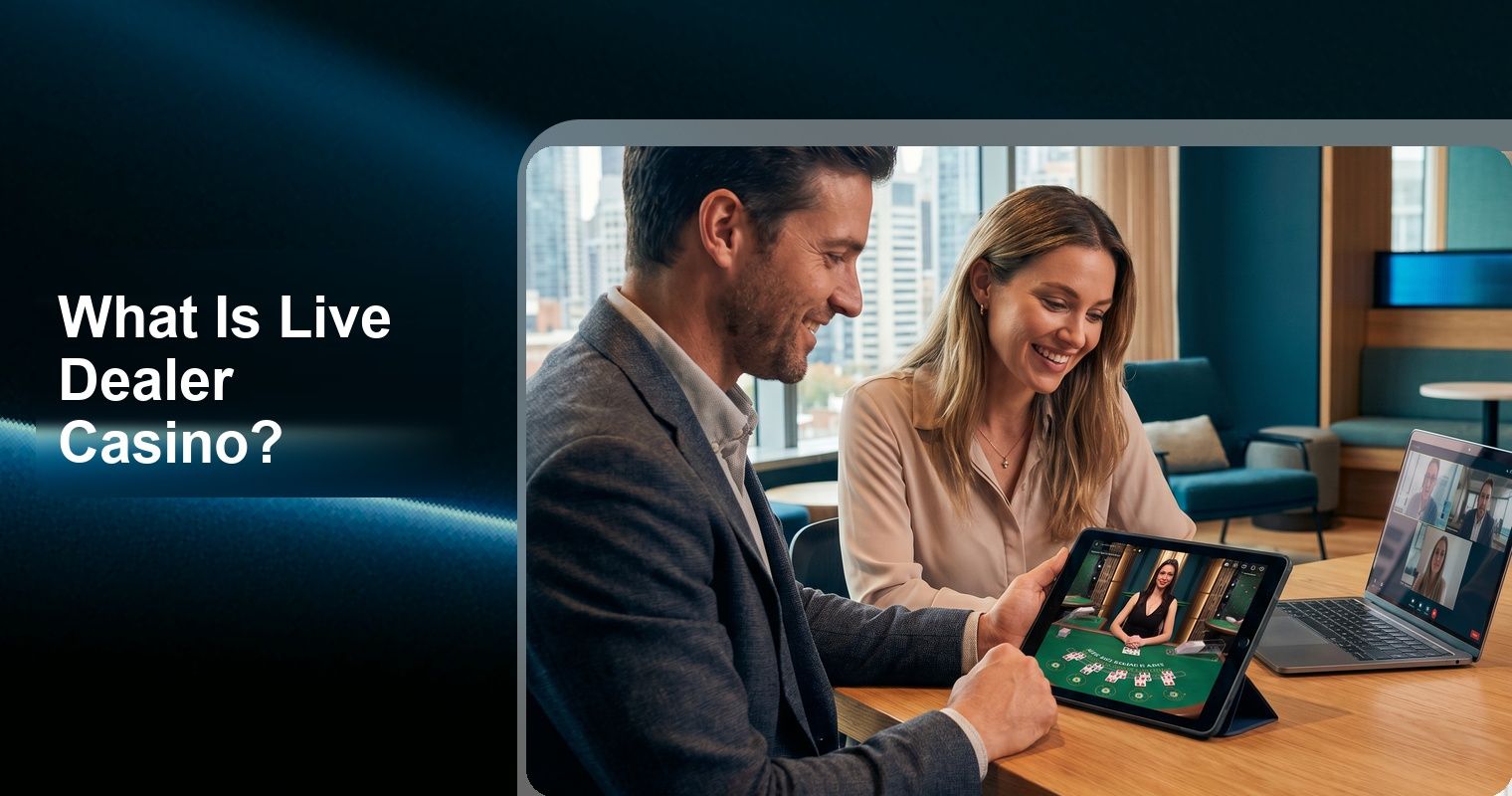
The global live casino market hit USD 14 billion in 2025 and is racing toward USD 34.2 billion by 2033 at a 12.6% CAGR (Statista). Behind those numbers is a simple insight: players want the trust of a physical casino and the convenience of playing from their couch. A live dealer casino delivers both—but only if the underlying technology can stream a real dealer's actions to thousands of concurrent players with sub-300ms latency, zero frame drops, and synchronized bet windows.
This guide covers everything: what a live dealer casino actually is, how the player experience works, which platforms lead the market, what game types dominate, and—most importantly—the real-time video architecture that makes it all possible. That last part is where most guides stop. We go deep.
TL;DR
- A live dealer casino streams real human dealers operating physical equipment (cards, wheels, dice) to players in real time—outcomes are determined by actual physical events, not RNG
- Sub-300ms latency is non-negotiable: it ensures fair betting windows, prevents arbitrage, and enables natural dealer-player interaction
- Evolution Gaming holds 50-60% global market share; Pragmatic Play is the fastest-growing challenger
- The hybrid RTMP ingest + WebRTC distribution architecture gives studios familiar workflows while delivering RTC-grade latency to players
- Multi-camera capture, SEI-based game state synchronization, and server-side recording form the technical foundation for compliant live dealer operations
What Is a Live Dealer Casino?
A live dealer casino is an online gambling platform where professional human dealers operate physical gaming equipment—cards, roulette wheels, dice—in a purpose-built studio, and the action is streamed in real time to players via high-definition video. Players place bets through a digital interface, but outcomes are determined by actual physical events happening on camera.
This is fundamentally different from traditional online casino games that use Random Number Generators (RNGs). In a live dealer online casino, you watch a real person shuffle real cards and deal them onto a real table. Optical Character Recognition (OCR) technology reads the card values and transmits the data to the platform, which then updates your screen and processes payouts automatically.
The key elements:
- Real dealer, real equipment: No software-generated outcomes
- Real-time HD/4K video stream: Multi-camera angles capturing every detail
- Interactive chat: Players communicate with the dealer and sometimes each other
- Digital betting interface: Bets placed on screen, processed instantly by the platform
- Auditable footage: Every hand, spin, and deal recorded for regulatory compliance
The result is a hybrid experience that combines the transparency and social atmosphere of a land-based casino with the accessibility of online play.
How a Live Dealer Casino Works: The Player Experience
Understanding what happens from the player's perspective helps clarify why the technology requirements are so demanding.
Step 1: Join a Table
You browse available tables—filtered by game type, stakes, language, or dealer. Each table shows a live video thumbnail, current players, and betting limits. You select a table and join mid-shoe or wait for the next round.
Step 2: Place Your Bet
A digital interface overlays the video stream. You click chips, place them on the designated betting areas (e.g., Player/Banker in Baccarat, specific numbers in Roulette), and confirm before the timer expires. The betting window is typically 10–15 seconds, synchronized across all players viewing that table.
Step 3: Watch the Action
The dealer performs the physical action—deals cards, spins the wheel, rolls dice. Multiple cameras capture the action: wide-angle for the full table, close-up for cards or wheel, and an overhead "bird's eye" view. The video stream must arrive at your screen with less than 300ms delay so your experience stays synchronized with other players at the same table.
Step 4: Results and Payout
OCR scanners read the physical outcome. The platform calculates wins and losses automatically. Your balance updates within seconds. The dealer announces the result verbally and via on-screen graphics.
Step 5: Interact
Throughout the game, you can send chat messages to the dealer. Professional dealers respond verbally on camera, creating a social, engaging atmosphere. Some platforms support tipping and side conversations.
Why Players Choose Live Dealer Over RNG Games
The shift toward live dealer isn't arbitrary. It's driven by specific player needs:
Trust and Transparency Players can see every action. There's no "black box" algorithm. If the roulette ball lands on 17, you watched it happen. This eliminates the perennial concern that online casino software is "rigged."
Social Experience Gambling has always been social. RNG games are solitary. Live dealer restores the human element—banter with dealers, shared excitement when a number hits, the communal energy of a busy table.
Authenticity The sensory experience—hearing cards being shuffled, watching the dealer's hands, seeing the wheel spin—provides a psychological sense of "real gambling" that animated RNG games cannot replicate.
Regulatory Confidence Regulators prefer live dealer because every session is recorded. Disputes are resolved by reviewing footage, not auditing code. Many jurisdictions have specific licensing categories for live dealer operations.
Top Live Dealer Casino Platforms
The live casino market is dominated by a handful of providers that operate massive studio networks and license their games to online casinos worldwide.
Evolution Gaming
Evolution is the undisputed market leader, holding an estimated 50–60% global market share. They operate 21+ studios worldwide with over 1,700 live tables. Key innovations include Lightning Roulette (random multipliers), Crazy Time (game show format), and Immersive Roulette (slow-motion replays).
- Studios: Riga, Malta, Tbilisi, New Jersey, Michigan, Pennsylvania, Vancouver, and more
- Signature Feature: Game show titles that blend live hosting with RNG bonus rounds
- Revenue: 85% of their €524.3M Q2 2025 net revenue came from live dealer games
Pragmatic Play Live
Pragmatic Play has rapidly grown to become Evolution's primary challenger. In July 2025, they briefly surpassed Evolution in GGR share (16.2% vs. 12.6%) across monitored operators. Their strength lies in competitive pricing and fast studio deployment.
- Studios: Bucharest, Manila, Buenos Aires
- Signature Feature: Mega Roulette, PowerUp Roulette, and speed variants
- Advantage: Lower integration costs attract mid-tier operators
Playtech Live
Playtech is one of the longest-standing live casino providers with deep penetration in regulated European markets. Their Age of the Gods live roulette series ties slot-style progressives to live table games.
- Studios: Riga, Manila, Bucharest
- Signature Feature: Quantum Roulette (random multipliers up to 500x)
- Advantage: Strong compliance tooling for regulated markets (UK, Italy, Spain)
Ezugi
Ezugi (owned by Evolution since 2018) focuses on emerging markets and offers a broader range of regional games. They provide localized experiences in Hindi, Turkish, and other languages, with game variants popular in specific geographies.
- Studios: Costa Rica, Romania, Cambodia
- Signature Feature: Andar Bahar, Teen Patti, and other regional games
- Advantage: Lower minimum integration requirements, ideal for startups
Live Dealer Game Types
Blackjack
The most popular live table game. Players take seats (usually 7 per table) and play their own hands against the dealer. Variants include:
- Classic Blackjack: Standard rules, 7-seat
- Infinite Blackjack: Unlimited players, all share the same initial deal
- Speed Blackjack: Fastest player to decide gets served first
- Lightning Blackjack: Random multipliers on winning hands (up to 25x)
Roulette
The highest-margin live game for operators. A single dealer and wheel can serve unlimited players simultaneously, making it extremely efficient.
- European Roulette: Single zero, standard layout
- Lightning Roulette: Random 50x–500x multipliers on straight-up bets
- Immersive Roulette: Multiple cameras, slow-motion ball landing
- Auto Roulette: Automated wheel with no human dealer (lower cost)
- Double Ball Roulette: Two balls, more frequent wins
Baccarat
Massively popular in Asian markets. Simple gameplay (Player vs. Banker) with fast rounds makes it ideal for high-volume play.
- Speed Baccarat: 27-second rounds
- No Commission Baccarat: No 5% banker commission (adjusted rules)
- Squeeze Baccarat: Dramatic card reveal (dealer slowly peels the card)
- Multi-Camera Baccarat: Different angles for premium feel
Game Shows
Evolution pioneered this category. These aren't traditional table games—they're hosted entertainment shows with gambling mechanics.
- Crazy Time: A money wheel with four bonus games, hosted by energetic presenters
- Monopoly Live: Board-game-themed bonus round
- Deal or No Deal Live: Adapts the TV show format
- Lightning Dice: Three dice with random multipliers
- Funky Time: Disco-themed wheel with dance-off bonuses
Game shows represent the fastest-growing segment because they attract a younger demographic less interested in traditional table games.
Poker
Live casino poker variants are typically "casino poker" (player vs. house), not player-vs-player:
- Casino Hold'em: Texas Hold'em structure against the dealer
- Three Card Poker: Fast, simple variant
- Caribbean Stud: Five-card poker with progressive jackpots
The Technology Architecture Behind Live Dealer Casinos
This is where most "what is live dealer casino" articles end. They describe the player experience, list some games, and maybe recommend a casino. But the real story—the infrastructure that makes sub-second latency possible for 10,000+ concurrent viewers per table—is far more interesting and far more complex.
Studio Infrastructure
A professional live dealer studio is essentially a broadcast facility optimized for gaming:
Physical Setup
- 3–5 cameras per table (wide, close-up, overhead, dealer face, auxiliary)
- Professional broadcast lighting (consistent color temperature, no flicker at high frame rates)
- Soundproofing (dealers work in adjacent rooms simultaneously)
- Green screen or physical set construction per table theme
- OCR scanning hardware embedded in the table surface
Encoding Infrastructure
- Hardware encoders (not software—dedicated silicon for consistent latency)
- H.264/H.265 encoding at 1080p60 or 4K30
- Adaptive bitrate ladders: 720p at 2.5 Mbps, 1080p at 5 Mbps, 4K at 15 Mbps
- Redundant encoding paths (failover within 50ms)
Network
- Dual uplinks with automatic failover
- Dedicated fiber from studio to nearest CDN/edge node
- Internal network on 10Gbps backbone with QoS prioritization for video packets
Multi-Camera Low-Latency Video Capture
Each live dealer table uses 3–5 cameras simultaneously. The challenge isn't just streaming one camera—it's synchronizing multiple feeds, switching between them in real time, and delivering the composite output with minimal latency.
Camera Switching A vision mixer (hardware or software) switches between camera angles based on game state:
- Wide shot during betting phase
- Close-up on cards during deal
- Overhead for result verification
- Dealer face during chat interactions
This switching must happen server-side so all viewers see the same angle at the same time. If switching happened client-side, each player would need to receive all camera feeds simultaneously, multiplying bandwidth requirements.
Frame-Accurate Synchronization All cameras must be genlocked (synchronized to the same clock signal) so frame timestamps align. Without genlock, switching between cameras produces visible judder. Professional studios use tri-level sync or PTP (Precision Time Protocol) across all capture devices.
RTMP vs. RTC: The Streaming Protocol Decision
This is the most critical architectural decision for any live dealer platform. The protocol you choose determines your latency floor, scalability ceiling, and development complexity.
RTMP (Real-Time Messaging Protocol)
RTMP was the traditional protocol for live streaming. The studio pushes an RTMP stream to a media server, which transcodes and distributes via HLS/DASH to viewers.
Typical Architecture:
Camera → Encoder → RTMP Ingest → Media Server → CDN → HLS/DASH PlayerCharacteristics:
- Latency: 3–8 seconds (HLS) or 1–3 seconds (Low-Latency HLS/DASH)
- Scalability: Excellent (CDN distribution is mature)
- Cost: Lower (commodity CDN pricing)
- Interactivity: One-way only; viewer cannot send real-time signals back
Problem for Live Casino: 3–8 seconds of delay means a player sees the card dealt 3–8 seconds after it actually happens. If betting windows are 10 seconds, by the time the player sees the window open, they may have only 2–7 seconds to react. Worse: if the outcome is visible to any player faster than others (due to CDN edge caching differences), it creates arbitrage opportunities—a player with a faster feed could bet knowing the result.
WebRTC / Full RTC (Real-Time Communication)
WebRTC was designed for video conferencing—bidirectional, sub-second latency communication. Applied to live casino, it eliminates the latency problem entirely.
Typical Architecture:
Camera → Encoder → RTC Media Server → Edge Network → WebRTC PlayerCharacteristics:
- Latency: 100–300ms (glass-to-glass)
- Scalability: More complex (requires SFU/MCU infrastructure, not standard CDN)
- Cost: Higher per viewer (dedicated media routing)
- Interactivity: Full duplex; players can send audio/video/data back to the studio
Advantage for Live Casino: Sub-300ms latency means all players see the action essentially simultaneously. Betting windows work reliably. No arbitrage risk. Plus, players can interact with dealers in real time—not just via text chat, but potentially via voice or video.
Hybrid Approach: RTMP Ingest + RTC Distribution
Many platforms use a hybrid model. The studio pushes via RTMP (simpler encoding workflow, compatible with existing broadcast infrastructure), and a media server converts the stream to WebRTC for last-mile delivery.
Architecture:
Camera → Encoder → RTMP → Tencent RTC Media Server → WebRTC → PlayerThis gives operators the best of both worlds: familiar studio workflows (RTMP encoding) with RTC-grade latency on the player side. Tencent RTC supports this hybrid architecture natively—studios push RTMP, and TRTC's media servers handle the protocol conversion, global distribution via 2,800+ edge nodes, and WebRTC delivery to players.
How Sub-300ms Latency Is Achieved
Getting video from a camera lens to a player's screen in under 300 milliseconds requires optimization at every stage of the pipeline:
1. Capture Latency (5–20ms)
- Global shutter cameras (no rolling shutter delay)
- Hardware encoders with single-frame buffer (no batching)
- Direct SDI/HDMI to encoder (no intermediate processing)
2. Encoding Latency (15–40ms)
- Hardware H.264/H.265 encoding
- Low-latency encoding profiles (no B-frames, reduced reference frames)
- Slice-level parallelism for faster frame output
- Constant bitrate mode (no rate control oscillation)
3. Network Transmission (30–100ms)
- UDP-based transport (WebRTC uses SRTP over UDP)
- No TCP head-of-line blocking
- Intelligent routing via private backbone (not public internet best-effort)
- TRTC's global edge network: 2,800+ nodes across 70+ countries
- Anycast routing to nearest edge node
4. Jitter Buffer (20–60ms)
- Adaptive jitter buffer that balances smoothness vs. latency
- For live casino, buffer configured aggressively low (20–40ms)
- Frame dropping preferred over buffering during congestion
5. Decoding and Rendering (10–30ms)
- Hardware-accelerated decoding on client devices
- Direct compositor rendering (bypassing OS-level vsync where possible)
- WebRTC's built-in timing mechanisms for smooth playback
Total: 80–250ms typical glass-to-glass latency on TRTC infrastructure.
Dealer-Player Bidirectional Interaction
A live dealer casino isn't just a video stream. It's an interactive experience requiring real-time data flowing in both directions:
From Studio to Player:
- Video stream (multi-camera composite)
- Audio (dealer voice, ambient studio sound)
- Game state data (current bets, timer countdown, results)
- Chat messages from dealer
From Player to Studio:
- Bet actions (place, modify, confirm)
- Chat messages (displayed on dealer's monitor)
- Reaction signals (emojis, tips)
- Optional: player audio/video (VIP tables)
This bidirectional communication requires a signaling layer alongside the video stream. TRTC's architecture handles this natively through its data channel capabilities—the same WebRTC connection that carries video also carries low-latency data messages, eliminating the need for a separate WebSocket connection that could drift out of sync with the video.
Recording and Audit Trail
Every regulated live dealer operation must record every session for compliance and dispute resolution:
- Multi-track recording: All camera angles stored independently (not just the switched output)
- Metadata synchronization: Bet actions, game state changes, and chat messages timestamped and aligned with video frames
- Retention: Typically 7–90 days depending on jurisdiction
- Tamper-proof storage: Write-once media or blockchain-anchored hashes
- Instant retrieval: Regulators and support staff must be able to pull any specific hand/spin within minutes
TRTC's cloud recording capabilities handle multi-stream recording natively—each participant's stream is recorded independently with millisecond-accurate timestamps, stored in cloud object storage, and accessible via API for compliance review.
Build Your Own Live Dealer Platform with Tencent RTC
If you're building a live dealer platform—whether a standalone operation or adding live tables to an existing online casino—the technology stack is your competitive moat. Here's how TRTC powers the core components.
Architecture Overview
┌─────────────────────────────────────────────────────────────┐
│                     STUDIO SIDE                              │
│                                                             │
│  Cameras → Hardware Encoder → RTMP Push to TRTC             │
│  OCR Scanner → Game Engine → TRTC Data Channel              │
│  Dealer Monitor ← TRTC Chat Messages from Players           │
│                                                             │
└──────────────────────────┬──────────────────────────────────┘
                           │
                    TRTC Global Network
                    (2,800+ Edge Nodes)
                           │
┌──────────────────────────┴──────────────────────────────────┐
│                     PLAYER SIDE                              │
│                                                             │
│  WebRTC Player ← Video Stream (sub-300ms)                   │
│  Betting UI ← Game State Data Channel                       │
│  Chat Input → TRTC Data Channel → Dealer Monitor            │
│                                                             │
└─────────────────────────────────────────────────────────────┘
Step 1: Player Joins a Live Dealer Room (Web SDK)
The player's browser connects to the TRTC room where the dealer is broadcasting. Here's the Web SDK integration:
import TRTC from 'trtc-sdk-v5';

// Initialize TRTC instance
const trtc = TRTC.create();

// Player enters the live dealer room as audience
async function joinDealerTable(roomId, userId, userSig) {
  try {
    await trtc.enterRoom({
      roomId: roomId,          // Each table = one room
      sdkAppId: 1400000001,    // Your TRTC app ID
      userId: userId,          // Player's unique ID
      userSig: userSig,        // Server-generated auth token
      scene: 'live',           // Live streaming scene (optimized for 1-to-many)
      role: 'audience',        // Player is audience, dealer is anchor
    });

    console.log('Connected to dealer table:', roomId);
  } catch (error) {
    console.error('Failed to join table:', error);
  }
}

// Subscribe to the dealer's video stream
trtc.on(TRTC.EVENT.REMOTE_VIDEO_AVAILABLE, ({ userId, streamType }) => {
  // userId here is the dealer's ID
  trtc.startRemoteVideo({
    userId: userId,
    streamType: streamType,
    view: document.getElementById('dealer-video-container'),
  });
});

// Subscribe to the dealer's audio
trtc.on(TRTC.EVENT.REMOTE_AUDIO_AVAILABLE, ({ userId }) => {
  trtc.startRemoteAudio({ userId });
});

// Handle connection state changes
trtc.on(TRTC.EVENT.CONNECTION_STATE_CHANGED, (state) => {
  if (state === 'DISCONNECTED') {
    // Reconnection logic
    console.warn('Connection lost, attempting reconnect...');
  }
});
Step 2: Real-Time Chat Between Player and Dealer
Players send messages that appear on the dealer's screen; the dealer responds verbally on camera. For text-based interaction, integrate TRTC's data channel or the Chat SDK:
import TencentCloudChat from '@tencentcloud/chat';

// Initialize Chat SDK
const chat = TencentCloudChat.create({
  SDKAppID: 1400000001,  // Same app as TRTC
});

// Login
await chat.login({
  userID: 'player_12345',
  userSig: playerUserSig,
});

// Join the table's chat group (one group per table)
await chat.joinGroup({
  groupID: `table_${roomId}`,
  type: TencentCloudChat.TYPES.GRP_AVCHATROOM, // Supports unlimited members
});

// Send message to dealer
async function sendMessageToDealer(text) {
  const message = chat.createTextMessage({
    to: `table_${roomId}`,
    conversationType: TencentCloudChat.TYPES.CONV_GROUP,
    payload: { text },
  });
  await chat.sendMessage(message);
}

// Receive messages (dealer announcements, other players' chat)
chat.on(TencentCloudChat.EVENT.MESSAGE_RECEIVED, (event) => {
  const messages = event.data;
  messages.forEach((msg) => {
    if (msg.from === 'dealer_001') {
      displayDealerMessage(msg.payload.text);
    } else {
      displayPlayerMessage(msg.from, msg.payload.text);
    }
  });
});

// Send game actions via custom message (bets, decisions)
async function sendBetAction(action) {
  const message = chat.createCustomMessage({
    to: `table_${roomId}`,
    conversationType: TencentCloudChat.TYPES.CONV_GROUP,
    payload: {
      data: JSON.stringify({
        type: 'BET_ACTION',
        action: action,       // e.g., { type: 'place', position: 'banker', amount: 50 }
        timestamp: Date.now(),
      }),
      description: 'Game action',
      extension: '',
    },
  });
  await chat.sendMessage(message);
}
Step 3: Studio-Side RTMP Push (Dealer Broadcast)
On the studio side, cameras encode to RTMP and push to TRTC's ingest servers. TRTC converts this to WebRTC for player delivery:
# OBS / Hardware encoder RTMP push URL format:
rtmp://push.trtc.tencent-cloud.com/live/{streamKey}

# Stream key format:
{sdkAppId}_{roomId}_{userId}_main

# Example:
rtmp://push.trtc.tencent-cloud.com/live/1400000001_88001_dealer_001_main
The studio encoder pushes standard RTMP at 1080p60. TRTC's media servers perform:
- Protocol conversion (RTMP → WebRTC)
- Adaptive bitrate transcoding (multiple quality levels)
- Global distribution to edge nodes nearest each player
- Frame-accurate synchronization with game state data
Step 4: Game State Synchronization via SEI Messages
To synchronize game events (card dealt, timer start, result announce) with the video frame they correspond to, use SEI (Supplemental Enhancement Information) messages embedded in the video stream:
// Studio-side: Embed game state in video frames via SEI
// This ensures game state arrives at the exact same moment
// as the corresponding video frame

// Server-side game engine sends SEI via TRTC Server API
const gameEvent = {
  type: 'CARD_DEALT',
  card: { suit: 'hearts', value: 'K' },
  position: 'player_hand_1',
  roundId: 'round_2025_001',
  timestamp: Date.now(),
};

// SEI is embedded in the next video frame
// Player receives it synchronized with the visual of the card being dealt
// Player-side: Parse SEI messages from video stream
trtc.on(TRTC.EVENT.SEI_MESSAGE, (event) => {
const gameState = JSON.parse(event.data);
switch (gameState.type) {
case 'BETTING_OPEN':
startBettingTimer(gameState.duration);
break;
case 'CARD_DEALT':
animateCard(gameState.card, gameState.position);
break;
case 'RESULT':
displayResult(gameState.winner, gameState.payout);
break;
case 'BETTING_CLOSED':
lockBettingInterface();
break;
}
});Step 5: Cloud Recording for Compliance
Enable recording for regulatory audit:
// Via TRTC Server API - start recording when table opens
const recordingConfig = {
  roomId: 88001,
  recordType: 'audio_video',
  storageParams: {
    vendor: 'cos',                    // Tencent Cloud Object Storage
    region: 'eu-frankfurt',           // Data residency compliance
    bucket: 'live-casino-recordings',
    filePrefix: 'table_88001/',
  },
  recordParams: {
    streamType: 'both',              // Record all streams
    maxIdleTime: 30,                 // Stop after 30s of no stream
    recordFormat: ['mp4', 'hls'],    // Dual format for flexibility
  },
  mixParams: {
    layoutMode: 'custom',            // Custom layout for multi-camera composite
    backgroundColor: '#000000',
  },
};
Why TRTC for Live Dealer Platforms
| Requirement | TRTC Capability |
|---|---|
| Sub-300ms latency | Global edge network, UDP transport, optimized jitter buffers |
| 10,000+ concurrent viewers per table | SFU architecture scales horizontally |
| Multi-camera ingest | RTMP hybrid mode + multiple stream types per room |
| Bidirectional interaction | Full duplex WebRTC + data channels |
| Game state sync | SEI message embedding in video frames |
| Recording & audit | Server-side cloud recording with metadata alignment |
| Global reach | 2,800+ edge nodes in 70+ countries |
| Mobile + Web + native | SDKs for Web, iOS, Android, Windows, macOS, Flutter, React Native |
Explore the full live streaming solution at TRTC Live and the real-time communication SDK at TRTC RTC. For card game and table game scenarios specifically, see the Interactive Game Console solution, which includes pre-built UI components for dealer-player interaction, hand history display, and multi-table management.
For developers integrating TRTC into their live dealer platform, the @tencentcloud/sdk-mcp MCP server accelerates development by letting AI coding assistants access TRTC's full API documentation, generate integration code, and troubleshoot issues—directly inside your IDE.
Live Dealer Casino: Regulatory and Fair Play Technology
Technology isn't just about performance—it's about compliance. Every regulated jurisdiction (UK Gambling Commission, Malta Gaming Authority, New Jersey DGE, etc.) requires specific technical capabilities:
Game Integrity
- OCR Verification: Optical Character Recognition reads every card dealt, confirming that the digitally displayed result matches the physical card. Any mismatch triggers an automatic void and investigation.
- Shuffling Protocols: Continuous Shuffling Machines (CSMs) or manual shuffles performed on camera with specific procedural requirements.
- RNG Certification for Hybrid Games: Game show titles that combine live elements with RNG bonus rounds must certify the RNG component separately.
Player Protection
- Session Recording: Complete audio/video recording of every game round
- Bet Confirmation: Cryptographic proof that a player's bet was received before the betting window closed
- Disconnect Protection: If a player disconnects mid-hand, the platform must apply a predetermined strategy (e.g., stand in blackjack) and record the justification
Anti-Fraud
- Multi-Account Detection: IP/device fingerprinting to prevent one person playing multiple seats
- Collusion Monitoring: AI analysis of betting patterns across players at the same table
- Insider Threat: Dealers wear pocketless uniforms, clear their hands on camera, and work under constant surveillance
The Future of Live Dealer Casinos
AR/VR Integration
Early experiments place players in virtual casino environments while maintaining the live dealer video feed. Imagine sitting at a VR blackjack table with avatar representations of other players, but the dealer is a real person streamed in real time.
AI-Assisted Dealing
AI won't replace human dealers (the human element is the product's core value), but it will augment them:
- Automatic detection of mis-deals
- Real-time odds display for players
- Predictive staffing based on player demand patterns
- Automated slow-motion replays of disputed moments
Personalized Streams
Rather than one switched output for all viewers, future platforms may deliver personalized camera angles per player—you prefer the overhead view, another player prefers the close-up. This requires multi-stream delivery, which TRTC's architecture already supports through its multiple stream type capabilities per room.
Voice-Enabled VIP Rooms
For high-roller tables where players speak directly to dealers, Tencent's GVoice provides the real-time audio layer—noise suppression, echo cancellation, and automatic gain control purpose-built for gaming communication. Combined with TRTC's video pipeline, operators can offer true face-to-face dealer interaction at GVoice quality levels that match in-person conversation.
Cryptocurrency and Blockchain
Provably fair mechanisms using blockchain for result verification, instant crypto deposits/withdrawals, and smart contract-based payouts are gaining traction in unregulated markets and gradually moving into regulated ones.
How to Choose a Live Dealer Technology Partner
If you're an operator evaluating technology for a live dealer platform, here are the non-negotiable requirements:
Latency
- Must achieve sub-300ms glass-to-glass under normal conditions
- Must not exceed 500ms at P99 (99th percentile)
- Must handle network degradation gracefully (adaptive bitrate, not buffering)
Scale
- Support 10,000+ concurrent viewers per table without quality degradation
- Handle traffic spikes (e.g., high-profile tournament finals) without pre-provisioning
Reliability
- 99.99% uptime SLA
- Automatic failover at every layer (encoder, network, edge node)
- No single point of failure
Compliance
- Server-side recording with metadata alignment
- Data residency options (EU, US, APAC)
- Encryption in transit and at rest
Integration Complexity
- SDK support for all target platforms (Web mandatory, mobile strongly preferred)
- Clear API documentation
- Hybrid RTMP ingest support (compatibility with existing studio equipment)
Global Coverage
- Edge nodes in your target markets
- Optimized routing for high-latency regions (Africa, South America, Southeast Asia)
TRTC checks every box. The platform was built for real-time interaction at scale—video conferencing, live streaming, and interactive entertainment scenarios that demand the same sub-second latency, bidirectional communication, and global distribution that live dealer casinos require.
Conclusion
A live dealer casino merges the authenticity of physical gambling with the accessibility of online play. For players, it means watching real cards dealt by real people with the ability to interact, all from a phone or laptop. For operators, it means complex real-time infrastructure that must deliver sub-300ms latency to thousands of concurrent players while recording every frame for compliance.
The technology stack behind live dealer is what separates a premium experience from a laggy, unreliable one. Multi-camera capture, protocol selection (RTMP hybrid vs. full RTC), global edge distribution, bidirectional data channels, and frame-accurate game state synchronization—these aren't optional features. They're table stakes.
Whether you're exploring what a live dealer online casino is as a player, or evaluating the architecture to build one as an operator, the underlying reality is the same: real-time video technology is the foundation everything else is built on.
Start building with TRTC Live for one-to-many dealer streaming, TRTC RTC for bidirectional player interaction, and the Interactive Game Console for pre-built gaming UI components. Use @tencentcloud/sdk-mcp with your AI coding assistant to explore TRTC APIs, generate boilerplate, and resolve integration questions without leaving your editor. The infrastructure is ready—the only question is what you'll build on it.
Documentation: For the complete live dealer streaming architecture — RTMP hybrid vs full RTC — see the TRTC Architecture Guide and Web SDK Quick Start.
Frequently Asked Questions
What is a live dealer casino and how does it work?
A live dealer casino streams real human dealers operating physical cards, wheels, and dice from professional studios to players via HD video. Players place bets through a digital interface, but outcomes are determined by actual physical events captured on camera—not random number generators.
Is live dealer casino rigged?
No. Licensed live dealer casinos are among the most transparent forms of online gambling because every action happens on camera. OCR technology independently verifies outcomes, all sessions are recorded for regulatory audit, and players can see every shuffle, deal, and spin in real time.
What internet speed do I need for live casino?
A stable 5 Mbps connection is sufficient for smooth 1080p live dealer streaming. Most platforms use adaptive bitrate delivery, automatically adjusting quality from 480p to 4K based on your network conditions without interrupting gameplay.
What's the difference between live dealer and RNG casino games?
RNG games use software algorithms to generate random outcomes—everything is animated. Live dealer games feature real people operating real equipment on camera with outcomes determined by physical events. Live dealer provides transparency and social interaction; RNG offers faster rounds and lower minimum bets.
How much latency is acceptable for live dealer casino?
Sub-300ms glass-to-glass latency is the industry standard for competitive live casino platforms. This ensures synchronized betting windows across all players, prevents arbitrage from latency differences, and enables natural conversational chat with dealers.
Which live dealer casino provider is the best?
Evolution Gaming dominates with 50-60% global market share, operating 21+ studios with 1,700+ tables. They pioneered game show formats (Crazy Time, Lightning Roulette). Pragmatic Play is the fastest-growing challenger with competitive pricing for mid-tier operators.
How much does it cost to build a live dealer platform?
Studio infrastructure (cameras, encoders, tables, lighting) costs $500K-$2M per location. Streaming technology and platform development adds $300K-$800K. Licensing fees vary by jurisdiction ($50K-$500K+). Using TRTC's infrastructure eliminates the need to build custom streaming from scratch, significantly reducing the technology investment.
Can live dealer casinos detect cheating?
Yes. Multi-camera recording, AI-powered pattern analysis, device fingerprinting, and dealer surveillance (pocketless uniforms, hand-clearing procedures) combine to detect and prevent cheating. Every game round is recorded with timestamped metadata for dispute resolution and regulatory audit.