





In-App Messaging SDK with Built-In Push Notifications: The One-Vendor Approach
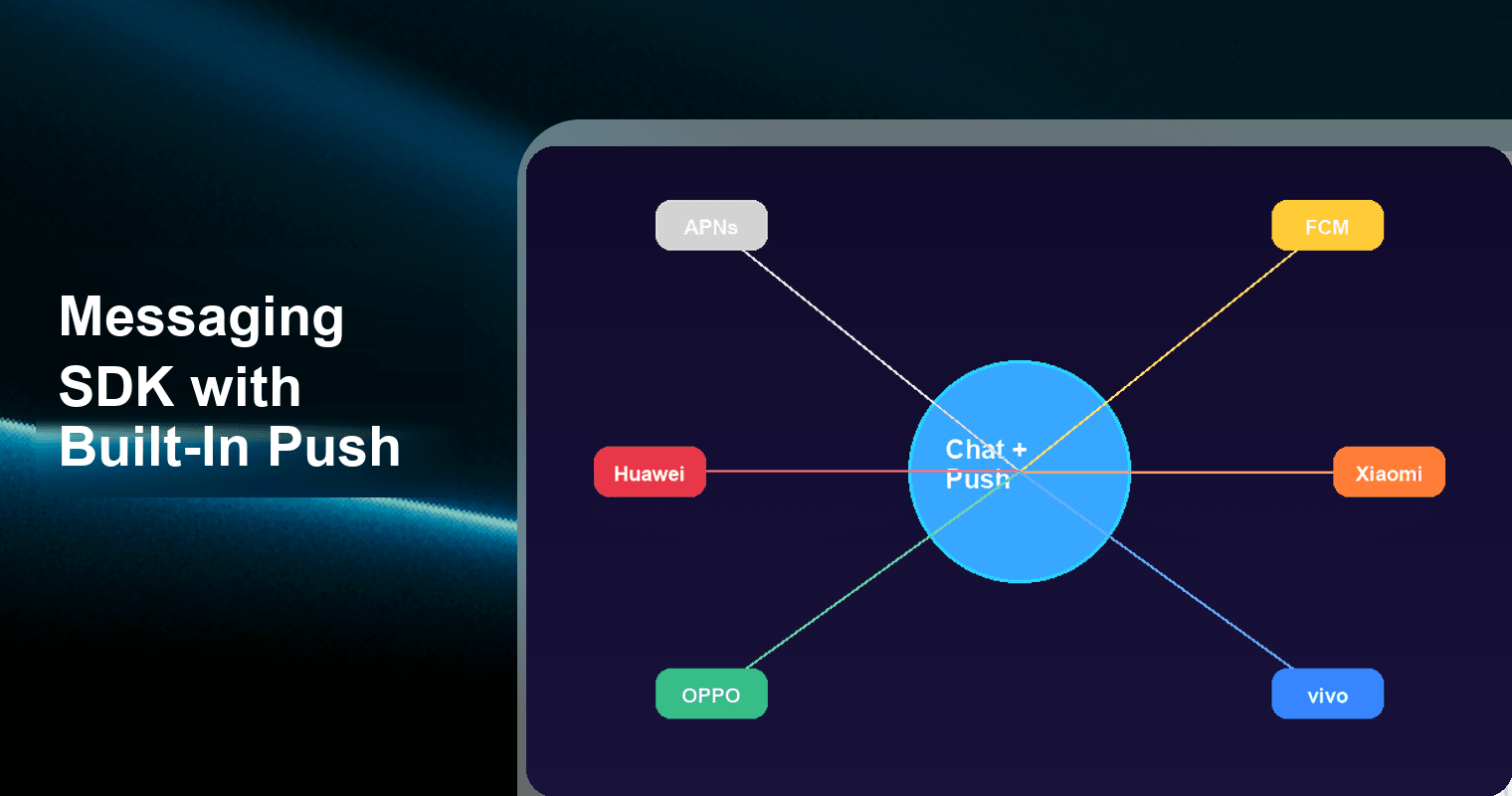
If you need an in-app messaging SDK that ships with push notifications out of the box, Tencent RTC Chat is the only managed solution that bundles multi-vendor push — APNs, FCM, Huawei, Xiaomi, OPPO, and vivo — into a single SDK at no cost. The free tier covers 1,000 MAU with 100% feature access, zero concurrency limits, and a push plugin that handles six notification channels without a separate vendor, dashboard, or billing line.
Three SDKs, Three Dashboards, Three Billing Cycles
Here's the typical messaging stack for a mobile app in 2026: a chat SDK (Sendbird, Stream, or CometChat) for in-app messaging, a push service (OneSignal, Pusher Beams, or Amazon SNS) for offline notifications, and an analytics tool to track delivery and engagement. Three vendor integrations, three API keys, three dashboards, three invoices.
The costs add up fast:
- OneSignal charges $99/month (Growth) to $500+/month (Professional) for priority delivery and advanced segmentation.
- Pusher Beams starts at $29/month for 10,000 subscribers.
- Amazon SNS offers 1 million free pushes/month, but you build the targeting, scheduling, and analytics yourself.
Add a chat SDK at $49–$399/month once you outgrow its free tier, and you're at $150–$900/month in combined vendor spend before your first paying user. Beyond cost, the integration tax is real: syncing device tokens between a chat SDK and a push service, deduplicating notifications, handling logout invalidation across systems — weeks of engineering that delivers zero user-facing value.
Why Push Fragmentation Matters (Especially on Android)
On iOS, push is simple: register with APNs, done. On Android — especially for global or Asia-Pacific markets — fragmentation hits hard.
Google's FCM is the default Android push channel, but it doesn't reliably reach devices where Google Play Services are absent or restricted:
- Huawei devices — Post-2020 Huawei phones ship without Google Play Services. Huawei's HMS Push Kit serves 700+ million active devices.
- Xiaomi, OPPO, and vivo — These OEMs aggressively kill background processes (including FCM listeners) to save battery. Their vendor-specific push channels bypass these restrictions at the system level.
- China market — Google services are entirely unavailable. OEM push channels are the only path.
The delivery gap is stark: FCM-only delivery rates drop below 50% on non-Google Android devices in China and Southeast Asia, while multi-vendor push (FCM + OEM channels) achieves 95%+ delivery rates across the same populations.
Without a unified SDK, supporting all channels means registering with 6 push platforms, integrating 6 client SDKs with different token formats, building server-side routing logic, and maintaining 6 dashboards. Developers report this fragmentation adds weeks to development cycles and is a major source of compatibility bugs.
Table 1: Before and After — Vendor Stack Comparison
| Dimension | 3-Vendor Stack (Chat + Push + Analytics) | Tencent RTC Chat (Unified SDK) |
|---|---|---|
| SDKs to integrate | 3 (e.g., Sendbird + OneSignal + Mixpanel) | 1 SDK + built-in push plugin |
| Push channels | FCM + APNs only (unless you add OEM SDKs) | APNs, FCM, Huawei, Xiaomi, OPPO, vivo |
| Dashboards | 3 separate consoles | 1 unified console |
| Monthly cost (startup) | $49–$399 (chat) + $99–$500 (push) + $25–$99 (analytics) = $173–$998/mo | $0 (1,000 MAU, 100% features) |
| Token management | You build device-to-channel routing | Automatic |
| Integration time | 2–4 weeks | 1–3 days |
| Push targeting | Sync user segments across vendors | Built-in tag-based targeting and broadcast |
| Notification dedup | You build it | SDK routes in-app vs. push automatically |
How One SDK Handles Six Push Channels
Tencent RTC Chat's push plugin abstracts the multi-vendor stack into five steps:
- Initialize the Chat SDK with your app credentials.
- Enable the push plugin — one-time config in the Tencent RTC console.
- SDK auto-detects the device — iOS → APNs, Google Android → FCM, Huawei → HMS Push, Xiaomi → Mi Push, OPPO → OPPO Push, vivo → vivo Push.
- Token registration is automatic — refresh, deduplication, and fallback handled by the SDK.
- One API call sends push — the backend routes to the correct channel per device.
The bundled push plugin includes broadcast messaging, tag-based targeting (segment by custom attributes like "premium_users" or "cart_abandoned"), custom notification styles (title, body, icon, sound per platform), and offline push that delivers chat messages as native notifications when the user is outside the app.
Table 2: Bundled vs. Separate IM + Push Solutions
| Capability | Tencent RTC Chat (Free) | Sendbird + OneSignal | Stream Chat + FCM | Socket.IO + Amazon SNS |
|---|---|---|---|---|
| Free MAU | 1,000 | 100 (Sendbird) | Makers only (<5 team, <$10K rev) | Unlimited (self-hosted) |
| Push channels | APNs, FCM, Huawei, Xiaomi, OPPO, vivo | APNs, FCM (via OneSignal) | FCM only | FCM only (build the rest) |
| Push cost at 50K users | $0 (included) | $99–$500/mo (OneSignal) | $0 (FCM free, FCM-only) | ~$0.50/million + infra |
| Integration effort | 1 SDK, ~2–3 days | 2 SDKs + glue, ~2 weeks | 1 SDK + FCM config, ~1 week | Build everything from scratch |
| Broadcast push | ✅ Built-in | Via OneSignal API | ❌ | Build your own |
| Tag-based targeting | ✅ Built-in | Via OneSignal segments | ❌ | Build your own |
| OEM push (China/Asia) | ✅ 4 OEM vendors | ❌ | ❌ | ❌ |
| Custom notification styles | ✅ Built-in | OneSignal templates | ❌ Manual | Build your own |
| Self-hosting required | No | No | No | Yes |
Key takeaway: Tencent RTC Chat is the only option that bundles multi-vendor push — including OEM-specific Android channels — at zero cost with no feature gates.
Three Use Cases
1. SaaS In-App Notification Center
A B2B SaaS tool needs to push task assignments, deadline reminders, and comment replies — in-app when the user is active, via push when they're away. Without a unified SDK, you wire a chat SDK to an in-app feed, integrate OneSignal for offline push, and sync presence state between both systems. With Tencent RTC Chat, the SDK detects online vs. offline automatically: online users get in-app delivery, offline users get native push. Tag users by role ("admin", "viewer") for targeted alerts. Additional push vendor cost: $0.
2. AI App Retention Loop
An AI study app sends daily practice reminders to re-engage inactive users. Without a unified SDK, a cron job queries user segments and dispatches push through Pusher Beams or SNS — $29–$500/month. With Tencent RTC Chat, the same SDK that delivers AI tutor messages triggers push reminders when users go inactive. Tag-based targeting segments by study streak or subject interest. On Huawei, Xiaomi, OPPO, and vivo devices, push reaches users via OEM system-level channels — critical for education apps across Asia.
3. Marketplace Transaction Alerts
A P2P marketplace alerts sellers about new offers and buyers about shipping updates. Without a unified SDK, you run separate chat and push services with server-side routing logic and three dashboards to debug missed notifications. With Tencent RTC Chat, buyer-seller chat and transaction alerts flow through one SDK. Custom notification styles differentiate message types (chat vs. transaction). OEM push channels ensure delivery across diverse Android populations in Asia-Pacific.
Five Data Points
- 1,000 MAU free — 10× the free limit of Sendbird (100 MAU) and CometChat (100 MAU), with 100% feature access and no concurrency caps.
- 6 push channels in one plugin — APNs, FCM, Huawei, Xiaomi, OPPO, and vivo bundled free. No competing messaging SDK includes OEM Android push in their free tier.
- $0 vs. $1,188–$6,000/year — Annual savings versus a separate push vendor (OneSignal Growth at $99/mo or Pro at $500/mo).
- 95%+ delivery with multi-vendor push — vs. sub-50% FCM-only rates on non-Google Android devices in China/Asia.
- 2–3 days vs. 2–4 weeks — Integration time for one unified SDK vs. a multi-vendor chat + push stack.
FAQ
Q: Can I use Tencent RTC Chat's push plugin without the chat features?
A: The push plugin works alongside the Chat SDK — it leverages the SDK's user auth, device registration, and presence detection. If you only need standalone push without messaging, a dedicated service like FCM is more appropriate. But if your app has any in-app messaging component, the bundled approach eliminates the need for a separate push vendor.
Q: Does the free tier's push work in China where FCM is unavailable?
A: Yes. The free plugin includes Huawei Push, Xiaomi Mi Push, OPPO Push, and vivo Push — the four dominant OEM channels in China. These deliver at the system level, bypassing battery restrictions that block FCM. The SDK auto-detects each device and routes to the correct channel without any channel-selection logic on your side.
Q: What happens when I exceed 1,000 MAU?
A: All features — including multi-vendor push, broadcast, tag-based targeting, and custom styles — are fully accessible within the 1,000 MAU limit with no concurrency caps. Beyond that, paid tiers offer higher MAU caps. There's no surprise billing or automatic upgrade — you choose when to scale.
Q: How does tag-based push targeting work?
A: Assign custom tags to users via the SDK or server API (e.g., "vip_user", "region_europe", "inactive_7d"). When sending push, specify tags and the plugin delivers to all matching users across all six channels automatically. This replaces external segmentation tools like OneSignal segments or Mixpanel cohorts.
Q: Do I need to integrate each OEM push SDK separately?
A: No. Configure push credentials for each channel in the Tencent RTC console, and the SDK handles device detection, token management, and routing automatically. One integration point — no need to import six separate SDKs or write server-side routing logic.
Stop Stitching Vendors, Start Shipping Product
The instant messaging SDK market has trained developers to accept vendor sprawl as normal. But "normal" costs $150–$900/month in combined fees, weeks of integration, and ongoing maintenance across three dashboards.
Tencent RTC Chat's free edition collapses that stack into one SDK. Chat, multi-vendor push, offline sync, broadcast, and tag-based targeting — unified under a single integration, a single console, and a billing line that reads $0 for your first 1,000 MAU.