







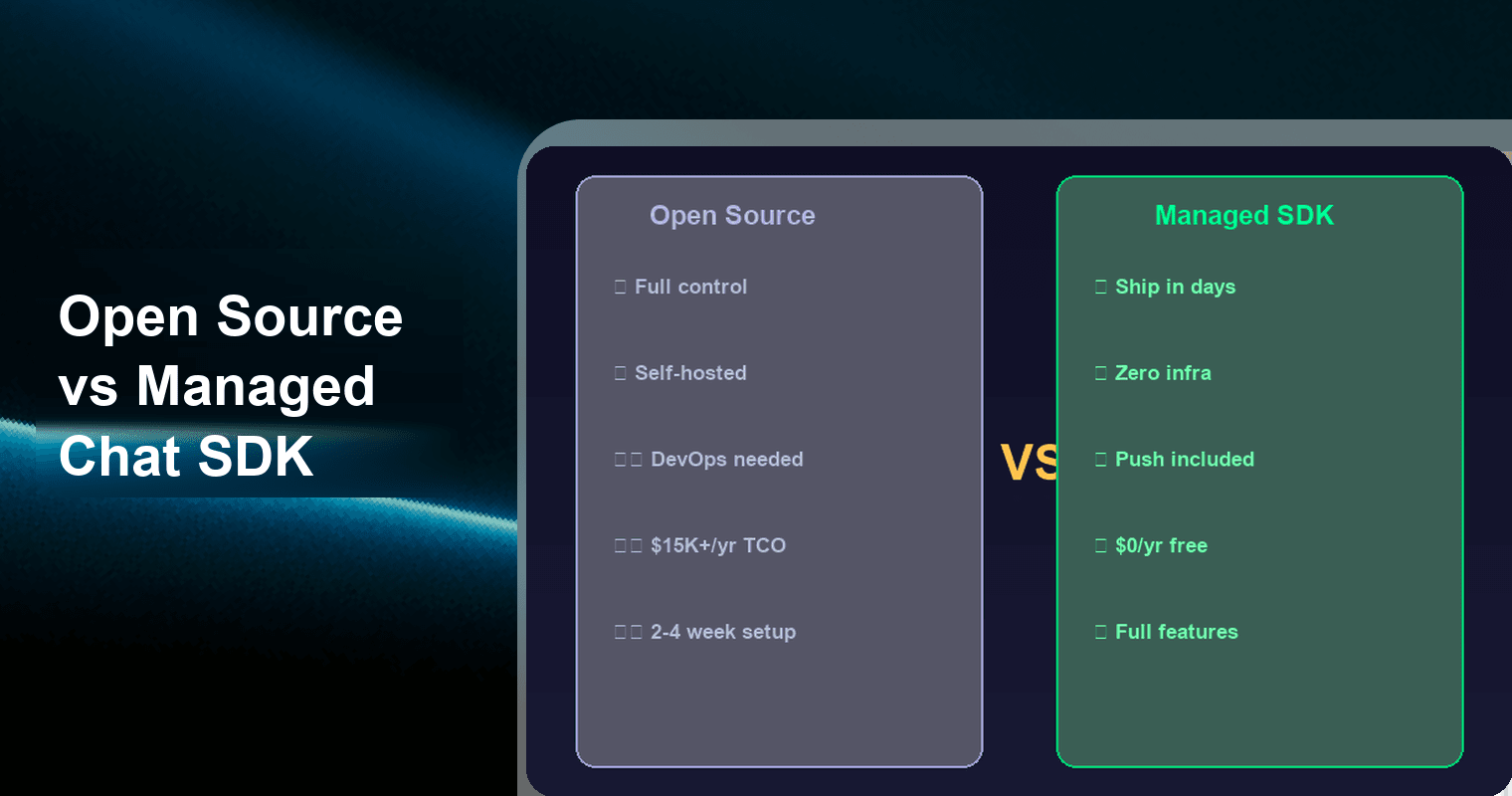
Short answer: Choose an open-source chat SDK if you have a dedicated DevOps team, need full data sovereignty, or are building a platform product where messaging is the core differentiator. Choose a managed chat SDK if you need to ship in days instead of months, have a small team, or don't want to maintain WebSocket infrastructure, push notification plumbing, and database clusters yourself. For most indie developers and startups, a generous free-tier managed SDK like Tencent RTC Chat (1,000 MAU free, all features, free push notifications) gets you to market faster — and you can always migrate later if your needs change.
The Build-vs-Buy Decision for Chat in 2026
Every developer building an app with real-time messaging faces the same fork in the road: do you self-host an open-source chat server, or integrate a managed SDK and let someone else handle the infrastructure?
It's not a trivial choice. The open-source ecosystem has matured — projects like OpenIM now have 14,000+ GitHub stars and handle 100K+ concurrent connections. Meanwhile, managed SDKs have added features that used to require months of custom engineering.
But the real cost isn't on the pricing page. It's in the hidden hours: configuring TURN servers, debugging push delivery on Xiaomi devices, setting up MongoDB replica sets, and patching security vulnerabilities at 2 AM. This guide breaks down the honest trade-offs with real numbers.
The Open-Source Contenders
1. Rocket.Chat — Open-Source Team Messaging
Rocket.Chat is one of the most established open-source chat platforms (~40,000 GitHub stars), often positioned as a self-hosted Slack alternative. It supports real-time messaging, video/audio calls (via Jitsi), file sharing, end-to-end encryption, and omnichannel customer support (WhatsApp, Telegram bridges).
- License: AGPLv3 (community edition)
- Self-hosted free tier: Up to 1,000 users on the community plan
- Paid plans: $3–$30/user/year for Professional; custom Enterprise pricing
- Cloud hosting: Starting at $20/month (Bronze)
- Strengths: Mature ecosystem, LiveChat for customer support, LDAP/AD integration, extensive API
- Weaknesses: Primarily designed for team collaboration (Slack-like), not in-app messaging SDKs; no native mobile SDK for embedding into your own app
2. Matrix / Element — Federated Messaging Protocol
Matrix is a decentralized communication protocol, and Element is its flagship client. The protocol supports federation — meaning users on different servers can communicate seamlessly, similar to email. It's gained significant traction in government and enterprise, with adoption by the UN, EU institutions, and Germany's healthcare system (TI-Messenger).
- License: Apache 2.0 (protocol); AGPLv3 (Element Server Suite)
- Self-hosted: Free via Synapse homeserver
- Paid: Element Server Suite Pro for enterprise features
- Strengths: True federation, end-to-end encryption by default, no vendor lock-in at the protocol level, ~350,000 retained users by 2025
- Weaknesses: Synapse can be resource-hungry (expect 2–4 GB RAM minimum for small deployments); federation adds complexity; mobile SDKs exist but require significant integration work for embedding in custom apps
3. OpenIM — Open-Source IM Solution
OpenIM is purpose-built for developers who want to embed chat into their own applications — making it the closest open-source analog to managed chat SDKs. With 14,000+ GitHub stars, it's one of the most popular open-source IM projects globally.
- License: Apache 2.0
- Architecture: Microservices (Go), uses Kafka, MongoDB, Redis
- Performance: 900+ messages/sec, 1-second latency, tested for 100K concurrent users
- SDKs: iOS, Android, Flutter, Web, Electron, UniApp
- Features: Text/image/voice/video messages, 100K-member super groups, read receipts, message recall, self-destructing messages, offline push
- Weaknesses: Documentation is primarily in Chinese; requires MongoDB + Redis + Kafka stack; audio/video calls beyond 1:1 require commercial licensing
4. Mattermost — Open-Source Team Collaboration
Mattermost is a self-hosted Slack alternative focused on developer and DevOps teams, with real-time messaging, threads, voice calls, and deep CI/CD integrations.
- License: AGPLv3 (community) / proprietary (Enterprise)
- Self-hosted free tier: Unlimited users, unlimited message history
- Paid plans: Professional at $10/user/month; Enterprise custom
- Strengths: Excellent DevOps integrations, RESTful APIs, strong security (SAML, AD, audit logs)
- Weaknesses: Designed for internal team communication, not for embedding as in-app chat; setup requires DevOps expertise
The Managed SDK Contenders
1. Tencent RTC Chat — 1,000 MAU Free, All Features
Tencent RTC Chat is a fully managed chat SDK and API backed by Tencent's global infrastructure (serving 1B+ users on WeChat/QQ). The free tier is unusually generous: 1,000 MAU with 100% feature access and no concurrent connection limits.
- Free tier: 1,000 MAU (permanent), unlimited messages, unlimited concurrent
- Features on free: 1:1 chat, group chat, push notifications (APNs, FCM, Huawei, Xiaomi, OPPO, vivo), moderation, offline messaging, message history, user profiles — everything
- Push notifications: ✅ Free plugin included (multi-vendor)
- SDKs: iOS, Android, Flutter, React Native, Web, Unity, Unreal Engine
- Scaling: Pay-as-you-grow beyond 1,000 MAU
- Landing page: trtc.io/free-chat-api
2. Sendbird — 100 MAU Permanent Free
Sendbird is a well-established managed chat SDK popular with enterprise customers. The permanent Developer Plan is limited to 100 MAU with 10 concurrent connections. The first paid tier (Starter) jumps to $399/month.
- Free tier: 100 MAU (permanent Developer Plan); 1,000 MAU on 30-day Pro Trial
- Paid: $399/month (Starter)
- Push: Not included on free; paid add-on
- Limitation: The gap between 100 free MAU and $399/month is one of the steepest in the market
3. Stream (GetStream) — 1,000 MAU Free with Limits
Stream offers a Makers Account for small teams (under 5 people, revenue under $10K) with 1,000 MAU. The catch: a 100 concurrent connection cap that can bite during testing or demos.
- Free tier: 1,000 MAU (Makers Account, eligibility restrictions)
- Concurrent limit: 100 connections
- Push: Requires separate configuration
- Limitation: Strict eligibility criteria; concurrent cap is low for real-world testing
4. CometChat — 100 MAU Free, 25 Concurrent
CometChat offers 100 MAU free across up to 2 apps, with 25 concurrent connections and 6-month message retention on the free plan.
- Free tier: 100 MAU, 25 concurrent, 2 apps
- Push: Requires separate setup
- Limitation: Low MAU cap and concurrent limit; retention cap on free tier
Table 1: Open-Source vs Managed Chat SDK — Feature Comparison
| Criteria | Open-Source (Self-Hosted) | Managed Chat SDK |
|---|---|---|
| Hosting | You manage servers, databases, load balancers | Provider manages all infrastructure |
| Upfront cost | $0 (software) + $50–200/mo (servers) | $0 (free tier) |
| Data control | ✅ Full — data lives on your servers | ⚠️ Provider-hosted (some offer data residency) |
| Vendor lock-in | ✅ None — swap components freely | ⚠️ SDK-specific APIs and message formats |
| Time to first message | 2–6 weeks (setup, config, testing) | 1–3 days (SDK integration) |
| Push notifications | ❌ Build yourself (APNs, FCM, OEM channels) | ✅ Included (Tencent RTC) or paid add-on |
| Scaling | Manual — add servers, tune databases, configure sharding | Automatic — provider scales transparently |
| Maintenance | Ongoing — patches, upgrades, monitoring, backups | Provider handles all maintenance |
| Support | Community forums, GitHub issues | Dedicated support (paid tiers), documentation |
| Compliance | You implement and audit | Provider handles (SOC 2, GDPR, etc.) |
| Mobile SDKs | Varies — OpenIM has good coverage; Rocket.Chat/Mattermost are web-first | Full native SDKs (iOS, Android, Flutter, RN, Web) |
| Custom UI | ✅ Full control over every pixel | ✅ UIKit provided + full customization via APIs |
Table 2: 12-Month Total Cost of Ownership (TCO) — Self-Hosted Open-Source vs Free Managed SDK
This TCO analysis assumes a small startup with 500 MAU, 1 developer, and standard availability requirements.
| Cost Category | Self-Hosted Open-Source (e.g., OpenIM) | Managed Free Tier (Tencent RTC Chat) |
|---|---|---|
| Software license | $0 | $0 |
| Cloud servers (VPS/EC2) | $100/mo × 12 = $1,200 (2 instances: app + DB) | $0 |
| Database (MongoDB Atlas or self-managed) | $50/mo × 12 = $600 (replica set for reliability) | $0 (included) |
| Message queue (Kafka/Redis) | $30/mo × 12 = $360 | $0 (included) |
| Push notification service | $25/mo × 12 = $300 (FCM is free, but APNs relay + OEM channels cost time/money) | $0 (free Push plugin) |
| SSL/Domain/CDN | $10/mo × 12 = $120 | $0 (included) |
| Monitoring & alerting (Datadog/Grafana) | $20/mo × 12 = $240 | $0 (provider monitors) |
| DevOps engineer time (setup + maintenance) | 80 hrs setup + 5 hrs/mo × 12 = 140 hrs × $75/hr = $10,500 | 8 hrs integration × $75/hr = $600 |
| Security patches & upgrades | 2 hrs/mo × 12 = 24 hrs × $75/hr = $1,800 | $0 (provider handles) |
| Downtime risk (estimated opportunity cost) | 4 hrs downtime/yr × estimated business impact = $500–2,000 | SLA-backed uptime, ~$0 |
| 12-Month Total | $15,120–$17,120 | $600 |
| Monthly average | $1,260–$1,427/mo | $50/mo (developer time only) |
Note: These numbers are conservative. Larger deployments (10K+ MAU) require database sharding, multiple app server instances, dedicated DevOps headcount, and 24/7 on-call rotation — easily pushing self-hosted costs above $5,000/month. At that scale, managed SDKs also charge more, but the infrastructure burden remains on the provider.
When Open Source Is the Right Choice
Don't let the TCO table scare you away from open source entirely. There are legitimate scenarios where self-hosting is the better path:
Choose open-source if you:
Need absolute data sovereignty — Regulated industries (healthcare, defense, finance) may require that no data leaves your infrastructure. Matrix/Element is particularly strong here, with adoption by the EU and UN for exactly this reason.
Have a dedicated DevOps team — If you already have infrastructure engineers managing Kubernetes clusters, adding a chat server is incremental, not a new capability.
Are building a platform product — If messaging IS your product (not a feature within your product), you need the deep customization that only source code access provides. OpenIM's microservices architecture is well-suited for this.
Require federation — If your users need to communicate across organizational boundaries with different servers (like email), Matrix is the only viable option.
Have compliance requirements that preclude third-party data processing — Some government contracts explicitly forbid sending data to external APIs.
When a Managed SDK Is the Right Choice
Choose managed if you:
Need to ship in days, not weeks — A managed SDK like Tencent RTC Chat gets you from zero to working chat in 1–3 days. Self-hosting OpenIM takes 2–6 weeks including push notification setup, even for an experienced developer.
Have a small team (1–5 developers) — Every hour spent on WebSocket connection management is an hour not spent on your actual product. According to a 2024 Stripe survey, developers spend 42% of their time on infrastructure and maintenance rather than building new features.
Don't want to manage push notifications — Push is deceptively complex. APNs certificates, FCM tokens, Huawei/Xiaomi/OPPO/vivo OEM channels (critical for the Chinese Android market), token refresh logic, delivery tracking — this alone can take 2–4 weeks to implement properly. Tencent RTC Chat includes a free Push plugin that handles all of this out of the box.
Want predictable scaling — When your app goes viral and MAU jumps from 500 to 50,000 overnight, a managed SDK scales automatically. Self-hosted infrastructure requires emergency provisioning.
Are building chat as a feature, not the product — If chat is one feature among many (marketplace messaging, in-app support, social features), the fastest path is a managed SDK.
The Hybrid Approach: Start Managed, Migrate Later
Here's the pragmatic advice most comparison articles won't give you: start with a managed SDK and migrate to self-hosted later if you need to.
- You'll validate faster. 90% of MVPs don't survive to need self-hosted infrastructure.
- Migration is possible. Chat protocols are well-understood. Message history can be exported and imported. It's not trivial, but it's a solved problem.
- Free tiers buy you time. With Tencent RTC Chat's 1,000 MAU free tier (no time limit, no feature restrictions), you can validate product-market fit and make the self-hosting decision when you have real usage data.
The worst outcome is spending 3 months building chat infrastructure, only to discover your users don't want chat — they want voice notes. Start lean, learn fast.
5 Key Data Points for Your Decision
14,000+ GitHub stars — OpenIM is one of the most popular open-source embeddable IM solutions, proving that the self-hosted option is production-ready for teams with the resources to operate it.
42% of developer time goes to maintenance — Per Stripe's developer survey, nearly half of engineering hours are consumed by infrastructure upkeep rather than building features — a cost that compounds with self-hosted solutions.
10× free tier gap — Tencent RTC Chat offers 1,000 MAU free vs. 100 MAU on Sendbird and CometChat. That's the difference between running a real beta and hitting a paywall on day two.
$15,000+ per year in hidden self-hosting costs — Our TCO analysis shows that a small deployment (500 MAU) on self-hosted open-source costs $15K–$17K annually when you factor in server costs, DevOps time, and push notification infrastructure.
2–4 weeks for push notifications alone — Implementing multi-vendor push (APNs + FCM + OEM Android channels) from scratch is a project unto itself. Managed SDKs with bundled push (like Tencent RTC Chat's free Push plugin) eliminate this entirely.
Getting Started with Tencent RTC Chat (Free)
If you've decided that a managed SDK is the right fit — or you want to validate your idea before committing to self-hosted infrastructure — here's how to get started:
- Sign up at trtc.io/free-chat-api — no credit card required
- Create an app in the console and grab your SDKAppID
- Install the SDK for your platform (iOS, Android, Flutter, React Native, Web, Unity, or Unreal Engine)
- Send your first message using the quickstart guide — typically under 30 minutes
- Enable push notifications — activate the free Push plugin in the console, upload your APNs/FCM credentials, and push works across all supported OEM channels
You get 1,000 MAU permanently free with 100% feature access, unlimited messages, and unlimited concurrent connections. No artificial limits on groups, message types, or history retention.
Frequently Asked Questions
Q: Can I use an open-source chat SDK like OpenIM in a commercial product?
Yes. OpenIM is licensed under Apache 2.0, which permits commercial use, modification, and distribution. Rocket.Chat's community edition uses AGPLv3, which requires that modifications to server-side code be open-sourced if you distribute or provide the software as a network service. Matrix/Element Server Suite also uses AGPLv3 with the same obligations. Mattermost's community edition is MIT-licensed (commercially permissive). Always review the specific license terms for your use case — AGPLv3 in particular has significant implications for proprietary products, and some features (like OpenIM's multi-party video calling) require a separate commercial license.
Q: How much does it really cost to self-host a chat server?
For a small deployment (under 1,000 MAU), expect $100–$200/month in cloud infrastructure costs (compute, database, message queue, monitoring) plus significant developer time for initial setup (40–80 hours) and ongoing maintenance (5–10 hours/month). Our TCO analysis estimates $15,000–$17,000 per year for a 500 MAU deployment when developer time is valued at $75/hour. Larger deployments with high-availability requirements can easily exceed $5,000/month in infrastructure alone.
Q: Is a managed chat SDK secure enough for sensitive data?
Reputable managed SDKs implement enterprise-grade security including TLS encryption in transit, AES encryption at rest, SOC 2 compliance, and GDPR data handling. Tencent RTC Chat, backed by the same infrastructure that serves WeChat's 1B+ users, offers data residency options and compliance certifications. However, if your regulatory environment requires that data never leave your own servers (e.g., certain defense or government contracts), self-hosted remains the only option — and Matrix/Element is the strongest choice for that scenario.
Q: What happens if I outgrow the free tier on a managed chat SDK?
With Tencent RTC Chat, you pay only for usage above 1,000 MAU on a predictable per-MAU pricing model — there's no cliff where you suddenly owe $399/month (unlike Sendbird's jump from 100 free MAU to $399/month Starter). Stream's Makers Account has eligibility restrictions (team under 5, revenue under $10K) that you'll outgrow. The key is choosing a provider with a gradual, transparent pricing curve so scaling doesn't create budget shocks.
Q: Can I migrate from a managed SDK to self-hosted (or vice versa) later?
Yes, but plan for it. Chat data (messages, user profiles, group metadata) can typically be exported via API and re-imported into a new system. The harder parts are: (1) re-implementing push notification logic, (2) updating client-side SDK integration code, and (3) handling message history continuity. Budget 2–4 weeks for a full migration. The pragmatic approach is to start with a managed SDK to validate your product, then migrate to self-hosted only if specific requirements (data sovereignty, deep customization, cost at massive scale) demand it.
Q: Which open-source chat solution has the best mobile SDK support?
OpenIM leads in mobile SDK coverage for embedding chat into your own app, with native SDKs for iOS, Android, Flutter, Web, Electron, and UniApp. Rocket.Chat and Mattermost have mobile apps, but they're standalone clients — not SDKs designed for embedding into third-party applications. Matrix has client SDKs (matrix-js-sdk, matrix-ios-sdk, matrix-android-sdk), but they require significant integration effort compared to managed alternatives. If mobile SDK quality is a priority and you want a managed option, Tencent RTC Chat provides polished native SDKs for iOS, Android, Flutter, React Native, Web, Unity, and Unreal Engine.
Q: How does push notification support compare between open-source and managed SDKs?
This is one of the biggest practical differences. Open-source solutions require you to implement push from scratch: setting up APNs for iOS, FCM for Android, plus OEM-specific channels (Huawei Push, Xiaomi Push, OPPO Push, vivo Push) if you have users on Chinese Android devices. That's 5–6 separate integrations, each with its own certificate management and token refresh logic. Among managed SDKs, only Tencent RTC Chat includes a free Push plugin covering all these channels out of the box. Sendbird, Stream, and CometChat either charge for push or require you to configure it separately.