







Secure Chat SDK for Enterprise: HIPAA-Compliant, Free to Evaluate, Production-Ready
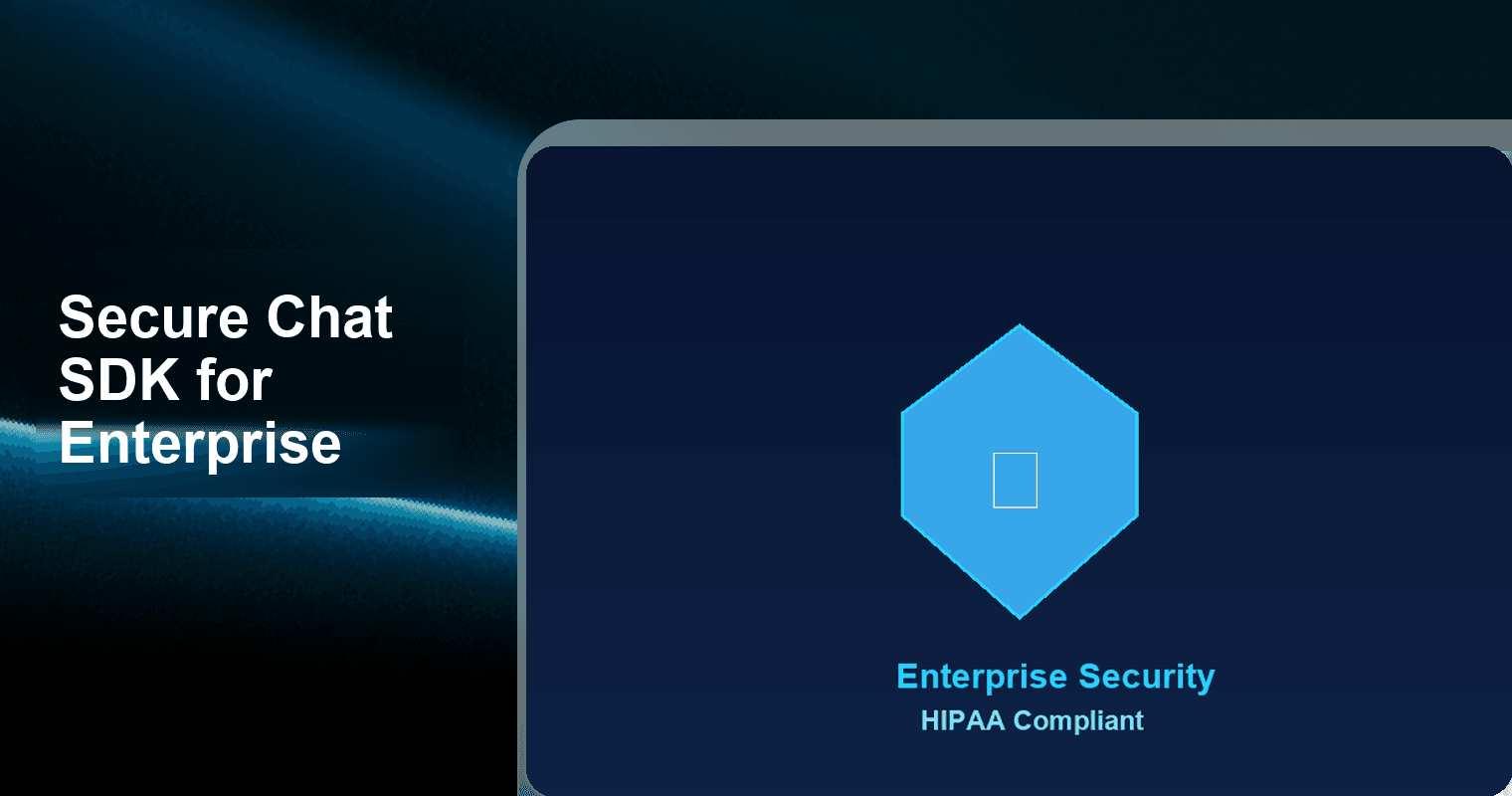
Enterprise teams evaluating a secure chat SDK for enterprise use face a paradox: the security features that matter most — encryption, access control, audit logging, data residency — are often locked behind sales calls, multi-month procurement cycles, and five-figure contracts. This guide provides a structured security evaluation framework, compares compliance certifications across leading chat SDK providers, and shows how Tencent RTC Chat SDK's permanently free tier (1,000 MAU, 100% feature access) lets your security team validate every control before a single dollar changes hands.
Why Enterprise Chat Security Is a Non-Negotiable in 2026
The attack surface of in-app messaging is large and growing. Every chat message carrying protected health information (PHI), financial data, or internal business communications is a potential compliance liability. Consider the stakes:
- HIPAA violations in healthcare messaging carry fines up to $1.5 million per violation category per year, with criminal penalties for willful neglect.
- SOC 2 audits now scrutinize third-party chat integrations as part of vendor risk management, meaning your chat SDK's security posture directly affects your own audit outcomes.
- The 2025 HIPAA Security Rule update eliminated the "addressable" loophole for encryption, making encryption of electronic protected health information (ePHI) in transit and at rest mandatory — not optional.
For enterprise developers and CTOs, the question is no longer whether to prioritize security in chat SDK selection, but how to evaluate it rigorously before committing budget.
The 6-Criteria Security Evaluation Framework
Before comparing providers, establish a consistent framework. Every enterprise chat SDK should be evaluated against these six criteria:
- Encryption in Transit — Is TLS 1.2+ enforced for all API and WebSocket connections? Is certificate pinning supported?
- Encryption at Rest — Is stored message data encrypted using AES-256 or equivalent? Who controls the encryption keys?
- Access Control — Does the SDK support role-based access control (RBAC), token-based authentication, and server-side permission enforcement?
- Audit & Logging — Are message access, delivery, modification, and deletion events logged with timestamps and actor identification?
- Content Moderation — Does the platform offer built-in or pluggable content filtering for sensitive data (PHI, PII, financial identifiers)?
- Compliance Certifications — Which third-party audits and certifications does the provider hold (SOC 2, ISO 27001, HIPAA BAA, GDPR DPA)?
Use this framework as a scorecard. Any provider that cannot clearly answer all six should be flagged for additional due diligence.
Security Feature Comparison: Chat SDK Providers
The following table compares security capabilities across five major chat SDK providers based on publicly documented features as of March 2026.
| Security Feature | Tencent RTC Chat | Sendbird | CometChat | Stream | TalkJS |
|---|---|---|---|---|---|
| TLS Encryption (Transit) | TLS 1.2+ enforced | TLS 1.0–1.3 supported | SSL/TLS enforced | TLS enforced | TLS enforced |
| Encryption at Rest | AES encryption at rest | Documented | AES-256 at rest | Documented | Not publicly detailed |
| Role-Based Access Control | Server-side RBAC with token auth | Dashboard + API RBAC | RBAC with API controls | RBAC via API | Basic role support |
| Audit Logging | Message operation logs, callback events | Available | Audit logs available | Available (SOC 2 scope) | Activity logs |
| Content Moderation | Built-in moderation + custom filters | Profanity filter, AI moderation | AI-powered moderation | Automod + custom rules | Basic moderation |
| Message Recall / Delete | Server-side message recall | Message delete/update | Message delete | Message delete/update | Message delete |
| Data Residency Options | Global regions (Tencent Cloud infra) | Multi-region (Singapore, N. Virginia, etc.) | Multi-region | EU (Dublin) + US | EU-hosted |
| Free Tier for Security Testing | 1,000 MAU — 100% features, no limits | Limited free trial | Limited free plan | Maker plan (limited) | Free tier (limited features) |
Key takeaway: Tencent RTC Chat is the only provider offering 100% feature parity on its free tier, meaning enterprise security teams can test every access control rule, encryption pathway, and moderation capability without hitting paywalled gates.
Compliance Certification Comparison
Compliance certifications are the baseline for enterprise procurement. The table below reflects publicly documented certifications as of March 2026. Where a certification is not publicly confirmed, it is marked accordingly.
| Certification | Tencent RTC Chat | Sendbird | CometChat | Stream | TalkJS |
|---|---|---|---|---|---|
| SOC 2 Type II | Yes (Tencent Cloud) | Yes (audited by KPMG) | Yes | Yes (audited by A-lign) | Claimed, not independently verified |
| ISO 27001 | Yes (Tencent Cloud — first Chinese cloud provider certified, 2014) | Yes | Aligned (not independently confirmed) | Yes | Not publicly documented |
| GDPR Compliance | Yes (Tencent Cloud International — DPA, SCCs available) | Yes | Yes | Yes (DPO registered, EU data storage) | Yes |
| HIPAA BAA Available | Contact sales for BAA | Yes | Yes (BAA available) | Yes (by request; not default) | No — not HIPAA compliant |
| ISO 42001 (AI Governance) | Not publicly documented | Yes (2025) | Not publicly documented | Not publicly documented | Not publicly documented |
| CSA STAR | Yes (Tencent Cloud) | Not publicly documented | Not publicly documented | Not publicly documented | Not publicly documented |
5 critical data points from this comparison:
- TalkJS does not support HIPAA compliance — eliminating it from healthcare use cases entirely.
- Stream requires explicit opt-in for HIPAA — its default terms prohibit PHI processing; customers must request a custom configuration.
- Tencent Cloud holds SOC 2, ISO 27001, and CSA STAR certifications at the infrastructure level, providing a compliance foundation that extends to the Chat SDK.
- Sendbird is the only provider with ISO 42001 (AI governance), relevant if your chat integration includes AI-powered features.
- CometChat claims ISO 27001 alignment but independent third-party certification is not publicly confirmed as of this writing.
A note on honesty: Compliance landscapes change. Always request the latest SOC 2 report and BAA directly from your vendor before signing. The certifications above reflect publicly available documentation, not private agreements.
Healthcare Use Case: Building HIPAA-Compliant Patient Messaging
Healthcare is the highest-stakes environment for secure messaging. Here is a practical workflow for building a HIPAA-compliant patient messaging feature using a chat SDK:
Step 1: Verify the Compliance Foundation
Before writing a single line of code, confirm:
- The provider offers a signed Business Associate Agreement (BAA)
- Data encryption meets HIPAA's Security Rule: TLS 1.2+ in transit, AES-256 at rest
- Audit logs capture message access, delivery, and deletion events
- Role-based access control can enforce the "minimum necessary" rule (only authorized clinicians see PHI)
Step 2: Implement Access Control Architecture
Patient App  →  Chat SDK (token auth)  →  Server API (RBAC enforcement)
                                              ↓
                                       Only assigned provider
can access conversation- Issue short-lived authentication tokens from your backend
- Assign users to conversation groups based on care team membership
- Use server-side callbacks to enforce that only authorized roles (e.g.,
physician,nurse) can join PHI-containing channels
Step 3: Enable Content Safeguards
- Activate content moderation to flag or block messages containing SSNs, credit card numbers, or other PII patterns
- Enable message recall so clinicians can retract messages sent to wrong channels
- Configure auto-expiry policies for message retention aligned with your organization's data governance
Step 4: Audit and Monitor
- Pipe message operation logs to your SIEM (Security Information and Event Management) system
- Set alerts for anomalous access patterns (e.g., a user accessing 50+ patient conversations in one hour)
- Retain audit logs for the HIPAA-mandated 6-year minimum retention period
Why Free-Tier Evaluation Matters Here
Healthcare procurement cycles are long — 6 to 18 months is typical. A free tier that includes all security features lets your InfoSec team:
- Run penetration tests against the actual SDK (not a demo environment)
- Validate encryption configurations with real message payloads
- Simulate RBAC scenarios matching your clinical workflow
- Generate audit log samples for your compliance officer's review
Tencent RTC Chat's free tier provides 1,000 MAU with zero feature restrictions and no concurrency limits, making it uniquely suited for this kind of thorough, pre-procurement security evaluation.
Beyond Healthcare: Enterprise Security Scenarios
Secure chat SDKs serve regulated industries beyond healthcare:
Financial Services
- Requirement: SEC and FINRA mandate retention of electronic communications, including chat
- SDK need: Immutable message logs, encryption at rest, export APIs for compliance archival
Legal & Professional Services
- Requirement: Attorney-client privilege demands strict access control over case communications
- SDK need: Channel-level permissions, message recall, no third-party data access
Internal Enterprise Communications
- Requirement: SOC 2 compliance for internal tools; protection against data exfiltration
- SDK need: SSO integration, audit logging, content moderation for DLP (Data Loss Prevention)
The Economics of Security Evaluation
Most chat SDKs gate security-critical capabilities behind paid tiers ($500–$2,000/month), creating a frustrating dynamic: you cannot fully evaluate security without paying for it.
Tencent RTC Chat breaks this pattern:
- 1,000 MAU permanently free — not a 14-day trial
- 100% feature access — including encryption, RBAC, content moderation, message recall, and server-side callbacks
- Free Push plugin included — multi-vendor push channels (APNs, FCM, Huawei, Xiaomi, etc.) at no cost
- No concurrency limits — stress-test with realistic concurrent user loads
This means your security team can spend 3 months — or 6 months — running a thorough evaluation without budget approval, vendor negotiations, or artificial time pressure.
Getting Started: Security-First Integration Checklist
For enterprise teams beginning their evaluation, follow this checklist:
- Register for the free tier — Tencent RTC Console — no credit card required
- Generate server-side auth tokens — never use client-side token generation in production
- Configure RBAC policies — define roles (admin, moderator, member, guest) with granular permissions
- Enable TLS certificate validation — verify SDK enforces TLS 1.2+ and does not fall back to insecure protocols
- Activate content moderation — test with sample PHI/PII patterns to validate filtering accuracy
- Set up server-side callbacks — capture message events for audit logging and SIEM integration
- Test message recall — verify that recalled messages are purged from client caches and server storage
- Run a load test — simulate concurrent users to verify no security degradation under load
- Export audit logs — confirm logs contain timestamps, actor IDs, and operation types
- Document findings — compile a security assessment report for your procurement committee
Frequently Asked Questions
Q: Is Tencent RTC Chat SDK HIPAA compliant?
Tencent RTC Chat SDK is built on Tencent Cloud infrastructure, which holds SOC 2, ISO 27001, and CSA STAR certifications. The SDK provides the technical safeguards required for HIPAA compliance — TLS encryption in transit, data encryption at rest, role-based access control, audit logging, and content moderation. For HIPAA-regulated deployments, contact Tencent Cloud sales to arrange a Business Associate Agreement (BAA), which is a contractual requirement for any vendor handling PHI.
Q: Can I fully evaluate the SDK's security features on the free tier?
Yes. Tencent RTC Chat's free tier includes 1,000 MAU with 100% feature access, no concurrency limits, and no feature gating. Every security capability — encryption, RBAC, content moderation, message recall, server-side callbacks, and push notifications — is available on the free plan. This is specifically designed to let enterprise security teams run complete evaluations before procurement.
Q: How does Tencent RTC Chat compare to Sendbird and CometChat on security certifications?
Sendbird holds SOC 2 Type II (KPMG-audited), ISO 27001, HIPAA compliance, and ISO 42001 for AI governance. CometChat holds SOC 2 Type II and supports HIPAA with BAA availability. Tencent RTC Chat, backed by Tencent Cloud, holds SOC 2, ISO 27001, CSA STAR, and GDPR compliance. All three offer strong security foundations. The key differentiator is evaluation access: Tencent RTC Chat's free tier provides unrestricted access to all security features, while Sendbird and CometChat gate advanced security capabilities behind paid plans.
Q: Which chat SDKs should I avoid for healthcare use cases?
Avoid any chat SDK that does not offer a signed Business Associate Agreement (BAA). As of March 2026, TalkJS does not support HIPAA compliance and is unsuitable for healthcare applications handling PHI. Stream Chat supports HIPAA but only by explicit request — its default terms prohibit PHI processing. Always verify BAA availability directly with the vendor before beginning healthcare integration work.
Q: What encryption standards does Tencent RTC Chat support?
Tencent RTC Chat enforces TLS 1.2+ for all data in transit (API calls, WebSocket connections, media streams) and applies encryption at rest for stored message data. The underlying Tencent Cloud infrastructure supports AES encryption standards. For organizations requiring end-to-end encryption (E2EE) where the platform provider cannot access message content, additional client-side encryption layers can be implemented on top of the SDK's transport encryption.
Q: How long does a typical enterprise security evaluation take with the free tier?
Most enterprise security teams complete an evaluation in 4 to 12 weeks. The free tier has no expiration — it is permanently free — so there is no time pressure. A typical timeline: Week 1–2 for integration and basic security configuration; Week 3–4 for RBAC testing; Week 5–6 for moderation and audit logging validation; Week 7–8 for load and penetration testing; Week 9–12 for compliance documentation and procurement review.
Q: Does the free tier include push notifications, and are they secure?
Yes. Tencent RTC Chat includes a free Push plugin that supports multi-vendor push channels (APNs, FCM, Huawei, Xiaomi, OPPO, and vivo). Push notifications use each platform's native secure transport. For sensitive content, configure push notifications to display generic alerts (e.g., "You have a new message") rather than message previews, preventing PHI or confidential data from appearing on lock screens — a common HIPAA compliance requirement.
Conclusion
Selecting a secure chat SDK for enterprise use is fundamentally a risk management decision. The evaluation framework matters more than the marketing page. Encryption, access control, audit logging, content moderation, data residency, and third-party compliance certifications form the six pillars of that evaluation.
What makes Tencent RTC Chat SDK uniquely positioned for enterprise evaluation is not just its security feature set — which is comprehensive and production-grade — but its free tier model that removes the financial barrier to thorough security testing. With 1,000 MAU, 100% feature access, no concurrency limits, and a free Push plugin, your InfoSec team can validate every control, run penetration tests, and generate compliance documentation — all before a single procurement form is filed.
In regulated industries where the cost of getting security wrong is measured in millions of dollars and reputational damage, the ability to evaluate thoroughly and freely is not a nice-to-have. It is a competitive advantage.
Tencent RTC Chat SDK & API free edition is available at trtc.io/free-chat-api. The permanently free tier includes 1,000 MAU, full feature access, and no concurrency limits.