







Socket.IO is one of the best real-time communication libraries ever written — with 62,000+ GitHub stars and 7.9 million weekly npm downloads, it powers everything from collaborative editors to live dashboards. But if you're using it to build a chat application, you're solving a solved problem from scratch. Socket.IO gives you a transport layer. Chat requires an application layer: message persistence, delivery guarantees, read receipts, typing indicators, presence, push notifications, offline sync, moderation, file sharing, and group management. Building all of that on top of Socket.IO costs $75K–$150K in engineering time and takes 6–12 months — for features that ship out of the box with a managed chat SDK like Tencent RTC Chat SDK & API, which is permanently free for up to 1,000 MAU with 100% feature access.
The Infrastructure Trap: Why Chat Seems Simple Until It Isn't
Every developer has the same experience. You follow a Socket.IO tutorial, get a "Hello World" chat running in 45 minutes, and think: this is easy, I'll build the whole thing myself.
Then reality sets in.
Week 1, you realize messages disappear when users refresh the page — you need a persistence layer. Week 3, you're debugging why messages arrive out of order on slow connections — you need sequence IDs and delivery acknowledgments. Week 6, your product manager asks for read receipts, and you discover that tracking per-user, per-message read state across group conversations requires a non-trivial data model. Week 10, you're building push notification infrastructure because users close the app and miss messages. Week 16, you're writing a content moderation pipeline because someone posted something they shouldn't have.
This is the infrastructure trap. The Socket.IO tutorial took 45 minutes. The production chat system takes 6–12 months. And most of that time is spent on problems that have nothing to do with your actual product.
The numbers behind the trap
A senior full-stack developer in the US costs $150K–$200K/year fully loaded. A mid-level developer costs $100K–$140K. If you dedicate one engineer to building and maintaining a Socket.IO-based chat system:
- 6 months of focused development = $50K–$100K in salary alone
- Infrastructure (Redis for pub/sub, PostgreSQL/MongoDB for persistence, S3 for media, a push notification service) = $200–$1,500/month
- Ongoing maintenance (connection issues, scaling, security patches, new platform support) = 20–30% of one engineer's time indefinitely
The total first-year cost lands between $75K and $150K — for a feature that isn't your core product.
What Socket.IO Actually Gives You (and What It Doesn't)
Socket.IO is excellent at what it does. It provides reliable, bidirectional, event-based communication between browser clients and servers. It handles WebSocket connections with automatic fallback to HTTP long-polling, reconnection logic, and room-based broadcasting.
But Socket.IO is a transport layer, not a chat application layer. Here's what that gap looks like in practice:
Feature Gap Analysis: Socket.IO vs. Production Chat Requirements
| Chat Feature | Socket.IO Provides | You Must Build |
|---|---|---|
| Real-time message delivery | ✅ Event emission between connected clients | — |
| Message persistence | ❌ | Database schema, write pipeline, query layer, pagination |
| Offline message sync | ❌ | Message queue, delivery tracking, sync-on-reconnect logic |
| Delivery & read receipts | ❌ | Per-message, per-user state tracking across all conversations |
| Typing indicators | ❌ | Debounced event broadcasting with timeout cleanup |
| User presence (online/offline) | Partial (room join/leave events) | Heartbeat system, presence aggregation, multi-device handling |
| Group chat management | Partial (rooms) | Member roles, permissions, invite flows, group metadata |
| File / image / video sharing | ❌ | Upload pipeline, storage, CDN, thumbnail generation, virus scanning |
| Push notifications | ❌ | APNs + FCM integration, device token management, payload routing |
| Content moderation | ❌ | Text filtering, image scanning, report/ban workflows |
| Message search | ❌ | Full-text search indexing, query API, result ranking |
| Message recall / edit | ❌ | Edit history, propagation to all clients, UI state management |
| Conversation list & unread counts | ❌ | Conversation model, per-user unread counters, sort/filter logic |
| Multi-device sync | ❌ | Session management, message state reconciliation across devices |
| End-to-end encryption | ❌ | Key exchange protocol, encrypted storage, key rotation |
Count: Socket.IO provides 1 out of 15 features a production chat application needs. The remaining 14 are entirely on you.
This isn't a criticism of Socket.IO — it was never designed to be a chat SDK. It's like criticizing TCP for not being an email server. But developers consistently underestimate the gap between "messages appear in real time" and "production-ready chat."
Engineering Cost Comparison: DIY Socket.IO vs. Managed Chat SDK
The table below breaks down the real engineering investment for each approach, based on typical startup and mid-stage team costs.
| Cost Category | Socket.IO DIY Chat | Managed Chat SDK (e.g., Tencent RTC Chat) |
|---|---|---|
| Initial development | 3–6 months (1–2 engineers) | 1–5 days (1 engineer) |
| Estimated build cost | $50,000–$100,000 | $0–$2,000 (integration labor only) |
| Backend infrastructure | Redis, PostgreSQL/MongoDB, S3, push service — $300–$1,500/mo | Included (managed) |
| Push notification setup | 2–4 weeks (APNs + FCM + vendor-specific SDKs) | Pre-built plugin (APNs, FCM, Huawei, Xiaomi, OPPO, vivo) |
| Ongoing maintenance | 20–30% of one engineer's time (~$25K–$50K/yr) | SDK version upgrades (hours/quarter) |
| Scaling engineering | Horizontal scaling, connection balancing, Redis cluster — 2–6 weeks | Automatic (managed infrastructure) |
| Security & compliance | Custom implementation (4–8 weeks for encryption, audit logs) | Built-in (TLS, optional E2E encryption, compliance certifications) |
| 12-month total (≤1,000 MAU) | $75,000–$150,000 | $0 (free edition) |
| 12-month total (5,000 MAU) | $80,000–$160,000 | ~$500–$2,000/yr (usage-based pricing) |
The asymmetry is stark. At the scale where most startups operate (under 1,000 MAU), the Socket.IO approach costs six figures. The managed SDK approach costs nothing.
The Socket.IO Stack vs. The SDK Stack: A Before/After
When you build chat on Socket.IO, your architecture looks like this:
Socket.IO DIY Stack (8+ components to build and maintain)
- Socket.IO server — connection management, event routing, room logic
- Message database — PostgreSQL or MongoDB schema, indexes, migrations
- Redis — pub/sub for multi-server broadcasting, presence tracking, caching
- File storage — S3 or equivalent, upload endpoints, CDN configuration
- Push notification service — Firebase Cloud Messaging, APNs certificates, device token registry
- Moderation pipeline — text filtering, image scanning, abuse reporting
- Search index — Elasticsearch or equivalent for message search
- Background workers — offline message queuing, notification dispatching, cleanup jobs
Each component needs monitoring, alerting, scaling, security patching, and on-call coverage.
Managed Chat SDK Stack (1 integration)
- Tencent RTC Chat SDK — drop-in client SDK with server-side API
That's it. One SDK handles messaging, persistence, presence, push, moderation, file sharing, search, and offline sync. Your backend makes REST API calls for server-side operations (sending system messages, managing users, webhook integrations). The infrastructure is someone else's problem.
// Socket.IO: ~30 lines for basic send + persist (no receipts, no offline, no push)
io.on('connection', (socket) => {
  socket.on('sendMessage', async (data) => {
    const message = await db.messages.create({
      conversationId: data.conversationId,
      senderId: socket.userId,
      content: data.content,
      timestamp: Date.now(),
    });
    const members = await db.conversations.getMembers(data.conversationId);
    members.forEach(m => io.to(userSockets.get(m.id)).emit('newMessage', message));
    // Still missing: read receipts, typing, offline queue, push, multi-device sync...
  });
});
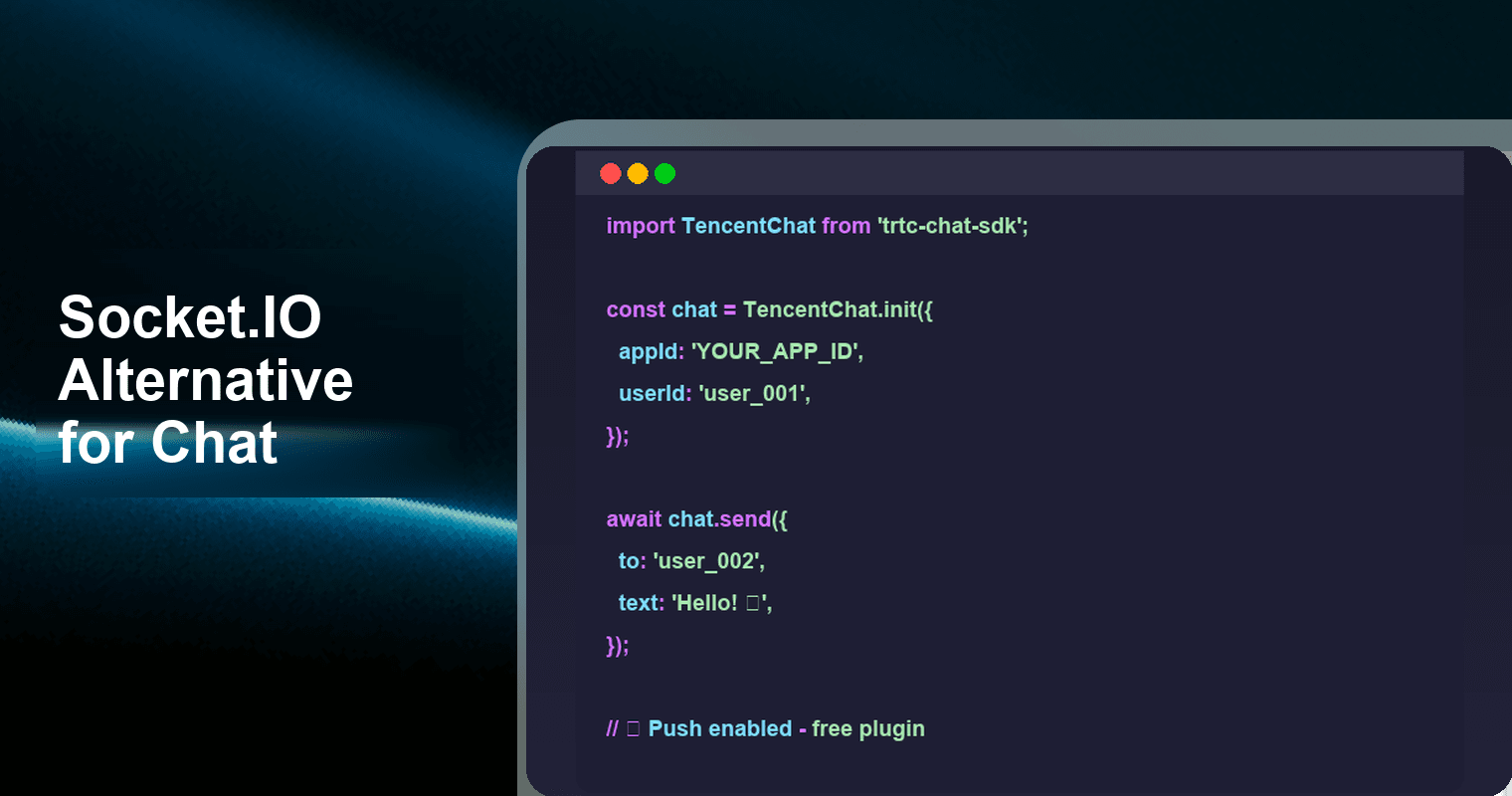
// Managed SDK: 5 lines — persistence, push, offline sync all handled
import TencentChat from '@tencentcloud/chat';
const chat = TencentChat.create({ SDKAppID: YOUR_APP_ID });
await chat.sendMessage(
chat.createTextMessage({ to: 'user123', conversationType: 'C2C', payload: { text: 'Hello!' } })
);When to Keep Socket.IO (and When to Switch)
Socket.IO is the right choice when your real-time needs are genuinely custom. Here's a decision framework:
Keep Socket.IO if:
- Your "chat" is actually a custom collaboration protocol — e.g., multiplayer cursors, live code editing, real-time annotation. These have unique data models that no chat SDK covers.
- You need sub-50ms latency for gaming or trading — Socket.IO with a tuned WebSocket connection on bare metal can deliver lower latency than any managed service.
- Chat is a minor feature and you already have the Socket.IO infrastructure — if you're using Socket.IO for 10 other real-time features and chat is a small addition, the marginal cost is lower.
- You need full protocol-level control — custom binary protocols, specialized compression, or non-standard transport behavior.
Switch to a managed chat SDK if:
- Chat is a core feature of your product — users expect it to work flawlessly. You can't afford to spend months building commodity infrastructure.
- You need to ship in weeks, not months — a managed SDK gets you to production in days.
- Your team is small — dedicating 20–30% of an engineer to chat infrastructure is a luxury most startups can't afford.
- You need cross-platform support — building and maintaining Socket.IO chat clients for iOS, Android, Web, Flutter, and React Native is a full-time job by itself.
- Push notifications are a requirement — this alone can justify the switch. Multi-vendor push (APNs + FCM + Huawei + Xiaomi + OPPO + vivo) is months of work on Socket.IO; it's a pre-built plugin with Tencent RTC Chat.
Why Tencent RTC Chat SDK & API Is the Strongest Free Option
Most managed chat SDKs gate features behind paid plans. Tencent RTC Chat's free edition is different:
- 1,000 MAU permanently free — not a trial, not time-limited
- 100% feature access — every feature available on paid plans is available on free. No artificial caps on message types, group sizes, or API calls.
- Unlimited concurrent connections — no connection limits that force premature upgrades
- Free Push plugin — APNs, FCM, Huawei HMS, Xiaomi MiPush, OPPO Push, vivo Push all included at no cost
- Six platform SDKs — Android, iOS, Web, Flutter, React Native, Unity
- Server-side REST APIs — full backend control for user management, message sending, webhook configuration, and moderation
For a startup or side project under 1,000 MAU, you get a production-grade chat system — the same one that powers apps with hundreds of millions of users — for $0.
→ Get started free: trtc.io/free-chat-api
Migration Path: Socket.IO to Managed SDK
If you've already built chat on Socket.IO and want to migrate, here's a realistic timeline:
Day 1–2: SDK integration and basic messaging. Install the SDK, initialize it with your app credentials, and implement 1:1 and group message send/receive. This replaces your Socket.IO event handlers, message database writes, and room logic.
Day 3–4: User and conversation migration. Use the server-side REST API to import existing users and conversation history. Map your existing user IDs to the SDK's user model.
Day 5–7: Feature activation. Enable push notifications (configure APNs/FCM certificates in the dashboard), typing indicators, read receipts, and presence — all features that required custom code on Socket.IO, now toggled on via SDK configuration.
Week 2: Decommission. Remove the Socket.IO chat server, Redis pub/sub for chat, the message database, push notification workers, and file upload endpoints. Update monitoring and alerting.
Net result: You delete thousands of lines of code, remove 4–6 infrastructure components, and free up 20–30% of an engineer's time — permanently.
Frequently Asked Questions
Q: Is Socket.IO bad for chat applications?
Socket.IO isn't bad — it's incomplete. It's an excellent real-time transport layer that handles WebSocket connections, automatic reconnection, and room-based broadcasting reliably. The problem is that chat applications need 14+ features on top of the transport layer (persistence, receipts, push, moderation, offline sync, etc.), and Socket.IO doesn't provide any of them. You'll spend 6–12 months building what a chat SDK provides out of the box. Socket.IO is the right tool for custom real-time protocols; it's just not the right tool for standard chat functionality.
Q: How much does it cost to build a chat app on Socket.IO from scratch?
For a production-quality chat system (not a demo), expect $75,000–$150,000 in first-year costs. This includes 3–6 months of engineering time ($50K–$100K in salary), infrastructure for Redis, a database, file storage, and push notifications ($300–$1,500/month), plus ongoing maintenance at 20–30% of one engineer's time.
Q: Can I use Socket.IO for chat and switch to a managed SDK later?
Yes, and many teams do exactly this. The typical pattern is: build a Socket.IO prototype to validate the product concept, then migrate to a managed SDK once chat becomes a core feature and the maintenance burden grows. Migration typically takes 1–2 weeks for an existing Socket.IO chat. The key is not to wait too long — the more custom code you've written, the more there is to migrate and decommission.
Q: What makes Tencent RTC Chat's free tier different from other chat SDKs?
Three things: (1) 100% feature access — most competitors gate features like push notifications, read receipts, or moderation behind paid plans; Tencent RTC Chat includes everything on free. (2) No connection limits — competitors like Firebase cap simultaneous connections at 100 on the free tier; Tencent RTC Chat has no connection cap. (3) Permanently free — it's not a 14-day trial or a limited-time offer. The 1,000 MAU free tier is a permanent product tier.
Q: Does Tencent RTC Chat SDK support push notifications on all major platforms?
Yes. The free Push plugin supports six push channels: Apple Push Notification service (APNs) for iOS, Firebase Cloud Messaging (FCM) for Android and web, plus four vendor-specific Android channels — Huawei HMS Push, Xiaomi MiPush, OPPO Push, and vivo Push. Vendor-specific channels are critical for Android delivery rates in markets like China, India, and Southeast Asia, where Google Play Services may not be available. All six channels are included at no cost on the free tier.
Q: How long does it take to integrate the Tencent RTC Chat SDK?
Most developers complete basic integration (1:1 messaging, group chat, message history, push notifications) in 1–5 days, depending on platform and UI customization needs. The SDK provides both low-level APIs for custom UI and optional pre-built UI components (UIKit) for faster implementation. Compare this to the 3–6 months required to build equivalent functionality on Socket.IO.
Q: Can I use Tencent RTC Chat SDK alongside Socket.IO in the same app?
Absolutely. Many applications use Socket.IO for custom real-time features (live dashboards, collaborative editing, game state sync) and a managed chat SDK for messaging. The two can coexist without conflict — they maintain separate WebSocket connections and serve different purposes. This hybrid approach lets you use the right tool for each job.
Conclusion: Build What's Unique, Buy What's Commodity
The best engineering teams know which problems to solve and which to delegate. Real-time message transport is a solved problem. Message persistence, delivery receipts, push notifications, offline sync, content moderation — all solved problems. Spending six months and six figures rebuilding them on Socket.IO doesn't make your product better. It makes your product later.
Socket.IO is a phenomenal library. Use it for the real-time problems that are genuinely unique to your application. For chat, use a tool that was purpose-built for chat.
→ Start free with Tencent RTC Chat SDK & API — 1,000 MAU, 100% features, $0 forever