




Packet loss, bandwidth limits, and jitter put different kinds of pressure on a video call. An SDK can preserve motion by reducing resolution, or retain a larger frame while rendering fewer frames per second. A useful comparison needs to show both.
This article examines a Web SDK benchmark dated October 23, 2026, comparing Tencent Real-Time Communication (TRTC) with Agora under six impaired-network scenarios. TRTC delivered higher rendered frame rates and pixel throughput under uplink packet loss and both jitter conditions. Agora maintained substantially higher frame rates in the two bandwidth-limited scenarios. Downlink packet-loss results were close, with Agora slightly ahead on frame rate and pixel throughput.
The findings below apply to the tested versions and configuration. They describe video rendering, resolution changes, and frame-rate recovery; they do not establish an overall ranking for every video application.
What the benchmark tested
Both SDKs used the same reported video targets: 640 × 480 resolution, 30 fps, H.264, and a target bitrate ceiling of 1,000 kbps. Measurements focused on the video rendered at the receiving endpoint.
| Setting | Reported configuration |
|---|---|
| Test date | October 23, 2026 |
| Platform | Windows device, Microsoft Edge 155 |
| TRTC version | TRTC Web SDK 5.20.1 |
| Agora version | Agora Web SDK 4.24.8 |
| Target resolution | 640 × 480 |
| Target frame rate | 30 fps |
| Target bitrate ceiling | 1,000 kbps |
| Video codec | H.264 for both SDKs |
A 60-second normal-network scenario provided a reference. The six impaired-network scenarios covered packet loss in each direction, bandwidth restrictions with and without packet loss, and jitter in each direction.
| Scenario | Applied condition | Impairment duration |
|---|---|---|
| S1 | 25% uplink packet loss | 30 seconds |
| S2 | 25% downlink packet loss | 30 seconds |
| S3 | 500 kbps bandwidth cap | 60 seconds |
| S4 | 500 kbps bandwidth cap + 25% packet loss | 60 seconds |
| S5 | 600 ms uplink jitter | 30 seconds |
| S6 | 600 ms downlink jitter | 30 seconds |
For S3 and S4, the impairment applied to the uplink for the first 30 seconds. Downlink impairment was then added for another 30 seconds while the uplink remained impaired. The scenario averages combine these two stages. The 600 ms jitter value is the configured impairment; it is not a measured end-to-end latency result.
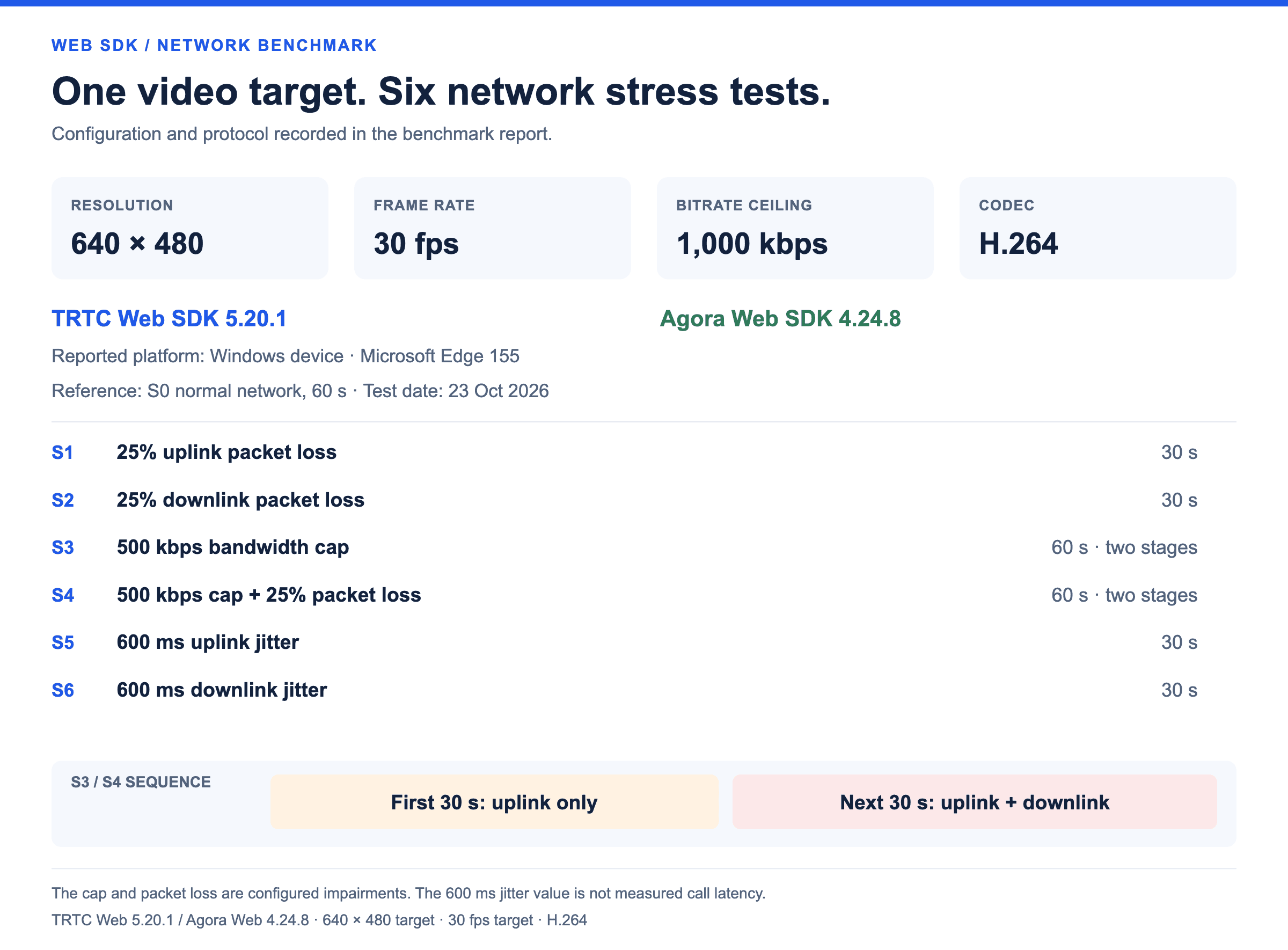
Figure 1. The reported video targets and impairment protocol. Bandwidth-limited scenarios include an uplink-only stage followed by an uplink-plus-downlink stage.
Test constraints
This report presents TRTC performance with the “Ensuring video smoothness” preference, i.e. the setting that prioritizes video smoothness over image clarity. This is an account-level setting that is disabled by default; to reproduce the test, contact TRTC Technical Support to have this setting provisioned for your account.
How to read the results
The comparison uses three complementary measurements:
- Rendered frame rate: how many video frames the receiver renders per second.
- 640 × 480 retention: the percentage of the impaired interval spent at the configured resolution.
- Rendered pixel throughput: the report's combined frame-rate-and-resolution metric, expressed in megapixels per second (MP/s).
The combined metric uses this relationship:
Rendered pixel throughput (MP/s) = rendered fps × frame width × frame height ÷ 1,000,000
At a fixed 640 × 480 resolution, 30 fps corresponds to about 9.22 MP/s. Reducing either frame rate or resolution reduces this value. When resolution changes during a scenario, the reported combined value reflects those changes; multiplying the average frame rate by the configured resolution would overstate delivery.
Pixel throughput is a descriptive proxy, not a perceptual video-quality score. It does not measure compression artifacts, text legibility, frame pacing, audio quality, or interaction delay. Resolution retention also describes frame dimensions, without proving how sharp the picture looked. Read these metrics together, with the frame-rate and resolution traces.
The source uses normalized display timelines. Packet-loss impairment appears at 60–90 seconds, and bandwidth impairment at 60–120 seconds. Jitter summary values use an analysis window shifted five seconds earlier, as specified in the report. The figures preserve the source traces and display timeline; that adjustment should be kept in mind when comparing the jitter charts with the averages.
Results across all six network conditions
| Network condition | TRTC fps | Agora fps | TRTC MP/s | Agora MP/s |
|---|---|---|---|---|
| 25% uplink packet loss | 28.8 | 25.4 | 8.85 | 3.85 |
| 25% downlink packet loss | 26.7 | 28.0 | 8.20 | 8.61 |
| 500 kbps bandwidth cap | 4.7 | 21.8 | 0.73 | 1.85 |
| 500 kbps cap + 25% packet loss | 2.5 | 17.1 | 0.49 | 1.51 |
| 600 ms uplink jitter | 17.7 | 12.1 | 3.49 | 2.54 |
| 600 ms downlink jitter | 11.6 | 3.6 | 3.56 | 1.11 |
The report's equally weighted mean across the six impaired scenarios was 4.22 MP/s for TRTC and 3.24 MP/s for Agora, approximately 30% higher for TRTC. Each scenario has the same weight in that summary, despite different durations. The number is not weighted by real-world network frequency or application priorities, and it does not mean that users experienced 30% better visual quality. Summary values retain the source's rounding; recalculating from rounded table cells can produce small differences.
Figure 2. Rendered pixel throughput during impairment. All six scenarios share the same scale. Higher values indicate more rendered pixels per second under this metric.
Packet loss: TRTC's clearest advantage was on the uplink
Under 25% uplink packet loss, TRTC averaged 28.8 fps and retained 640 × 480 for the entire impaired interval. Agora averaged 25.4 fps and retained the configured resolution for 27% of the interval. Its resolution dropped for the remaining time.
That combination produced 8.85 MP/s for TRTC versus 3.85 MP/s for Agora, approximately 2.3 times as much rendered pixel throughput. Most of the gap is clearer when resolution is considered alongside frame rate: a comparison of 28.8 fps with 25.4 fps alone would miss the resolution difference.
Figure 3. With 25% uplink packet loss, TRTC retained the configured resolution throughout the impaired interval, while Agora reduced resolution.
Under 25% downlink packet loss, both SDKs retained 640 × 480 throughout the impaired interval. Agora averaged 28.0 fps, compared with 26.7 fps for TRTC, and recorded 8.61 versus 8.20 MP/s. This was a much smaller separation than in the uplink case. The report does not provide repeated-run variance or confidence intervals, so the small difference should be read as a result of this test.
Bandwidth limits: Agora maintained higher frame rates
The strongest result in Agora's favor appeared when bandwidth was capped at 500 kbps. In the cap-only scenario, Agora averaged 21.8 fps, while TRTC averaged 4.7 fps. Adding 25% packet loss widened the motion gap: 17.1 fps for Agora versus 2.5 fps for TRTC.
The report shows different resolution trade-offs. TRTC spent most of the constrained periods at 480 × 360, while Agora spent most of them at 320 × 240. In this setup, retaining larger frames coincided with a much lower rendering rate for TRTC.
Agora also led on the combined pixel-throughput metric: 1.85 versus 0.73 MP/s with the bandwidth cap alone, and 1.51 versus 0.49 MP/s with the cap and packet loss together. TRTC's larger frame dimensions did not offset its lower frame rate in either scenario.
Figure 4. At a 500 kbps cap, Agora preserved more motion while TRTC mostly retained a larger resolution. Shading distinguishes the uplink-only stage from the combined uplink and downlink stage.
These are observed outcomes under the tested configuration. They do not prove a permanent product-wide preference for resolution or smoothness. Both SDKs expose controls that can affect the trade-off: TRTC documents its qosPreference setting, and Agora documents video optimization modes. The report does not specify the exact values used for these controls, so it cannot isolate their contribution to the result.
Jitter: TRTC led in both directions
Under 600 ms uplink jitter, TRTC averaged 17.7 fps, compared with 12.1 fps for Agora. Its rendered pixel throughput was 3.49 versus 2.54 MP/s, approximately 1.4 times Agora's result. Both SDKs reduced resolution during this scenario.
Under 600 ms downlink jitter, both retained 640 × 480 throughout the impaired interval. The frame-rate difference was therefore especially visible: 11.6 fps for TRTC versus 3.6 fps for Agora, with 3.56 versus 1.11 MP/s of pixel throughput, approximately a 3.2-times difference.
TRTC held up better under these jitter conditions, although both downlink results remained well below the configured 30 fps target. A relative advantage here should not be mistaken for unaffected playback.
Figure 5. Both SDKs kept the configured resolution under downlink jitter. The source reports a higher average rendering rate for TRTC, using its five-second-adjusted jitter analysis window.
Resolution retention adds context to the frame-rate numbers
TRTC retained 640 × 480 for the entire impaired interval in both packet-loss scenarios and the downlink-jitter scenario. Agora did so under downlink packet loss and downlink jitter. Neither SDK consistently retained the configured resolution under the 500 kbps restrictions.
| Network condition | TRTC at 640 × 480 | Agora at 640 × 480 |
|---|---|---|
| 25% uplink packet loss | 100% | 27% |
| 25% downlink packet loss | 100% | 100% |
| 500 kbps bandwidth cap | 6% | 5% |
| 500 kbps cap + 25% packet loss | 4% | 19% |
| 600 ms uplink jitter | 27% | 30% |
| 600 ms downlink jitter | 100% | 100% |
The report's equal-scenario averages were 56% for TRTC and 47% for Agora. The bandwidth results show why retention needs context: keeping larger frames did not guarantee a more fluid video experience.
Figure 6. Resolution distribution during impairment. Segment widths preserve the source HTML's percentages; displayed labels are rounded. Resolution colors represent frame sizes, and each row identifies the SDK.
Recovery: similar averages, different scenario results
Recovery time measures how long the rendered frame rate takes to reach 90% of that scenario's baseline, with the threshold met for three consecutive seconds, after the impairment is removed.
| Network condition | TRTC recovery | Agora recovery |
|---|---|---|
| 25% uplink packet loss | 0.2 s | 0.4 s |
| 25% downlink packet loss | 2.6 s | 0.8 s |
| 500 kbps bandwidth cap | 0.2 s | 2.0 s |
| 500 kbps cap + 25% packet loss | 0.9 s | 0.1 s |
| 600 ms uplink jitter | 2.8 s | 7.5 s |
| 600 ms downlink jitter | 6.6 s | 2.9 s |
| Mean across six scenarios | 2.2 s | 2.3 s |
Both SDKs met the criterion within the report's 30-second recovery observation window. The averages were close, but the faster SDK varied by scenario: TRTC recovered sooner after uplink jitter, while Agora recovered sooner after downlink jitter.
These are frame-rate recovery times. The report notes that resolution sometimes returned more slowly. A recovered rendering rate therefore does not establish that the original video resolution, visual appearance, or interaction latency had also recovered.
Figure 7. Time to recover to 90% of the scenario baseline for three consecutive seconds. This criterion measures frame rate only.
What these results mean for a Web video evaluation
For this configuration, uplink packet loss and severe jitter were TRTC's stronger scenarios; sustained bandwidth restrictions were Agora's. The useful next step is to match those conditions to the networks and media your application actually encounters.
Evaluate the two SDKs with the same source video, explicit video targets, and documented adaptation settings. Record uplink and downlink impairments separately. Include rendered frame rate and resolution, then add measurements for freeze duration, audio continuity, and interaction latency if those determine whether a call is usable. Agora's remote video statistics reference distinguishes rendered frame rate from received and decoded frame rates, a useful distinction when instrumenting a comparison. TRTC's Web video configuration guide explains how to set custom resolution, frame-rate, and bitrate targets.
The underlying HTML report provides summary measurements and plotted traces, but the supplied material does not include raw sample logs, the test harness, repetition counts, or a complete network-emulation specification. It also does not establish behavior across other devices, regions, browsers, SDK releases, or adaptation settings. This article preserves the reported results; it is not an independent rerun of the benchmark.
Choose evaluation criteria before aggregating scores. If motion continuity matters most, the bandwidth-limited frame rates deserve more weight. If retaining frame dimensions during uplink loss is a priority, the packet-loss results deserve closer attention. The final decision should follow the network conditions and user experience your application needs to support.


