






You’re elbow-deep in a dog grooming session when the phone rings. Or halfway through a client’s balayage. Or leading a packed yoga class.
You can’t pick up. The caller hangs up. And there’s an 85% chance they won’t call back — they’ll just book with whoever answers next.
So now you’re weighing your options: hire a receptionist, or use an AI receptionist? The AI receptionist vs hiring a receptionist decision comes down to cost, coverage, and what your business actually needs. This guide gives you the real numbers so you can stop guessing.
No fluff. Just math and honest comparisons.
What Hiring a Receptionist Actually Costs in 2026
Most people look at salary and stop there. That’s a mistake.
The Bureau of Labor Statistics puts the median receptionist salary at $37,230 per year — about $17.90/hour. But salary is just the starting line.
The Full Cost Breakdown
Here’s what you’ll actually pay for a full-time, in-house receptionist:
Expense | Annual Cost |
Base salary (median) | $37,230 |
Payroll taxes (7.65% FICA) | $2,848 |
Health insurance | $6,200 |
Paid time off (2 weeks) | $1,432 |
Workers’ comp insurance | $450 |
Equipment (phone, computer, desk) | $1,500 |
Training & onboarding | $1,200 |
Total | $50,860 |
That’s $4,238 per month before they pick up a single call. In expensive metros like LA, New York, or Seattle, bump that to $60,000–$75,000 all in.
And there’s a cost most owners forget: turnover. The Society for Human Resource Management estimates replacing an employee costs 50–200% of their salary. Receptionist turnover is notoriously high. If yours quits after six months, you’re out thousands in recruiting and retraining — and back to missing calls while you search.
The Part-Time Compromise
Some owners try splitting the difference with a part-time hire. You’ll pay $15–$20/hour for 20 hours a week — roughly $1,300–$1,700/month.
Cheaper? Sure. But you only get coverage half the time. Every hour they’re not there, calls go to voicemail. And those are often your most valuable calls — evenings and weekends, when people actually have time to browse and book.
What an AI Receptionist Costs
An AI phone receptionist is software that answers calls, talks to customers, books appointments, answers common questions, and takes messages. It runs 24/7 without breaks, benefits, or bad days.
Pricing varies a lot depending on the provider. Here’s the 2026 landscape:
Provider | Starting Price | Model |
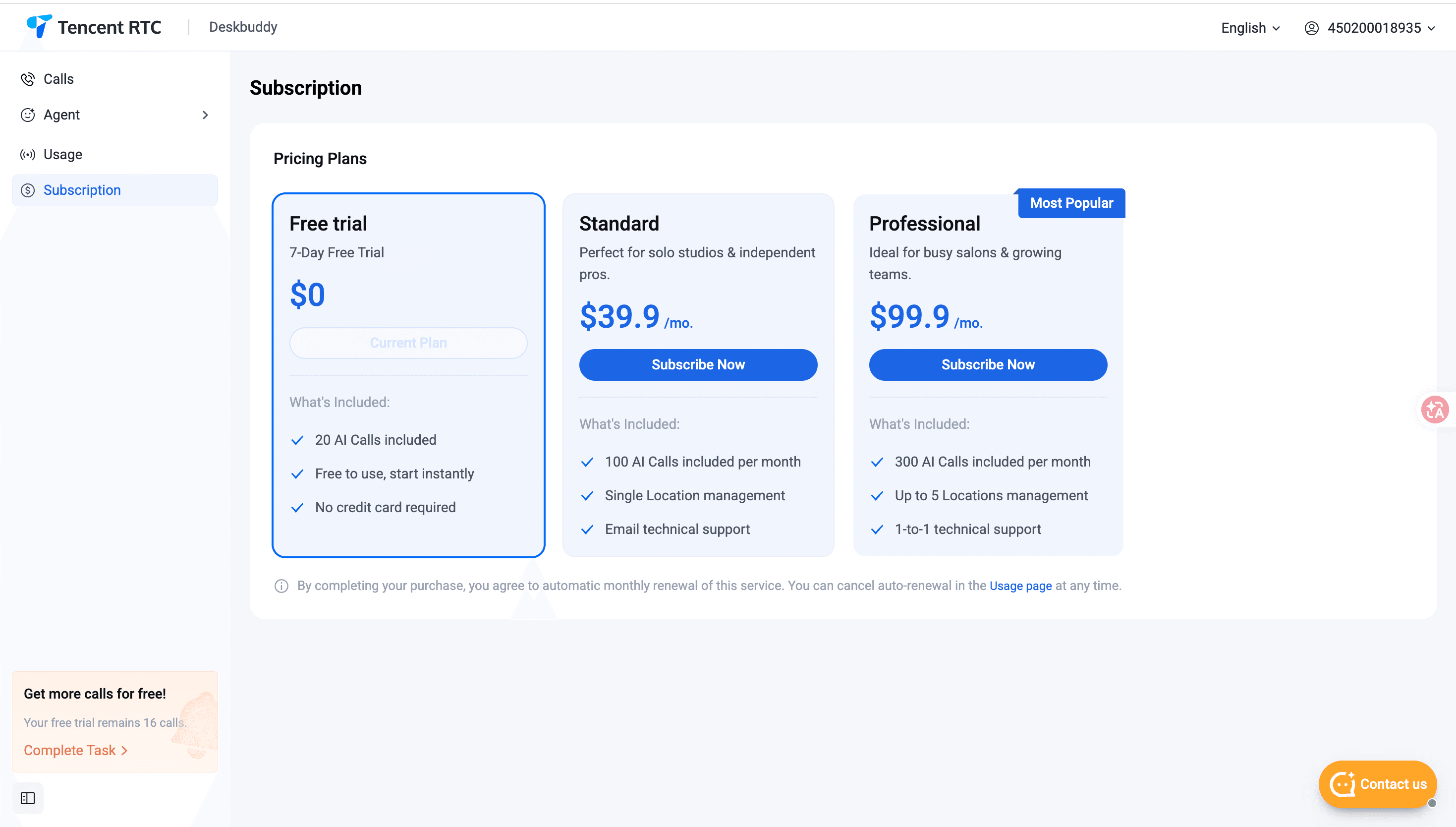
$39.90/mo | AI-powered, flat rate, built for service businesses | |
Ruby Receptionist | ~$235/mo | Live humans (50 minutes included, then per-minute) |
Smith.ai | ~$292.50/mo | Live + AI hybrid (30 calls included, then per-call) |
Dialzara | ~$29/mo | AI-powered, basic features |
Notice the difference in models. Ruby and Smith.ai use real people, so they charge per minute or per call. That adds up fast if you get more than a handful of calls per day.
AI-only services like DeskBuddy charge a flat monthly rate. No per-minute fees. No surprises. You pay the same whether you get 10 calls or 200.
AI Receptionist vs Hiring a Receptionist: The Full Comparison
Here’s the side-by-side you actually need.
Feature | Full-Time Receptionist | Live Virtual (Ruby, Smith.ai) | AI Receptionist (DeskBuddy) |
Monthly cost | $4,238+ | $235–$700+ | $39.90–$99.90 |
Annual cost | $50,860+ | $2,820–$8,400+ | $479–$1,199 |
Availability | 40 hrs/week | Business hours (varies) | 24/7/365 |
Simultaneous calls | 1 | Depends on plan | Unlimited |
Auto-books appointments | No (manual) | Sometimes | Yes |
Multilingual | Rare | Sometimes (extra $) | Yes, included |
Scales with volume | No — need more hires | Costs increase per call | Flat rate |
Setup time | 2–4 weeks | 1–3 days | Under 1 hour |
Sick days / turnover | Yes | Not your problem | Never |
Integrations | Manual entry | Limited | Google Calendar, Mindbody, Square |
Handles walk-ins | Yes | No | No |
Complex emotional calls | Excellent | Good | Limited |
The cost gap is staggering. An AI receptionist runs about 98% cheaper than a full-time hire on a yearly basis. But cost isn’t the whole story — let’s dig into what each option actually delivers.
Where AI Receptionists Win
They Answer Every Single Call
This is the biggest advantage, and it’s not close.
Your human receptionist works about 2,000 hours a year. Your phone rings up to 8,760 hours a year. That’s a massive coverage gap. Every unanswered call during lunch, after 5 PM, or on weekends is a potential client lost.
Research from Invoca shows 62% of people who call a business are ready to buy. And the first business to respond wins the booking 78% of the time. If your competitor answers and you don’t, that client is gone.
An AI receptionist picks up every call instantly. At 2 AM on a Saturday. During your busiest afternoon. On Christmas. Every time.
They Book Appointments on the Spot
A good AI receptionist doesn’t just take messages. It checks your real-time availability and books the appointment during the call. The caller hangs up with a confirmed slot. No phone tag. No “someone will call you back.”
DeskBuddy connects directly to Google Calendar, Mindbody, and Square. When someone calls your salon at 8 PM to book a Wednesday cut, it just handles it. You wake up to a full schedule.
The 3-Year Math Is Eye-Opening
Let’s compare total cost over three years for a small service business:
● Full-time receptionist: $50,860 × 3 = $152,580
● Ruby Receptionist (mid-tier): ~$435/mo × 36 = $15,660
● DeskBuddy (mid-tier): $69.90/mo × 36 = $2,516
The gap between a full-time hire and DeskBuddy over 3 years: $150,064. That’s renovation money. New equipment money. Second-location money.
They Handle Volume Spikes Without Flinching
Holiday season hits and your call volume doubles. With a human receptionist, you’re either missing calls or scrambling for temp help.
With an AI receptionist on a flat rate, double the calls just means double the value. Your bill stays the same.
They’re Consistent Every Time
Your human receptionist has off days. They get tired at 4 PM. They forget to mention a promotion. They put someone on hold too long because three lines rang at once.
An AI receptionist delivers the exact same experience on call one and call one thousand. It follows your script. It mentions your specials. It captures the caller’s info every time. That consistency builds trust.
They Start Working Immediately
Hiring a receptionist means posting the job, reviewing applications, interviewing candidates, then training them on your systems. That’s 3–6 weeks minimum before they’re fully productive.
An AI receptionist? Sign up, configure your business details, connect your calendar, go live. Most DeskBuddy users are fully set up during their lunch break.
Want to see it in action? Try DeskBuddy free — set up your AI receptionist in under 10 minutes. It plugs into Google Calendar, Mindbody, and Square. No credit card required.
Where a Human Receptionist Still Wins
AI isn’t the right call for every business. Here’s where humans keep the edge.
Complex or Emotional Conversations
When a client is upset about a charge, anxious about a procedure, or dealing with something sensitive, a real person handles that better. AI has gotten surprisingly good at conversational tone, but genuine empathy is still a human skill.
Walk-In Greeting and Physical Presence
If your business gets heavy foot traffic, you need someone at the front desk. An AI receptionist can’t smile at the person walking through the door, check them in on a tablet, or offer them water while they wait. Medical offices, high-end spas, and busy retail shops still need a warm body up front.
Deep Relationship Building
A receptionist who’s been with you for two years knows your regulars by name. She remembers that Mrs. Johnson always wants the chair by the window, or that Dave’s golden retriever hates the blow dryer. AI can store notes and preferences, but it’s not the same as genuine human rapport.
The Hybrid Approach: What Smart Owners Are Doing
Here’s the move a lot of growing businesses are making in 2026: use both.
Keep a part-time front desk person for walk-ins and in-person tasks. Route all phone calls to an AI receptionist like DeskBuddy, 24/7.
The result:
● Every call gets answered — mornings, evenings, weekends, holidays
● Your front desk person focuses 100% on the people standing in front of them
● You cut total staffing costs by 50–70%
● Appointments book themselves automatically
For a pet grooming shop, yoga studio, or neighborhood salon, this is the sweet spot. Your in-person experience stays personal. Your phone experience stays bulletproof.
The Hidden Cost Most Owners Forget: Missed Revenue
The cost comparison is dramatic enough. But the bigger financial impact is the revenue you stop losing.
Let’s run the numbers for a typical hair salon:
● Average new client lifetime value: $1,200
● Missed calls per week without a receptionist: 10–15
● Percentage that were potential new bookings: ~30% (3–5 calls/week)
● Potential revenue lost per month: $3,600–$6,000
That’s $43,000–$72,000 per year in revenue walking out the door — just from missed calls. An AI receptionist at $50/month that captures even half of those calls pays for itself 300x over.
This math works the same way for fitness studios, pet services, med spas, cleaning companies — any service business where the phone is the front door.
How to Pick the Right AI Receptionist
Decided AI is the way to go? Here’s your checklist:
1. Built for your industry. A generic chatbot doesn’t understand salon scheduling or class-based booking. Pick something designed for service businesses.
2. Real integrations. If it doesn’t connect to your booking system (Google Calendar, Mindbody, Square), you’ll still be doing manual work.
3. Flat-rate pricing. Per-minute and per-call billing gets expensive fast. Look for a predictable monthly cost.
4. Fast setup. If it takes more than an hour to configure, move on.
5. Free trial. You should be able to test it with real calls before paying anything.
DeskBuddy hits all five: purpose-built for service businesses, direct integrations with the tools you already use, flat pricing from $39.90/month, setup in minutes, and a free trial to prove it works. Give it a shot.
The Bottom Line: Which Should You Choose?
Go with an AI receptionist if:
● You’re a salon, pet groomer, fitness studio, spa, or similar service business
● Most calls are bookings, schedule changes, or common questions
● You need after-hours and weekend coverage
● You want to spend under $100/month instead of $4,000+
Hire a human receptionist if:
● You need someone physically at a front desk
● Your calls require nuanced emotional intelligence
● The role includes significant non-phone duties (filing, inventory, office management)
● Budget isn’t a constraint
For most small service businesses, the math points clearly toward AI in 2026. The technology works. The savings are enormous. And every missed call is money you’ll never get back.
Ready to stop losing clients to voicemail? Start your free DeskBuddy trial — it takes under 10 minutes to set up, integrates with Google Calendar, Mindbody, and Square, and starts answering calls right away. Plans from $39.90/month.
FAQ: AI Receptionist vs. Hiring a Receptionist
How much does an AI receptionist cost compared to hiring a receptionist?
An AI receptionist typically costs between $30 and $100 per month ($360–$1,200/year). A full-time human receptionist costs around $50,000–$75,000 per year including salary, benefits, taxes, and overhead. That makes AI roughly 97–98% cheaper for phone reception duties.
Can an AI receptionist book appointments for my salon or fitness studio?
Yes. Modern AI receptionists like DeskBuddy integrate with Google Calendar, Mindbody, and Square to book appointments in real time during the phone call. The client hangs up with a confirmed booking — no follow-up needed.
Will my clients know they’re talking to an AI?
Some will, some won’t. Today’s AI voice tech is natural-sounding and handles interruptions, follow-up questions, and conversational flow well. But here’s what actually matters: callers care that their call got answered and their problem got solved. Whether a human or AI did it is secondary for most people.
Is an AI receptionist reliable enough for my business?
AI receptionists run on cloud infrastructure with 99.9%+ uptime. They don’t call in sick, take lunch breaks, or quit without notice. For pure call-answering reliability, AI actually outperforms humans — it never misses a shift and handles unlimited simultaneous calls.
Can I use both an AI receptionist and a human receptionist?
Absolutely. Many businesses do exactly this. A part-time front desk person handles walk-ins and in-person tasks while an AI receptionist covers all phone calls 24/7. You get full coverage without the payroll of multiple full-time hires. It’s often the smartest setup for growing service businesses.


