






Your next loyal client might be calling right now — in a language your front desk can’t speak.
For service businesses across the United States, the phone is still where relationships start. A new client calls to ask about pricing, book an appointment, or check your hours. But what happens when that caller speaks Spanish, or Mandarin, or limited English — and no one on your team can understand them?
They hang up. They call someone else. And you never even know you lost them.
A multilingual AI receptionist for small business changes that. It picks up every call, in the caller’s own language, and handles it the way your best front desk staff would — booking appointments, answering questions, and making people feel welcome from the very first word.
Let’s talk about why this matters, what your options are, and how to set it up without any hassle.
The Language Gap in American Service Businesses
Here’s a number worth knowing: over 67 million people in the US speak a language other than English at home. That’s roughly one in five residents.
Spanish is by far the most common. According to the U.S. Census Bureau’s American Community Survey, about 13% of the US population — more than 41 million people — speak Spanish at home. In states like California, Texas, Florida, New York, and Arizona, that percentage is significantly higher. If you run a salon in Houston, a gym in Miami, or a spa in Los Angeles, a large share of your potential clients are Spanish speakers.
Chinese-speaking communities are growing fast, too. Mandarin and Cantonese are the third most spoken languages in the country, with large and active populations in cities like New York, San Francisco, Los Angeles, and Houston. Many of these residents are looking for the same services you offer — haircuts, fitness classes, massages, facials — and they prefer to communicate in their first language. In fact, research from Common Sense Advisory (now CSA Research) found that 76% of consumers prefer to buy products and services in their native language, and 40% will never buy from businesses that don’t communicate in their language.
Here’s the problem: bilingual staff are expensive and hard to find. A bilingual receptionist in a major metro area typically earns $18 to $22 per hour — that’s $37,000 to $46,000 per year before benefits. For a small salon, spa, or fitness studio, that’s a serious expense. And even if you hire one bilingual employee, they can’t cover every shift, every language, or every sick day.
Most small service businesses simply go without. And that creates a gap between the clients who need your services and your ability to reach them.
What Happens When a Non-English Speaker Calls and Nobody Can Help
Picture this: Maria just moved to your neighborhood. Her coworker recommended your hair salon. She calls to book a color appointment, but she’s more comfortable speaking Spanish. Your receptionist picks up, and within a few seconds, it’s clear neither person can understand the other well enough to book anything.
Maria says “OK, thank you” and hangs up. She searches for “salón de belleza cerca de mí” and books somewhere else.
Or consider Wei, who wants to sign up for yoga classes at your studio. He calls and tries to ask about membership options in English, but the details about pricing tiers and class schedules get too complicated for a quick phone conversation across a language barrier. He gives up and finds a studio with Chinese-language support.
These aren’t rare situations. They happen every day in cities and suburbs across the country. The frustrating part? You never see these lost clients in any report. There’s no “missed due to language barrier” column in your booking software. They don’t show up as cancellations or no-shows. They simply never appear. The revenue gap is completely invisible — until you close it.
The Clients You’re Losing to Language Barriers
Let’s put rough numbers to it.
Say you run a busy salon and miss just three Spanish-speaking callers per week because of a language barrier. If each new client is worth $80 per visit and comes in once a month, that’s:
● 3 missed callers/week × 4 weeks = 12 lost new clients per month
● 12 clients × $80/visit × 12 months = $11,520 in lost revenue per year
And that’s a conservative estimate with modest numbers. Many service businesses in multilingual neighborhoods could be losing far more. Some of those callers would have become regulars who visit for years and refer their friends and family.
According to the Latino Donor Collaborative’s U.S. Latino GDP Report, Latino consumers alone contribute over $3.6 trillion to US GDP. Chinese-speaking households represent another fast-growing segment with significant purchasing power. These communities aren’t a niche — they’re a massive market of people who need haircuts, massages, gym memberships, and wellness services just like everyone else.
The language barrier isn’t just an inconvenience. It’s a leak in your business that costs real money every single month.
Your Options for Bridging the Language Gap
So what can you actually do about it? Here are the most common approaches:
1. Hire Bilingual Staff
This is the gold standard — a real person who speaks the languages your clients speak. But it comes with real costs.
● Bilingual receptionists earn $18–$22/hour or more, depending on your market.
● You need coverage for all your business hours, so you might need multiple hires.
● Finding someone fluent in the right languages and skilled at front desk work is a very small hiring pool.
● What if you need three languages? Now you’re staffing a call center, not a front desk.
For larger businesses with big budgets, this works. For most small and mid-size service businesses, it’s simply not practical.
2. Use Translation Apps on the Phone
Some businesses try using Google Translate or similar tools during live calls. In theory, it sounds reasonable. In practice, it’s painful.
● Phone conversations move fast — there’s no time to type and translate back and forth.
● Nuance gets lost. Tone gets lost. Trust gets lost.
● The caller feels like an inconvenience rather than a valued client.
Translation apps are great for reading a menu abroad. They’re not great for booking a 2 PM facial with a specific therapist.
3. Use a Multilingual AI Receptionist
This is the newer option — and for most small service businesses, it’s the most practical one. A multilingual AI receptionist answers your phone, speaks with callers in their language, and handles common tasks like booking appointments, answering questions, and taking messages.
It works around the clock, costs a fraction of a full-time hire, and handles multiple languages without needing coverage or time off. The best ones don’t just translate word-by-word — they actually hold natural, fluent conversations in each supported language.
How DeskBuddy Handles Multilingual Calls
DeskBuddy is an AI phone receptionist built for service businesses — salons, spas, gyms, wellness studios, and more. One of its core strengths is native multilingual support in English, Spanish, and Chinese — the three most widely spoken languages in the United States.
The key word here is “native.” DeskBuddy doesn’t translate on the fly from English scripts. Each language is a natural, fluent conversation — not a robotic word-for-word conversion. A Spanish-speaking caller hears real Spanish with proper phrasing and tone. A Mandarin-speaking caller hears natural Mandarin. It sounds like talking to a helpful person who genuinely speaks their language.
That distinction matters. When someone calls a business and hears their own language spoken naturally, something shifts. The guard comes down. They feel welcome. They stay on the line. They book the appointment.
What DeskBuddy Can Do in Any Supported Language
● Answer calls and greet callers in their preferred language
● Book appointments by connecting with Google Calendar, Mindbody, or Square
● Answer common questions about your services, hours, pricing, and location
● Take messages when you’re unavailable
● Handle after-hours calls so you never miss a potential client, day or night
All of this works the same way whether the call is in English, Spanish, or Chinese.
Use Cases: How Different Businesses Benefit
Hair Salons and Barbershops
In neighborhoods with large Hispanic communities, a big share of callers speak Spanish. With DeskBuddy, a Spanish-speaking client can call your salon, hear a greeting in Spanish, ask about availability for a balayage appointment, and get booked in for 3 PM — all without anyone at the salon picking up the phone. She hangs up feeling taken care of. You get a new client on the books.
Spas and Wellness Centers
Chinese-speaking communities often seek out massage, acupuncture, and wellness services. A Mandarin-speaking caller can ask about treatment options, compare packages, and book a couples massage — all through a natural Mandarin conversation. DeskBuddy handles the scheduling through Mindbody, your existing booking system. No new software to learn.
Gyms and Fitness Studios
Multilingual gym members can call to ask about class schedules, membership plans, or cancellation policies in their language. Instead of struggling through a conversation in a second language, they get clear, friendly answers — which means fewer misunderstandings and happier members. Payments and sign-ups flow through your Square integration.
Medical and Dental Offices
Patients who speak limited English often hesitate to call or delay appointments because they’re unsure they’ll be understood. An AI receptionist that speaks their language removes that barrier and helps them get the care they need on time. That’s not just good for business — it’s the right thing to do.
How It Works: Simple Setup, No Technical Skills Needed
You might wonder: how does the AI know which language to speak? DeskBuddy gives you two straightforward options:
1. Set a default language. If most of your callers speak Spanish, configure DeskBuddy to greet callers in Spanish. Simple and effective.
2. Automatic language detection. DeskBuddy listens to the first few words a caller says and responds in the same language. If someone starts speaking Mandarin, the conversation continues in Mandarin.
Behind the scenes, the AI uses advanced speech recognition and natural language processing tuned for each supported language. But you don’t need to worry about any of that. From your side, the setup takes about two minutes:
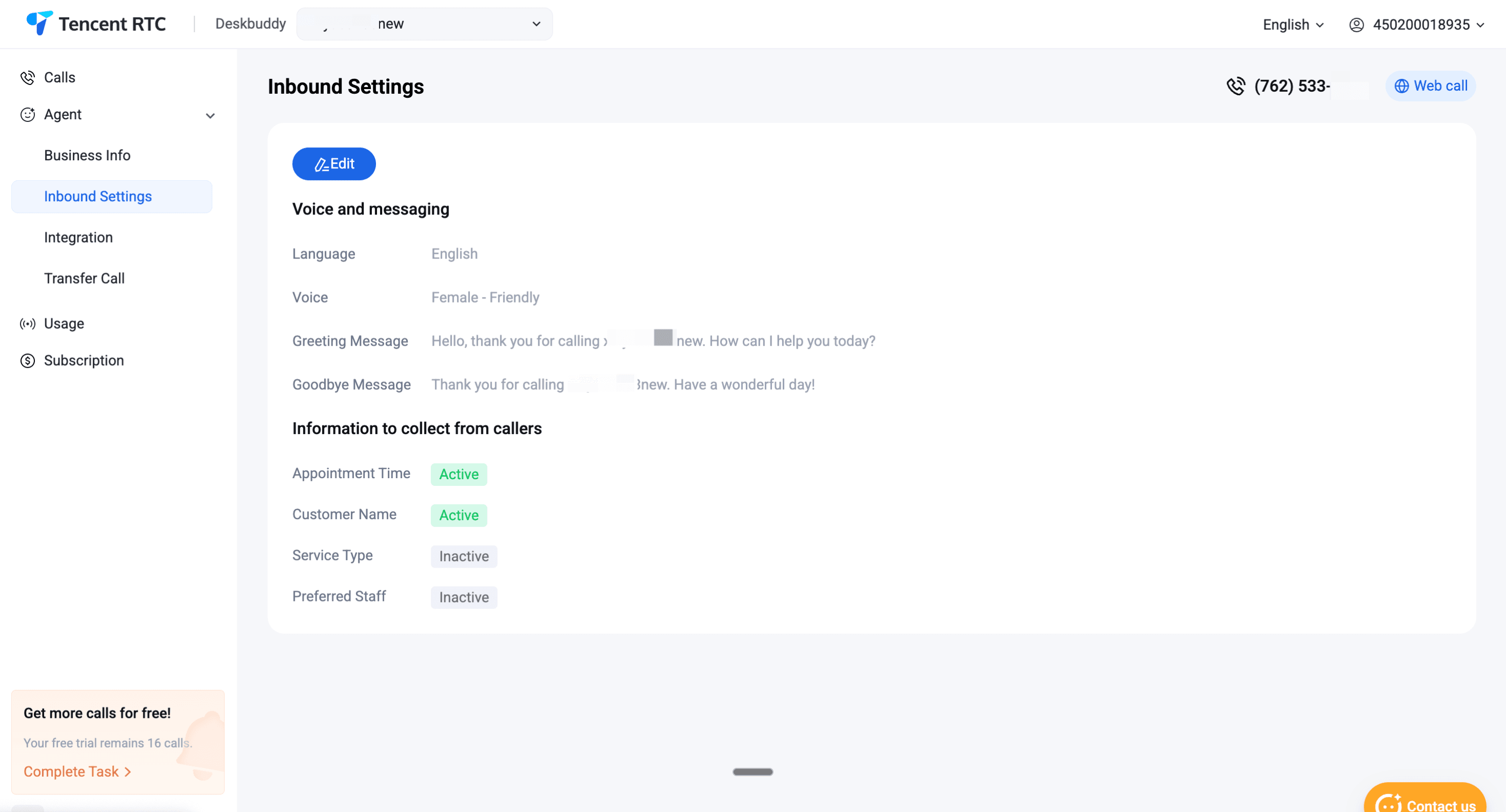
1. Sign up for DeskBuddy at deskbuddy.trtc.io
2. Go to your language settings
3. Select the languages you want to support
4. Done
No coding. No complicated configuration. No training required. It works with your existing phone number and connects to the scheduling tools you already use — Google Calendar, Mindbody, and Square.
What This Costs (And Why It Pays for Itself)
DeskBuddy plans range from $39.90 to $99.90 per month. Let’s put that in context:
Option | Monthly Cost |
Full-time bilingual receptionist | $3,000–$3,800+ |
Part-time bilingual assistant | $1,400–$1,800+ |
DeskBuddy (multilingual AI receptionist) | $39.90–$99.90 |
For less than $100 per month, you get:
● Multilingual phone answering in English, Spanish, and Chinese
● 24/7 availability — no sick days, no PTO, no shift gaps
● Appointment booking through your existing calendar and scheduling system
● A professional, welcoming first impression for every caller, in every language
If the language gap is costing you even a few new clients per month — and it almost certainly is — DeskBuddy pays for itself many times over.
Frequently Asked Questions
Does DeskBuddy sound natural in Spanish and Chinese, or does it sound like a translation?
DeskBuddy is built to converse naturally in each supported language. Spanish-speaking callers hear fluent, natural Spanish — not stilted, translated phrasing. The same goes for Chinese (Mandarin). It’s designed to feel like talking to someone who genuinely speaks the language, not a machine reading from a translated script.
Can DeskBuddy switch languages during a single call?
Yes. If a caller starts in English and then switches to Spanish, DeskBuddy can follow along. This is especially helpful for bilingual callers who naturally mix languages in conversation.
Do I need separate phone numbers for each language?
No. DeskBuddy works with your existing business phone number. It handles language detection and switching automatically, so all your callers — regardless of the language they speak — reach you on the same number you already use.
How long does it take to set up multilingual support?
Just a few minutes. Create your DeskBuddy account, select your preferred languages in the settings, customize your greeting and business details, and you’re live. No technical skills needed, and no IT help required.
Stop Losing Clients to a Problem That’s Already Been Solved
Language barriers are one of the most overlooked reasons small service businesses lose clients. It doesn’t show up in your analytics. Nobody complains about it to your face. Callers just quietly hang up and move on to a competitor who can speak their language.
But it doesn’t have to be that way. With a multilingual AI receptionist like DeskBuddy, every caller gets a warm, professional experience in the language they’re most comfortable with — and you get more booked appointments, more loyal clients, and more revenue from your community.
The setup takes minutes. The cost is a fraction of any alternative. And the very first call it handles in a client’s native language could be the start of a relationship that lasts for years.


