






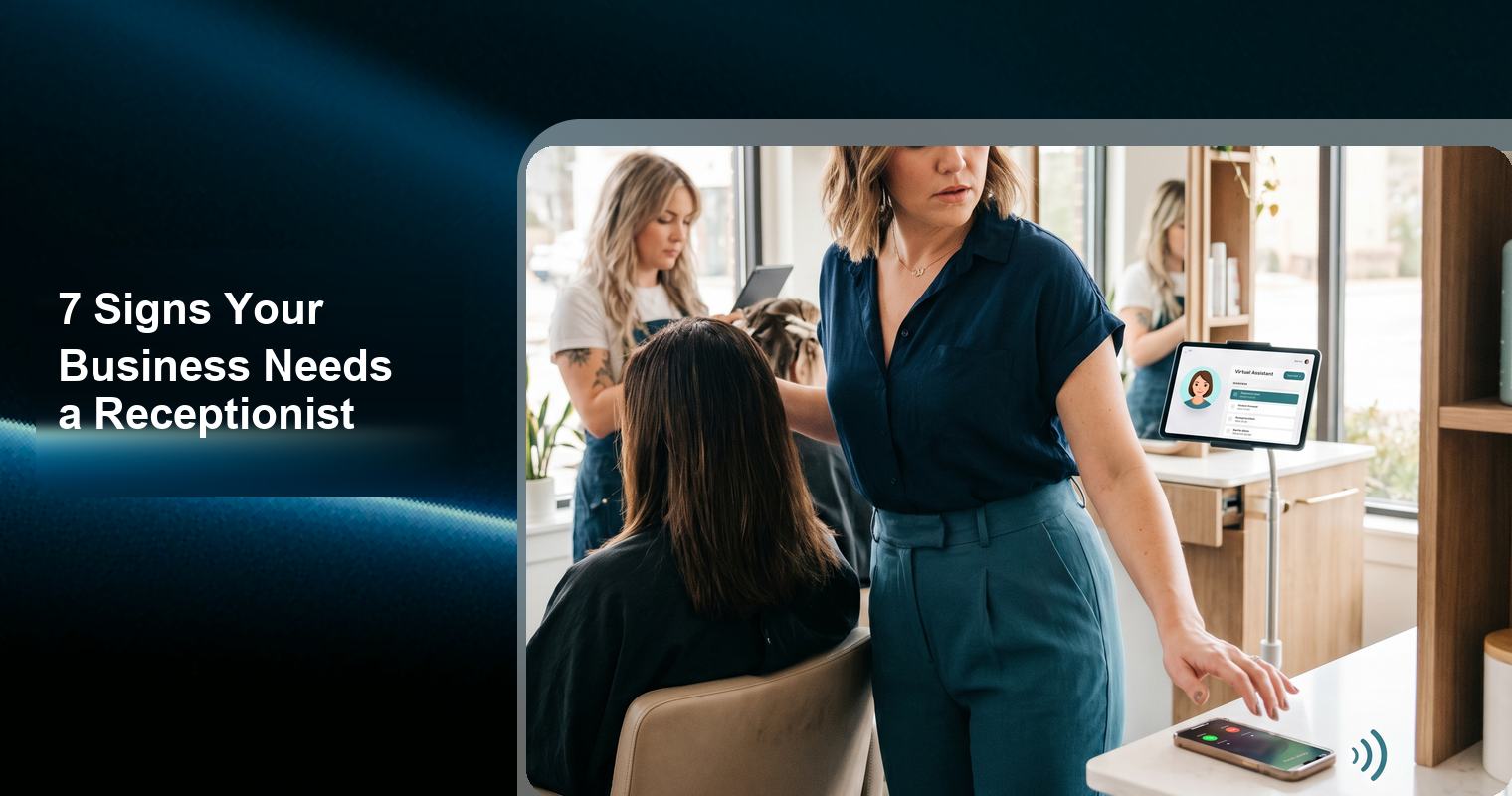
You opened your business to do what you love — cut hair, train clients, groom dogs, teach yoga. Not to spend your evenings returning missed calls.
But here you are, squinting at your phone between appointments, listening to voicemails during lunch, and losing sleep over the booking you know slipped away because you couldn’t pick up.
Sound familiar? You’re not alone. Studies show that 62% of calls to small businesses go unanswered during business hours. And 85% of those callers? They won’t call back.
The question isn’t whether you need help answering phones. It’s what kind of help makes sense. Let’s walk through the seven telltale signs — and then talk about your options.
Sign 1: You’re Missing Calls While Working With Clients
Picture this. You’re a salon owner, halfway through a balayage. Your phone buzzes in your apron pocket. You glance down — it’s a local number. Could be a new client. Could be someone wanting to book a $200 color appointment.
But your hands are covered in developer. Your client is mid-conversation. You let it ring.
By the time you check, there’s no voicemail. Just a missed call from a number you don’t recognize. That person has already called the salon two blocks down.
This is the most common sign. When your hands are literally full — with a dog on the grooming table, a client on the reformer, a customer at the counter — you simply can’t answer the phone. And every unanswered call is a coin flip: maybe it was nothing, or maybe it was your next regular.
The cost: Research from the Phone2 blog estimates that each missed lead costs small businesses an average of $287. If you miss just three calls a week, that’s over $44,000 a year walking out the door.
Sign 2: Clients Complain They Can’t Reach You
This one stings, because you usually hear it in person.
“I tried calling Tuesday but nobody picked up.”
“I had to message you on Instagram because the phone just rang and rang.”
“Honestly, I almost went somewhere else.”
A gym owner in Austin shared this exact experience on a small business forum — a long-time member wanted to upgrade their membership but couldn’t get through. After three attempts, they signed up at a competitor. The gym owner only found out when the member came in to cancel.
When clients tell you they had trouble reaching you, they’re doing you a favor. Most people won’t say anything. They’ll just leave. In fact, 78% of callers who can’t get through will contact a competitor instead.
If you’ve heard this complaint more than once, it’s not a fluke. It’s a pattern — and it’s costing you clients you’ve already earned.
Sign 3: Your Voicemail Box Is Always Full (Or Nobody Leaves Messages)
There are two versions of this problem, and both are bad.
Version one: Your voicemail fills up because you can’t keep up. A pet grooming shop owner described checking her voicemail on Sunday night and finding 23 messages — some from Thursday. By the time she called back, half the people had already booked elsewhere.
Version two: Your voicemail is empty, but you know people are calling. That’s because 80% of callers won’t leave a voicemail. They’ve been trained by years of experience that voicemails go into a black hole. If they can’t talk to a person (or at least get an immediate answer), they move on.
Either way, voicemail isn’t doing what you think it’s doing. It’s not catching leads for you. It’s a dead end for your callers and a false sense of security for you.
Sign 4: You Check Your Phone Between Every Appointment
You know this feeling. You finish with one client, and before you even clean up, you grab your phone. Missed calls. Texts. DMs. You try to call someone back but now your next appointment is walking in.
A yoga studio owner described her day like this: “I teach six classes a day. Between every single one, I’m on my phone for five minutes trying to return calls and answer questions. My breaks aren’t breaks. I haven’t had an actual lunch in months.”
This constant phone-checking isn’t just exhausting — it’s a sign that your business has outgrown the one-person-does-everything model. You’re splitting your attention between the clients in front of you and the ones trying to reach you, and neither group is getting your best.
It also takes a toll on quality. Research on context-switching shows it takes an average of 23 minutes to fully refocus after an interruption. When you’re bouncing between grooming a dog and returning a call about pricing, you’re not giving either task your full attention.
Sign 5: You’ve Lost a Booking Because You Couldn’t Answer in Time
This is the one that keeps you up at night.
Maybe it was a wedding party that wanted to book your salon for bridal hair and makeup. Maybe it was a corporate client looking for weekly massage sessions for their team. Maybe it was just a regular Tuesday booking — but you know it happened because you saw the missed call, called back an hour later, and heard: “Oh, I already booked with someone else.”
A mobile pet groomer shared her story on Reddit: she missed a call from a client with three dogs who wanted monthly grooming for all of them. By the time she called back (45 minutes later), the client had found someone else. That was $350 a month — $4,200 a year — from a single missed call.
78% of customers buy from the first business to respond. Not the best. Not the cheapest. The first. Speed isn’t everything, but in service businesses, it’s close.
Sign 6: Your Evenings and Weekends Are Spent Returning Calls
You closed the shop at 6 PM. But your work isn’t done.
You’re on the couch at 8:30, calling back the people you couldn’t get to during the day. You’re texting clients on Saturday morning to confirm Monday appointments. You’re answering DMs on Sunday night because you know if you wait until Monday, they’ll book elsewhere.
A personal trainer described it well: “I work 6 AM to 7 PM training clients. Then I go home and spend another hour on the phone. My wife says I never actually stop working. She’s right.”
Here’s the thing — 67% of calls to small businesses come outside standard 9-to-5 hours. Your clients are calling when they have free time, which is often when you don’t. If nobody answers during evenings and weekends, you’re invisible during the hours when most people are actually looking.
This isn’t just a business problem. It’s a quality-of-life problem. You started your business for freedom, and now the phone has you on a shorter leash than any boss ever did.
Sign 7: You’re Thinking About Hiring — But Can’t Justify the Cost
So you’ve accepted it: you need help with the phones. Your first thought is to hire a receptionist.
Then you do the math.
A part-time receptionist costs $15-20 per hour. Even at 20 hours a week, that’s $1,200-1,600 a month before taxes, insurance, and the time you’ll spend training them. A full-time receptionist runs $2,500-4,000 per month.
For a solo salon owner doing $8,000-12,000 in monthly revenue, that’s a huge bite. For a small gym or studio, it might not be feasible at all.
And here’s the kicker — a receptionist only works during set hours. They take lunch breaks. They call in sick. They quit. And the moment they’re not at the desk, you’re back to square one.
You need the help. But the traditional solution doesn’t fit the budget or the reality of running a small service business.
The Smarter Alternative: You Don’t Need to Hire Someone
Here’s what most “signs you need a receptionist” articles won’t tell you: you probably don’t need a full-time human receptionist.
What you need is someone (or something) to handle the 80% of calls that follow a predictable pattern:
● “What are your hours?”
● “Do you have availability on Saturday?”
● “How much is a haircut?”
● “I need to book an appointment.”
● “I need to cancel my 2 PM.”
These aren’t complex conversations. They’re repetitive, predictable, and — honestly — exactly the kind of work that an AI phone receptionist handles well.
What an AI Receptionist Actually Does
DeskBuddy is an AI phone receptionist built for service businesses — salons, gyms, groomers, spas, studios, and similar. Here’s what it handles:
● Answers every call, 24/7. No missed calls at 8 PM on a Tuesday. No full voicemail box. No “sorry, we’re closed” dead ends.
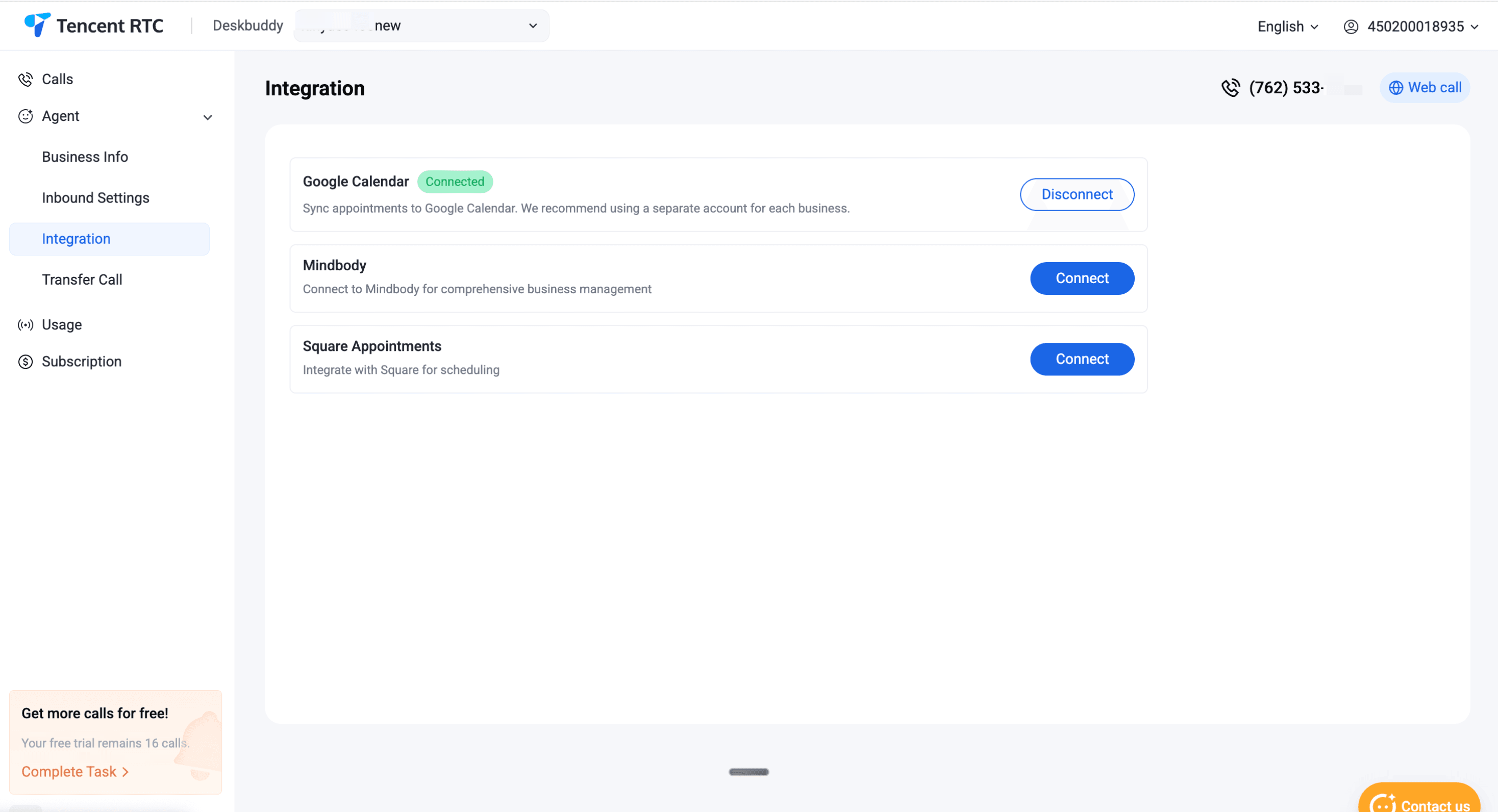
● Books appointments directly. It integrates with Google Calendar, Mindbody, and Square, so clients can book on the spot without you touching anything.
● Answers common questions. Hours, pricing, location, services, cancellation policies — the questions you answer ten times a day.
● Transfers calls when needed. If a caller needs to speak to you personally, DeskBuddy routes them through. You only get the calls that actually need you.
What It Doesn’t Do (Being Honest)
AI isn’t magic. DeskBuddy won’t greet walk-in clients at your front desk. It won’t handle a complicated insurance question or calm down an angry customer who needs a human touch. It won’t make coffee for your waiting room.
For the 20% of situations that need a real person — you’re still that person. But instead of being pulled away from clients a dozen times a day, you’re handling two or three calls that genuinely need your attention. That’s a manageable number.
Think of it less as a replacement and more as a filter. DeskBuddy handles the routine stuff so you can focus on the work that actually requires you.
The Cost Comparison
| Human Receptionist | DeskBuddy |
Monthly cost | $2,500 - $4,000 | $39.90 - $99.90 |
Available hours | 40 hrs/week (with breaks) | 24/7/365 |
After-hours coverage | No (unless you pay overtime) | Yes |
Sick days / turnover | Yes | No |
Books appointments | Yes | Yes (Google Calendar, Mindbody, Square) |
Answers FAQs | Yes | Yes |
Greets walk-ins | Yes | No |
Handles complex issues | Yes | No (transfers to you) |
For most small service businesses, the math is simple. DeskBuddy covers the phone work at roughly 1-2% of the cost of a human receptionist. And for the situations it can’t handle, it sends the call to you.
If your business grows to the point where you need a full-time person at the front desk, that’s a great problem to have. But until then, there’s no reason to spend $3,000 a month when $39.90 handles the bulk of it.
What To Do Next
If you recognized yourself in three or more of these signs, your phone situation is already costing you money. The longer you wait, the more bookings slip away.
Here’s a simple starting point:
1. Track your missed calls for one week. Just count them. Most business owners are shocked by the actual number.
2. Estimate the value. If even 30% of those missed calls were potential bookings, what’s that worth per month?
3. Try an AI receptionist. DeskBuddy lets you set it up for your business so you can see how it handles real calls — without committing to a $3,000/month hire.
Your clients are calling. The only question is whether someone’s picking up.
Frequently Asked Questions
Will an AI receptionist sound robotic to my clients?
Modern AI voice technology has come a long way. DeskBuddy is designed to sound natural and conversational — not like the clunky phone menus from ten years ago. Most callers won’t realize they’re speaking with AI. That said, it identifies itself honestly if asked. The goal is helpfulness, not deception.
Can DeskBuddy handle my specific booking system?
DeskBuddy currently integrates with Google Calendar, Mindbody, and Square — which covers the majority of small service businesses. If you use a different system, it’s worth checking the website for the latest integration list, as new ones are added regularly.
What happens if a caller has a question DeskBuddy can’t answer?
It transfers the call to you (or whoever you designate). DeskBuddy is trained on your business information — services, hours, pricing, policies — so it handles most routine questions. But when something falls outside its scope, it doesn’t guess or make things up. It connects the caller to a real person.
Do I still need a receptionist if I get DeskBuddy?
It depends on your business. If you have a physical front desk that needs a human presence, DeskBuddy won’t replace that. But if your main problem is phone calls — missed calls, after-hours calls, repetitive questions — DeskBuddy handles that piece. Many business owners use it as a first step and only hire a receptionist later if the in-person side truly demands it.


